
One of the most common concerns I hear from patients considering a hair transplant abroad is simply this: “What if it doesn’t work?” That is a completely fair question, and honestly, the right one to be asking. A hair transplant is not just a financial investment. It is an investment in your confidence and your sense of self. So before you decide between Thailand and Turkey, let us talk honestly about what hair transplant success rates actually mean, what the data looks like, and what you can realistically expect from each destination.
Key Takeaways
- Hair transplant success rates depend on surgeon expertise, graft handling, technique precision, and consistent post-operative follow-up. At Dr. Top Hair Hospital, our FUE procedures typically achieve approximately 90% graft survival, rising to above 95% cell viability when our ATP graft preservation solution is used.
- Both Thailand and Turkey offer legitimate pathways for hair restoration surgery, but they differ significantly in clinical model, surgeon involvement, and the consistency of outcomes across the market.
- Thailand’s surgeon-led, internationally certified approach, combined with access to advanced combination techniques and structured 3, 6, and 12-month follow-up care, creates the clinical conditions that consistently support strong, long-term hair transplant results.
What Actually Drives Hair Transplant Success Rates

The term “success rate” gets used a lot in hair transplant marketing, but what does it actually measure? In clinical practice, success is primarily defined through graft survival rate, which refers to how many transplanted hair follicles survive extraction, establish a blood supply, and produce consistent new hair growth over time.
In over 10,000 procedures at Dr. Top Hair Hospital, our FUE graft survival rate typically comes in at approximately 90%. When we apply our ATP graft preservation solution during the procedure, cell viability rises to above 95%, preserving follicle health during the critical period between extraction and implantation. These figures reflect more than 20 years of focused hair restoration work, not a marketing claim.
Free Assessment
Not Sure How Many Grafts You Need?
Get a personalized treatment plan from Dr. Top's team. Takes 2 minutes to complete — no cost, no obligation.
The key drivers behind any clinic’s success rate are worth understanding before you choose where to go:
- Surgeon involvement: A certified hair transplant surgeon who remains directly engaged throughout extraction and implantation preserves follicle integrity far more reliably than a model where technicians manage the majority of the work.
- Technique used: FUE and FUT yield meaningfully different outcomes depending on hair type, scalp condition, and degree of hair loss. The skill behind the technique matters as much as the technique itself.
- Time outside the body: Grafts are living tissue. At Dr. Top Hair Hospital, our critical implant window is within 6 hours of extraction. Every hour beyond that increases the risk of follicle damage and reduced graft survival.
- Graft count and planning: We plan for 40 to 50 grafts per cm² for standard density and up to 60 to 70 grafts per cm² for high-density cases. Extracting more than the donor area can healthily support compromises both donor zone recovery and final results.
- Post-operative monitoring: Our structured follow-up at 3, 6, and 12 months is not optional. It is how we track growth progression, address concerns early, and ensure every patient has continuous support throughout their full recovery.
Understanding these factors gives you a meaningful framework to evaluate any clinic in any country.
What Real Success Looks Like in Practice
Numbers become meaningful when they are attached to real people. Let me walk through a few representative cases from our practice that show what success actually looks like across different patient profiles.
A patient in his early 40s from Australia presented with a Norwood 5 hair loss pattern, significant frontal recession, and crown thinning. He received approximately 3,200 grafts using our Combination Technique, which pairs FUE with ALMI (Autologous Lipocyte Micronized Injection) Nano Fat therapy to support scalp health and improve the environment for graft survival. By his 6-month follow-up, he had reached approximately 50% visible growth. By 12 months, his result was at 80 to 90% of his final outcome, with full density continuing to develop toward the 18-month mark.
A patient in her mid-30s from the UK with diffuse thinning across the crown received approximately 1,800 grafts in a single session. Her case required careful planning given her hair type and donor characteristics. At her 9-month check-in, she reported significant visible improvement and mentioned, for the first time in years, feeling comfortable going out without relying on styling products to conceal her thinning. Hair restoration is not just about hair. It is about reclaiming confidence in how you move through your day.
A patient in his late 50s from Germany had previously researched clinics in Turkey before choosing Thailand. His primary concern was knowing exactly who would be performing his procedure and how involved the surgeon would be throughout. He underwent approximately 2,500 grafts with us and described his 12-month result as exceeding what he had expected. What he valued most was not just the outcome, but the transparency of the process from start to finish.
Behind every success rate statistic is a real person who trusted us with their confidence. That responsibility shapes how we approach every single case.
Your Hair Growth Timeline: What to Expect Month by Month
One of the most anxiety-producing parts of the hair transplant journey is the waiting period. Many patients worry that nothing is happening when, in reality, the process is unfolding exactly as it should. Here is the timeline we share with every patient:
- 4 months: Approximately 40 to 50% of visible results begin to emerge
- 6 months: Approximately 50% visible progress
- 9 months: Significant growth, often the first point where patients feel genuinely encouraged
- 12 months: 80 to 90% of the final result is visible
- 12 to 24 months: Full results develop as remaining follicles continue to mature
What I always tell my patients is this: the 12-month mark is your real benchmark. Trust the process, follow your aftercare instructions, and resist the urge to judge the outcome at week six when the shed phase may still be active.
Hair Transplant in Thailand: The Clinical Standard
Thailand has built a well-earned reputation in international medical tourism, and its standing within global healthcare quality rankings reflects years of consistent investment in facilities, surgeon training, and patient safety infrastructure. Clinics serving international patients operate within a regulated environment, and many hold accreditation from internationally recognized bodies that enforce strict standards across hygiene, surgical protocols, and clinical oversight. The Thai government has also formally positioned Thailand as a global health hub, reflecting the country’s commitment to maintaining world-class medical standards.
At Dr. Top Hair Hospital, I hold ABHRS certification from the American Board of Hair Restoration Surgery, which is the only internationally recognized board certification in the specialty of hair restoration surgery. There are approximately 300 ABHRS-certified surgeons worldwide, and roughly 20 in Thailand. This certification requires documented surgical case logs, before-and-after photographic evidence of outcomes, and a comprehensive oral and written examination. It is the clearest, most credible marker of surgical expertise in this field.
Our work has been recognized internationally as well. Our research and techniques were selected as a top-3 finalist at the AMWC Monaco from over 1,000 submissions across 60 countries and 10,000 attendees, and Dr. Top Hair Hospital received the HOFS Awards 2024 in recognition of our contributions to the field. I was also an invited speaker at the IMCAS World Congress 2026 in Paris, where advancements in hair restoration techniques are presented to the global medical community.
Our Combination Technique is what sets our clinical outcomes apart from standard FUE alone. Rather than performing FUE in isolation, we pair it with ALMI Nano Fat therapy, which introduces growth-factor-rich nanofat into the scalp to improve microcirculation, support follicle health, and create a more favorable biological environment for newly transplanted grafts to establish and thrive. This approach goes beyond what most clinics in either Thailand or Turkey offer as a standard treatment.
Our complication rate is approximately 2% or less, and our overall failure rate is approximately 5% or less across more than 10,000 procedures. These figures are the direct result of surgeon-led care, precise technique, and structured aftercare from day one through to the 12-month milestone.
Hair Transplant in Turkey: An Honest Look
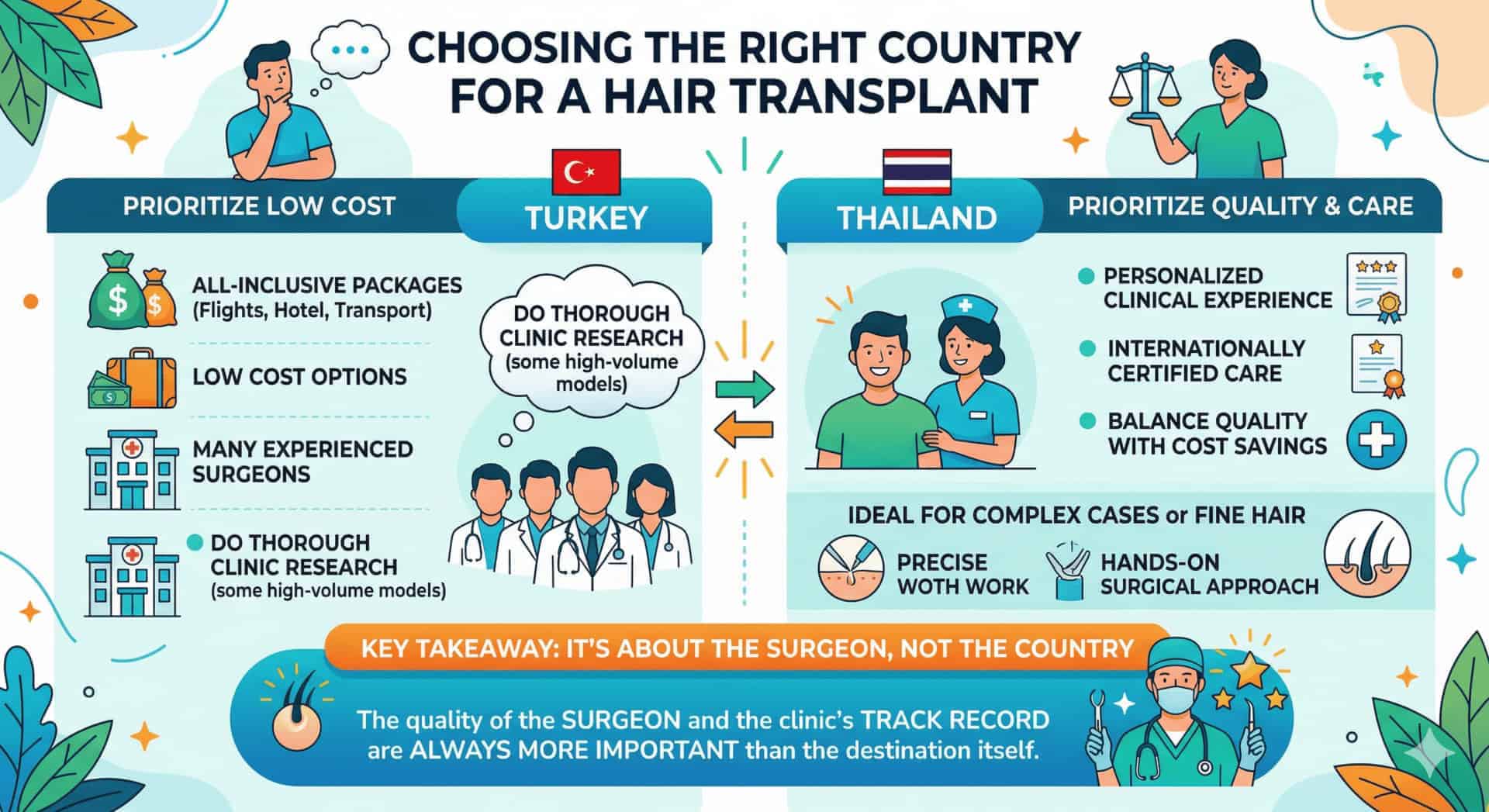
Turkey has established itself as one of the most recognized destinations for hair transplant surgeries globally, and it has earned that recognition through genuine strengths. The country offers competitive pricing, a large concentration of hair transplant clinics, and experienced surgeons who have performed significant volumes of procedures over many years. Turkey’s all-inclusive packages, which typically bundle surgery, accommodation, and transfers into one price point, make it financially accessible for patients from western countries where the cost of hair transplant procedures is substantially higher.
With that said, the volume and commercialization of the hair transplant industry in Turkey creates quality inconsistency that patients should understand before committing. Some well-documented concerns include:
- Procedures being carried out largely by trained technicians rather than the certifying surgeon
- High daily patient volumes that can compress procedure time and compromise careful graft handling
- Limited structured follow-up once the patient returns home
- Hair transplant success rates that vary significantly depending on the clinic tier and the package selected
None of this makes Turkey a poor choice categorically. Skilled surgeons and high-quality clinics do operate there. What it does mean is that the research burden on the patient is considerably higher, and the variability in outcomes across the market is broader than what a well-regulated, consistently credentialed clinical environment typically produces.
How Technique Affects Hair Transplant Success Rates
FUE is the most widely used technique in hair restoration surgery today. It extracts individual hair follicles from the donor area and implants them one by one into the recipient site. It produces no linear scar, supports a faster recovery, and delivers natural-looking results when performed by a skilled surgeon in a controlled clinical environment.
Advanced techniques such as DHI and Sapphire FUE are available in both Thailand and Turkey and can improve precision and graft placement when applied appropriately. At Dr. Top Hair Hospital, our Combination Technique goes a step further. By integrating FUE with ALMI Nano Fat therapy, we actively support the scalp environment itself, not just the mechanical process of extracting and placing grafts. This translates into improved follicle health, better scalp conditions for long-term growth, and more consistent results even in complex cases.
The structural difference between destinations is who is performing these techniques and how. Thailand’s surgeon-led model keeps the operating surgeon directly engaged from start to finish. Turkey’s high-volume market more commonly delegates significant portions of the procedure to trained technicians under general surgical supervision. For complex cases, finer hair types, or larger graft counts, that distinction has a real and measurable impact on success rates.
Costs in Thailand vs Turkey
Turkey generally offers lower upfront pricing, driven by the all-inclusive package model and the scale of its hair transplant market. Prices in Bangkok are competitive with mid-tier Turkish clinics, and while they can be somewhat higher in certain cases, that difference typically reflects what is built into the base service: direct surgeon involvement, access to advanced technique options including our Combination Technique, and structured monitoring across a full 12-month post-operative cycle.
What matters most is the total value picture over time. Revision surgery after a substandard outcome carries its own significant financial and emotional costs that can quickly exceed any savings made on the initial procedure. When weighing costs in Thailand vs Turkey, evaluating full outcome value rather than the headline package price is always the more practical and financially sound approach.
Safety in Thailand vs Turkey
Thailand maintains a strong healthcare regulatory framework. Medical facilities serving international patients are held to standards enforced by globally recognized accreditation bodies, and Thailand’s standing as a top medical tourism destination reflects years of consistent investment in patient safety, surgical oversight, and clinical infrastructure. For patients traveling to Thailand, the support system is built specifically with international patients in mind, from initial consultation through to post-operative recovery.
Turkey also enforces medical regulations, and its best clinics operate to genuine standards. The density of the market and the pricing competition within it, however, contribute to broader variation in quality across providers. Verifying a clinic’s accreditation, confirming that a qualified surgeon will personally perform your procedure, and asking specific questions about post-operative monitoring protocols are non-negotiable steps regardless of which country you choose.
Tourism in Thailand vs Turkey
Thailand offers a culturally rich, genuinely welcoming environment that makes the recovery period feel far less clinical than it might elsewhere. Bangkok is a well-connected international hub surrounded by remarkable temples, extraordinary food, and vibrant city life, with some of the most beautiful natural landscapes in the world within easy reach. Many of our patients from the UK, Germany, Australia, Canada, and across Asia extend their stay after their procedure to explore what the country has to offer. Traveling to Thailand for hair restoration surgery combines genuine medical quality with an experience that makes the journey worthwhile in its own right.
Turkey, particularly Istanbul, blends deep cultural history with a modern energy that is difficult to replicate. Its accessibility from Europe and the Middle East makes it a practical travel option for many, and the food, architecture, and culture create a memorable setting. Both destinations offer comfortable environments where patients can rest and recover well beyond the walls of the clinic.
Conclusion
Hair transplant success is not determined by geography alone. It is determined by the surgeon performing your procedure, the technique applied, the quality of graft handling throughout the process, and the continuity of care you receive from surgery through to your final result. When all of those elements are working together, the outcomes speak for themselves. With 10,000+ procedures performed, ABHRS certification shared by approximately 300 surgeons globally, a complication rate of approximately 2% or less, and a structured 12-month follow-up protocol built into every treatment plan, Dr. Top Hair Hospital holds itself to a standard that consistently produces natural, lasting results for patients arriving from across the world.
Choosing the right destination starts with understanding your own situation clearly. A short personalized assessment gives you a realistic picture of your candidacy, your likely graft count, and what the full journey looks like before you commit to anything or book a flight.
Wondering if you’re a good candidate? Take our free 2-minute assessment to find out — no obligation, and your details stay completely private.
Reviewed by Dr. Top, ABHRS-certified, one of approximately 20 ABHRS-certified surgeons in Thailand and 300 globally. Top-3 finalist at AMWC Monaco, HOFS Awards 2024 recipient, and invited speaker at IMCAS World Congress 2026 in Paris. Over 10,000 procedures performed across more than 20 years, with patients from over 11 countries including the UK, Germany, Australia, Canada, France, and across Asia.