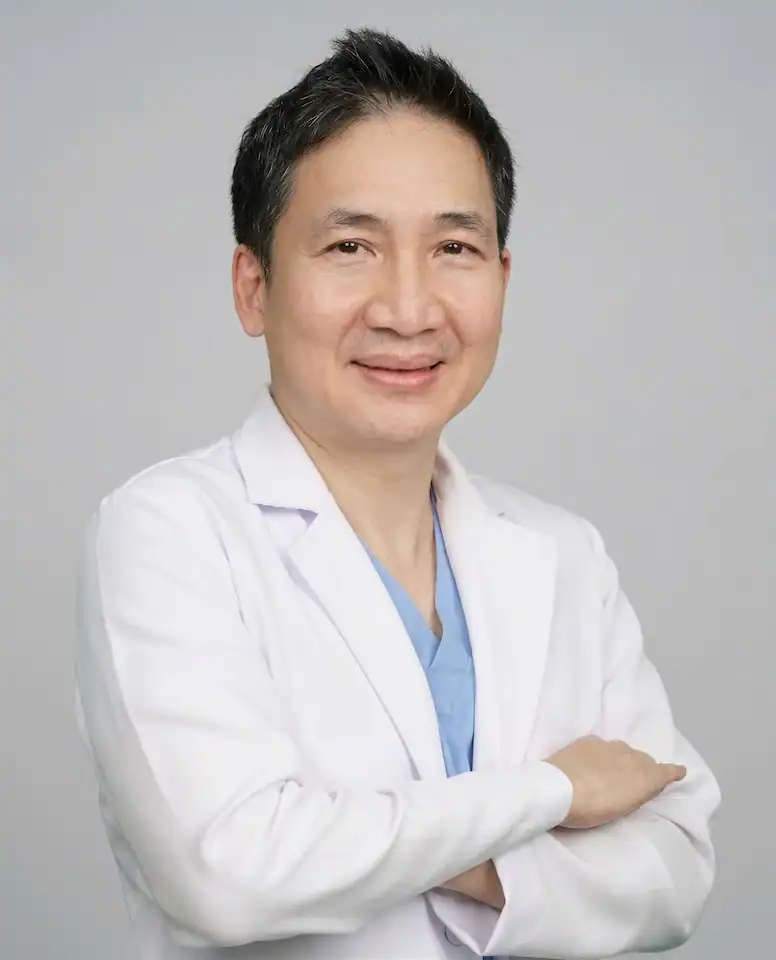

Almost every week, a patient reaches out to me after a procedure that did not go the way they hoped. Sometimes they flew across the world for it. Sometimes they spent months saving for it. And when they finally sit in front of me, the first question they ask is not “can you fix this?” It is: “How do I know I can trust you this time?”
That question is fair. And honestly, it is the right question to ask any clinic, including mine. So let me answer it directly.
Key Takeaways
- Dr. Top is a Diplomate of the American Board of Hair Restoration Surgery (ABHRS), a credential that can be independently verified, not just a marketing claim.
- Every procedure is performed exclusively by doctors and video-recorded, prioritizing graft survival over volume.
- Dr. Top pioneered the Combination Technique (FUE + ALMI Nano Fat therapy) and specializes in complex revision cases that other clinics often turn away.
Bangkok’s Hair Transplant Scene

Bangkok has grown into one of Asia’s most active medical tourism destinations. Thailand generates hundreds of millions of dollars annually in medical tourism revenue, and hair restoration is a significant part of that. The city has no shortage of clinics, marketing budgets, or package deals designed to catch your attention online.
That is exactly why the choices get confusing.
Free Assessment
Not Sure How Many Grafts You Need?
Get a personalized treatment plan from Dr. Top's team. Takes 2 minutes to complete — no cost, no obligation.
Some clinics handle 5 to 10 patients per day. Some allow non-physician staff to perform surgical steps. Some sell graft packages by volume, where the number of grafts becomes the selling point rather than the quality of each one. I am not naming anyone here, and I am not interested in tearing anyone down. What I am interested in is making sure you know what questions to ask, so you can evaluate any clinic with the same standard you would apply to mine.
The ABHRS Certification
One of the clearest ways to evaluate a hair restoration surgeon is board certification. I hold a Diplomate of the American Board of Hair Restoration Surgery (ABHRS), which is the only hair restoration certification recognized by both the International Society of Hair Restoration Surgery (ISHRS) and the European Society of Hair Restoration Surgery.
To earn this certification, a surgeon must demonstrate surgical experience, aesthetic skill, and deep clinical understanding of hair loss. That includes submitting documented cases, before-and-after photography, and passing both written and oral examinations covering the full scope of the specialty.
I am also a member of the ISHRS and received the Best Hair Restoration Award at the Aesthetic and Anti-Aging Medicine World Congress (AMWC 2025) in Monaco, selected from over 1,000 submissions across 60 countries. In 2026, I was invited to present at the IMCAS World Congress in Paris. These are not awards I mention to impress you. I mention them because they represent peer-reviewed recognition from the global medical community, which is an entirely different level of credibility from clinic marketing.
The Doctor-Only Team Model
| What We Do | What Some Volume Clinics Do |
|---|---|
| Every surgical step performed by a doctor | Technicians perform extraction or implantation |
| Rotating team of specialist doctors | Single surgeon, non-physician assistants |
| Minimizes graft out-of-body time | Speed prioritizes throughput, not graft survival |
| Video documentation provided to patient | No record of who performed which step |
Here is the thing about graft survival that most patients do not hear explained clearly. Grafts, which are the small follicular units (bundles of 1 to 4 hairs) that we extract and reimplant, begin to deteriorate the moment they leave your scalp. The entire procedure is essentially a race against time. Every additional minute a graft spends outside the body increases the risk that it will not survive after implantation.
The reason I built a rotating team model, with a team of approximately 20 medical professionals across 7 Bangkok locations, is specifically to reduce that out-of-body window. No single surgeon, working alone with technician assistants, can match the speed of a coordinated team of doctors working in rotation. No technicians perform surgical steps at Dr. Top Hair Hospital. Not for extraction. Not for implantation. Not for any part of the procedure. That is not a policy I implemented for marketing purposes. It is the direct clinical response to what the science of graft survival actually requires.
Every Graft Is a One-Time Opportunity
I want to say this plainly, because I think a lot of patients understand it intellectually but do not feel the weight of it until it is too late. Your donor area, the region at the back and sides of your scalp from which grafts are harvested, is finite. Once those follicles are removed, they do not regenerate at the extraction site. Once they are damaged during a procedure, they are gone permanently.
This means that every hair transplant decision you make today directly affects what options you have in 10 or 20 years.
I approach every case as part of a patient’s long-term hair management strategy. Someone who is 28 years old with early-stage hair loss has a very different lifetime donor budget than someone who is 50. If I over-harvest the donor area today to give you a larger graft count, I may be taking away your ability to address future hair loss with a second procedure down the line. That is not a trade-off I am willing to make without a clear, honest conversation about it first.
Our FUE (Follicular Unit Extraction) graft survival rate is approximately 90%, and with our ATP graft preservation solution, cell viability exceeds 95%. These numbers matter, but only if each graft is handled correctly from extraction to implantation, which is why the entire model is built around protecting those grafts at every step.
Transparency You Can Verify
One of the most common fears I hear from patients researching clinics is: “How do I know what actually happened during my procedure?” When you are sedated, or even just deeply focused on staying still during a long session, you have no way to independently verify who performed which steps, how many grafts were extracted, how many were damaged, or how many were successfully implanted.
Every procedure at Dr. Top Hair Hospital is video-recorded in full, and that recording is given to the patient.
This is not a marketing gesture. It is a verification mechanism. You can review who performed each step, the graft counts at extraction and implantation, and the documented outcome. For international patients who cannot easily return to the clinic for follow-up in person, this documentation is especially critical. It is also the clearest possible signal of accountability, because a clinic that records everything has nothing to hide.
Long-Term Planning Over Quick Wins
A lot of clinics will tell you how many grafts they can give you in a single session. What they will not always tell you is what that means for your donor area five years from now.
We perform up to 5,000 grafts in a single Long Hair FUE session when clinically appropriate. Standard density at Dr. Top Hair Hospital is 40 to 50 grafts per cm², and high-density work reaches 60 to 70 grafts per cm². But the number of grafts I recommend is always determined by your specific situation, including your current hair loss pattern, your age, your likely future progression, and your lifetime donor supply.
Here is what the honest timeline looks like for a typical patient:
- 4 months post-transplant: Approximately 40–50% visible results
- 6 months: Around 50% visible growth
- 9 months: Significant growth becomes noticeable
- 12 months: 80–90% of the final result is visible
- 12–24 months: Full final results achieved
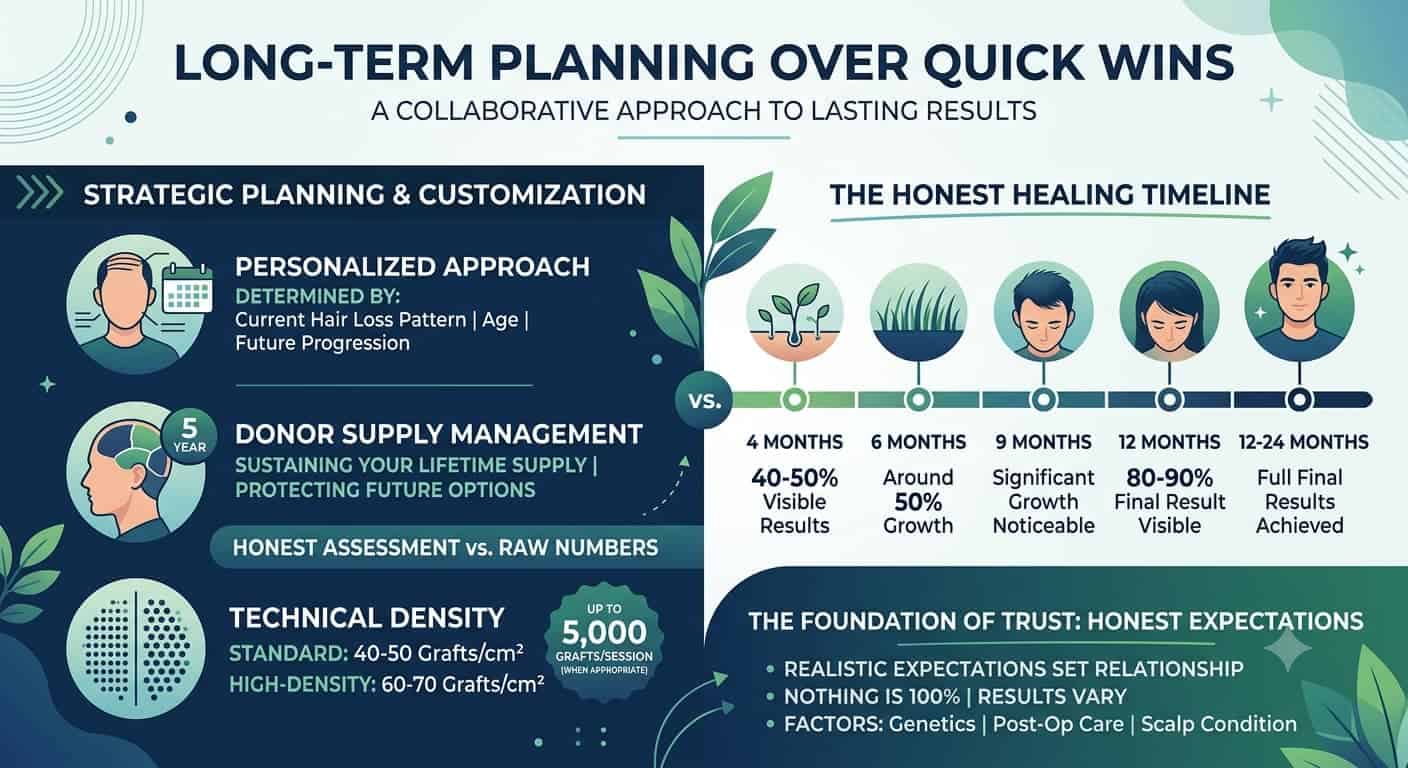
I tell every patient that nothing is 100%. Hair transplantation produces excellent results for the right candidates, but individual outcomes vary based on factors including genetics, scalp condition, post-operative care, and underlying hair loss progression. Honest expectation-setting is not a disclaimer. It is the foundation of a good patient relationship.
The Combination Technique and Revision Expertise
I pioneered a specific approach I call the Combination Technique, which pairs FUE with ALMI Nano Fat therapy. ALMI, which stands for Autologous Lipocyte Micronized Injection, uses the patient’s own processed fat tissue to improve scalp health, blood supply, and the overall environment that grafts are implanted into. In my clinical experience, this combination supports better graft survival and more natural-looking density compared to the transplant alone.
I also specialize in revision and repair cases, which are procedures performed on patients whose previous transplant did not produce satisfactory results. These cases are more complex. There is existing scar tissue. The donor area has already been partially depleted. Blood supply to the scalp may be affected. I handle cases from patients who have traveled from Australia, Italy, Japan, the UK, and the US specifically for corrective work after procedures elsewhere did not go as planned.
The phrase I use with these patients is “Mission Possible.” Not because every revision has a simple solution, but because honest assessment almost always reveals options, even in the most difficult situations. The first step is always the same: a thorough evaluation of what donor resources remain and what the scalp condition can support. I never quote outcomes before I see the patient’s specific situation. That would not be honest, and honesty is the only standard I work to.
Why Thailand, and Why Bangkok
Thailand has built one of the most respected medical tourism ecosystems in Asia, and Bangkok specifically offers a combination of things that are difficult to find anywhere else at this level.
The medical training standards here are internationally competitive. I completed my training through Mahidol University, Saint Louis University in the USA, and DHI Medical Group in London. The continued professional development our team pursues, including conferences and training programs across both Europe and Asia, reflects the standard of care we hold ourselves to. Bangkok’s infrastructure also makes the practical side of medical travel genuinely manageable: direct international flights, world-class hotel options within minutes of our clinics, and a healthcare ecosystem built around serving international patients with care and respect.
There is also something about Thai medical culture specifically worth mentioning. The approach to patient care here is not transactional. It is attentive, detail-oriented, and deeply service-minded. International patients who visit Bangkok for hair restoration are not just choosing a procedure. They are choosing an experience where they feel looked after from the consultation through to follow-up, regardless of where in the world they are when recovery happens.
Our patients come from over 11 countries, including the UK, Germany, Australia, New Zealand, Italy, France, Spain, India, Kenya, Canada, and across Asia. The fact that patients fly specifically to Bangkok for complex cases, including revision procedures, is the kind of outcome-based trust that no marketing can manufacture.

Conclusion
If you are doing serious research on where to have your hair transplant, you are already doing the right thing. The Dr. Top Difference is not a slogan. It is a set of specific, verifiable choices: a lead surgeon who oversees every procedure, a doctor-only team built around graft survival, full video documentation of every procedure, and a planning approach that considers your hair health for the next 20 years, not just the next 12 months. Bangkok offers world-class hair restoration at a genuinely competitive cost compared to Western markets, and within that landscape, I believe the standard of care we practice speaks for itself.
Wondering if you are a good candidate? Take our 2-minute hair assessment to find out — no obligation, and your details stay completely private.