
Almost every week, a patient contacts me after spending hours comparing destinations for their hair transplant. Turkey usually comes up first. The cost is hard to ignore. But here’s the thing: after 20 years and more than 10,000 procedures, I’ve seen what happens when that decision is made on price alone. So let me give you the honest breakdown: the real pros and cons of getting a hair transplant in Turkey, and why Thailand deserves a serious place in that conversation.
Key Takeaways
- Turkey is known for low hair transplant costs, but price alone is not a measure of safety, surgical quality, or long-term results.
- Thailand offers internationally accredited clinics, surgeon-performed procedures, and a model built around each graft surviving, not just being implanted.
- The right decision depends on understanding what actually happens inside the operating room, not just what the package price says.
Why Turkey Became the Hair Transplant Capital
I understand why Turkey is the first place most people look. Istanbul alone performs more hair transplant procedures annually than almost any city in the world. That volume created a whole ecosystem: lower prices, all-inclusive packages, streamlined logistics. For someone flying in from Europe or North America, the convenience is real.
Turkey hair transplant costs typically range from $1,500 to $3,000, often bundled with hotel stays, airport transfers, and aftercare kits. In markets where the same procedure costs $10,000 or more, that difference is significant. The sheer number of Turkish clinics also means the market is competitive, which drives prices down further.
Some Turkish surgeons are genuinely skilled. A few hold internationally recognized credentials, including membership in the International Society of Hair Restoration Surgery (ISHRS). I want to be fair here: the destination is not the problem. The model is.
Free Assessment
Not Sure How Many Grafts You Need?
Get a personalized treatment plan from Dr. Top's team. Takes 2 minutes to complete — no cost, no obligation.
The Honest Pros of Getting a Hair Transplant in Turkey
Let me give credit where it’s due. There are real advantages to Turkey as a hair transplant destination, and ignoring them would not be honest.
Lower overall cost. Turkey hair transplant costs are among the most affordable globally, typically ranging from $0.55 to $2.50 per graft. For patients needing 3,000 or more hair grafts, the cost savings compared to the US, UK, or Australia are substantial.
All-inclusive packages reduce logistical stress. Many hair transplant clinics in Turkey bundle accommodation, ground transportation, translation, and aftercare into one fee. For international patients, that simplicity genuinely removes friction from the process.
Technique variety is wide. Turkish clinics typically offer FUE (follicular unit extraction), a method where individual hair follicles are taken from the donor area one by one, as well as DHI (direct hair implantation, where grafts go directly into the scalp without pre-made channels) and Sapphire FUE. The competitive market pushes the adoption of newer hair restoration technologies quickly.
High volume builds procedural speed. Clinics in Turkey that perform multiple procedures daily do develop a level of technical speed that, in the right hands, can translate into efficient graft handling.
The Real Cons of Hair Transplant in Turkey
This is the part that matters most. And in my clinical experience, these are not small concerns.
Who Is Actually Performing Your Procedure?
In many high-volume clinics, the surgeon consults at the start and may perform the initial channel opening. After that, the extraction and implantation of grafts is handled by technicians, not doctors. I need you to understand what that means in practice.
Every follicular unit, the small bundle of 1 to 4 hairs that we extract as a single graft, must be handled with precision from the moment it leaves the donor area until it is placed in the scalp. The graft is alive. It begins to deteriorate the moment it is outside the body. In my clinic, every surgical step is performed by a doctor. No technicians operate. That is not the norm in high-volume clinics that prioritize volume over surgical oversight.
Every graft is a one-time resource. If it is damaged during extraction, no skill in implantation can make it grow. That is an irreversible loss.
Regulation Gaps Are a Real Risk
Turkey introduced updated clinic safety regulations in 2023, but enforcement remains inconsistent across the country. Some clinics operate with minimal medical oversight. Many advertise very low-cost hair transplants without the staff qualifications or infrastructure to support a safe procedure. When something goes wrong and the patient is thousands of miles from home, follow-up care becomes a serious logistical problem.
Graft Count Inflation
Some high-volume clinics quote very large graft numbers to justify higher package fees. A patient who needs approximately 2,500 well-placed grafts might be sold a 4,500-graft package. Overharvesting the donor area depletes the follicular reserves a patient needs for any future hair restoration surgery. I approach every case with the next 10 to 20 years in mind. Over-harvesting today means fewer options in the future, and that future arrives faster than people expect with progressive hair loss.
Repair Cases Tell the Real Story
I have personally treated patients who came to me after unsatisfactory results from hair transplant procedures abroad. Hairlines placed too low, poor graft survival, uneven density, donor areas showing scarring. Revision procedures are among the most technically complex cases I handle. They are not always fully correctable. Prevention costs less, in every way, than repair.
Hair Transplant Turkey vs. Thailand: A Direct Comparison
Here is where the conversation gets more specific for patients in Asia and Southeast Asia.
| Feature | Turkey | Thailand |
|---|---|---|
| Average FUE Cost (USD) | $1,500 – $3,000 | $3,000 – $7,000 |
| Cost Per Graft | $0.55 – $2.50 | $1.50 – $5.00 |
| All-Inclusive Packages | Standard at most clinics | Less standardized |
| Who Performs Surgical Steps | Varies; often technicians at high-volume clinics | Surgeon-led at accredited clinics |
| International Medical Accreditation | Inconsistent | More consistently applied |
| Flight Time from Southeast Asia | 10 – 14 hours | 2 – 4 hours |
| In-Person Follow-Up Access | Difficult for regional patients | Practical for regional patients |
| Long-Term Graft Planning | Less common in volume model | Built into surgeon-led approach |
The cost difference on paper is real. But the full picture looks different when you factor in return flights for follow-up visits, potential revision procedures, and the compound cost of a procedure that did not achieve the result you expected.
What Thailand Offers That Changes the Equation
Thailand has built one of the strongest medical tourism ecosystems in the world. Bangkok specifically has developed genuine depth in hair restoration, with several clinics operating under international accreditation standards and surgeons who have trained in Europe and the United States.
For patients in Asia, Southeast Asia, or the Pacific, the geography alone changes the calculation significantly. Getting to Bangkok from the Philippines, Australia, or Singapore takes a fraction of the time it takes to reach Istanbul. Post-operative follow-up appointments, which are essential for monitoring hair growth, graft survival, and scalp recovery, become realistic rather than theoretical.
At Dr. Top Hair Hospital, I oversee every procedure, working alongside a rotating team of specialist doctors who bring extensive hair restoration experience to every case. The rotation model exists for a specific reason: each doctor’s rotation during the procedure reduces the total time that grafts spend outside the body. That out-of-body window directly affects graft survival rates. My FUE graft survival rate is approximately 90%, and every graft is kept within the critical implantation window of 6 hours from extraction.
I also use a combination approach that pairs FUE hair transplant surgery with ALMI Nano Fat therapy, a technique that supports scalp health and graft integration in ways that a transplant procedure alone cannot achieve. Every procedure is video-recorded from start to finish, and each patient receives that recording. Graft counts are documented and transparent. There are no surprises.
I am a Diplomate of the American Board of Hair Restoration Surgery (ABHRS). I presented at IMCAS World Congress 2026 in Paris and received the Best Hair Restoration Award at AMWC 2025 in Monaco. I tell you this not to boast, but because credentials exist for a reason. They represent a standard of training and accountability that you deserve to verify in any surgeon you consider, including me.
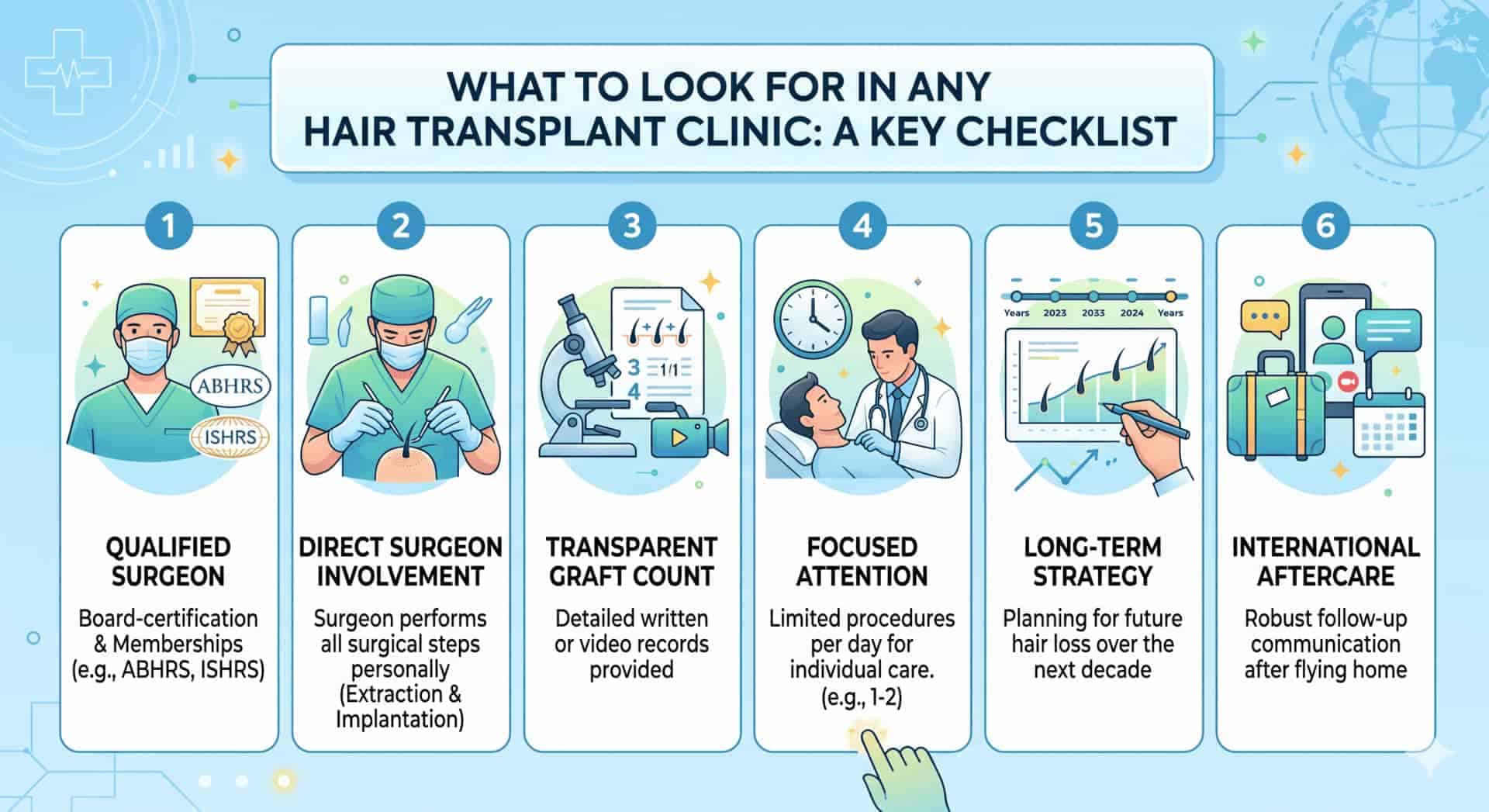
What to Look for in Any Hair Transplant Clinic
Whether you are evaluating clinics in Turkey or clinics in Thailand, the questions you ask should be the same.
- Is the surgeon board-certified? Look for a Diplomate of the American Board of Hair Restoration Surgery (ABHRS) or active ISHRS membership as minimum verification.
- Does the surgeon personally perform every surgical step? Ask this directly. Extraction and implantation should not be delegated to non-physician staff.
- Is the graft count documented transparently? Ask for written records before and after the procedure. Video documentation is even better.
- How many procedures does the clinic perform per day? A surgeon performing 5 to 10 procedures daily cannot give each case the attention it requires.
- What does the long-term plan look like? A responsible clinic plans for your hair loss progression over the next decade, not just for today’s session.
- What does aftercare look like if you are an international patient? Follow-up communication and access to your surgeon matter when you fly home.
Conclusion
If you are weighing the hair transplant Turkey pros and cons and trying to figure out where Thailand fits in, here is what I would tell you if you were sitting across from me: Turkey is a reasonable destination if you do thorough research, verify that the surgeon personally performs every surgical step, and go in with a clear picture of what you are paying for. But for patients in Asia and Southeast Asia, Thailand removes a significant amount of risk logistically, medically, and in terms of long-term access to your surgeon. The grafts placed today affect what options you have in 10 years. I think about that with every single case.
If you are still weighing your options, the clearest next step is not a consultation call or a package quote. It is a short personalized assessment that gives you a realistic picture of your candidacy, your graft requirements, and what the right approach looks like for your specific situation.
The grafts placed today shape your options for the next decade. Start with the right information.
Wondering if you’re a good candidate? Take our free 2-minute assessment to find out — no obligation, and your details stay completely private.
Reviewed by Dr. Top, ABHRS-certified. Over 10,000 procedures performed across more than 20 years, with patients from over 11 countries including the UK, Germany, Australia, Canada, France, and across Asia.