
Hair loss is something millions of people deal with every day, and for many, a hair transplant abroad feels like the most practical and affordable path forward. But with so many clinics, so many countries, and so many promises flying around online, knowing how to choose the right one can feel overwhelming. This guide breaks it all down, with an honest look at what to watch for and what actually matters.
Key Takeaways
- Not all hair transplant clinics abroad meet the same standards, and knowing the difference between a medical license, a professional membership, and a board certification, three very different things, is one of the most useful things you can learn before booking.
- FUE and FUT describe how donor hair is harvested. How it’s implanted is a separate step, and terms like “DHI” describe an implantation approach, not a distinct harvesting method, however they’re marketed.
- The questions worth asking any clinic, in any country, matter more than which country you pick: who performs each step, what their credentials actually are, what aftercare looks like, and what happens if something goes wrong.
Questions Worth Asking Any Clinic Before You Book
Before you commit to any clinic abroad, bring these questions to your consultation. A clinic that answers clearly and without deflection is one operating with confidence in its own standards.
- Who specifically will perform each part of my procedure? Not just “who’s the surgeon on paper,” but who does the donor harvesting, who creates the recipient sites, and who places the grafts. These can be different people, and that’s worth knowing upfront.
- What are that person’s actual credentials? Ask for their medical license and which board, if any, has certified them specifically in hair restoration surgery. Don’t accept “internationally accredited” as an answer on its own, ask what that means concretely.
- What does aftercare actually look like, including after I’ve gone home? Ask who you contact, how, and within what timeframe.
- What happens if I have a complication once I’m back in my home country? This is the question people forget to ask and regret not asking.
- What exactly is included in my written quote? Ask for a breakdown covering consultation, the procedure, medications, and any follow-up visits, in writing, not verbally.
- Can I see before-and-after results from patients with a hair loss pattern similar to mine?
Why Medical Tourism for Hair Transplants Has Exploded

Over the past decade, the global hair transplant market has grown at a remarkable pace. More people are traveling abroad for hair restoration than ever before, and it is not hard to see why. Cost savings are significant, wait times are often shorter, and many international clinics offer packages that bundle surgery, accommodation, and aftercare into one convenient plan.
Medical tourism for hair transplants has turned destinations like Thailand and Turkey into household names in the hair restoration industry. Both countries attract thousands of international patients every year, and both have built reputations on delivering results that rival or exceed what patients would find at home. But reputation alone is not enough. The rise in demand has also meant a rise in clinics that cut corners, which is exactly why knowing how to choose a hair transplant clinic abroad is so important.
Free Assessment
Not Sure How Many Grafts You Need?
Get a personalized treatment plan from Dr. Top's team. Takes 2 minutes to complete — no cost, no obligation.
Understanding Credentials: License, Membership, and Certification Aren’t the Same Thing
[CLINICIAN REVIEW NEEDED FOR THIS SECTION]
This trips up a lot of patients, understandably, since clinics often list several credentials together in a way that makes them sound interchangeable. They’re not.
A medical license is the legal authorization to practice medicine, issued by the government regulatory body in whatever country the clinic operates in, Thailand’s is the Medical Council of Thailand. Without this, a person legally cannot perform surgery, regardless of any other credential they hold.
Professional society membership, such as membership in the International Society of Hair Restoration Surgery (ISHRS), means a practitioner has joined an organization dedicated to the field, agreed to abide by its code of ethics, and typically participates in its continuing education. It’s a meaningful signal of engagement with the specialty. It is not, on its own, proof of a specific skill level or a certification.
Board certification is a distinct, more rigorous credential, earned by meeting specific training and examination requirements set by a certifying board. For hair restoration surgery specifically, that’s the American Board of Hair Restoration Surgery (ABHRS). This is worth being precise about: ISHRS’s own published guidance on misleading marketing explicitly states that members “may not claim to be board certified by the ISHRS,” and that language like “board certified hair restoration surgeon” used loosely is considered improper messaging. The same guidance separately flags “incorrectly claiming to be certified by the ABHRS or claiming to be a member or Fellow of the ISHRS” as a form of credential misrepresentation clinics should avoid.
What this means practically: when a clinic lists ISHRS affiliation, ask what it actually refers to, membership or something else, and ask separately whether the treating surgeon holds board certification from a recognized certifying body like ABHRS. These are two different questions with two different answers, and a credible clinic should be able to answer both precisely without conflating them.
Green Lights: What a Trustworthy Hair Transplant Clinic Looks Like
Verified Medical Credentials. Ask the clinic to show you the treating surgeon’s medical license directly, not just a logo on their website. Separately, ask whether they hold board certification in hair restoration surgery specifically, and from which board. Professional memberships (ISHRS and similar) are worth asking about too, but treat them as one data point, not a substitute for license or certification verification.
A Qualified, Experienced Hair Transplant Surgeon. This is the single most important factor. Ask specifically who will be performing your procedure, and which parts of it. Delegating surgical steps to unlicensed staff is a real concern in parts of the industry; it’s worth asking the direct question rather than assuming.
Transparent Pricing. Good clinics are upfront about what’s included in their quote: consultation, procedure, post-operative care, medications, and follow-up appointments. If a price seems too good to be true, it often is.
Genuine Patient Reviews. Look for reviews on independent platforms rather than testimonials hosted only on the clinic’s own site. Pay attention to how clinics respond to negative reviews too.
Before-and-After Results That Are Realistic. The best clinics show authentic before-and-after images from real patients, ideally at multiple stages of recovery. Results that look flawless immediately after surgery should raise an eyebrow
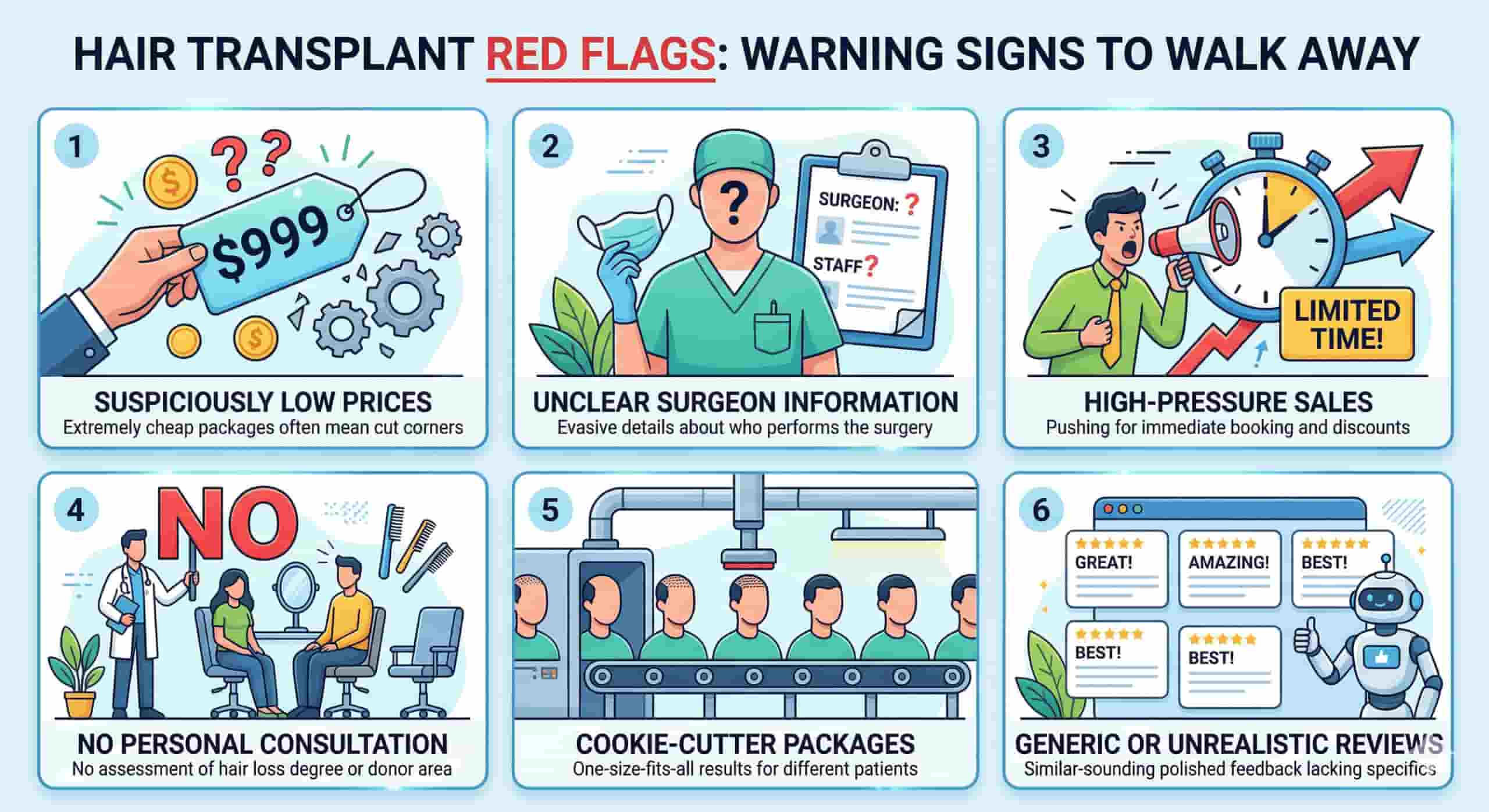
Red Flags: Warning Signs to Walk Away From
Just as important as knowing what to look for is knowing what to avoid. The hair transplant industry abroad has its share of clinics that prioritize volume over quality, and being wary of clinics that display these warning signs can protect you from serious regret.
- Unusually low prices with vague inclusions. Extremely cheap packages often mean corners are being cut somewhere, whether in the quality of equipment, the experience of the team, or the sterility of the facility.
- No clear information about who performs the surgery. If a clinic is evasive about the surgeon’s credentials or whether a doctor will actually be in the room, that is a serious concern.
- Pressure tactics and urgency-based selling. Reputable clinics give you the time and information to make an informed decision. Any clinic pushing you to book immediately with a “limited time” discount deserves skepticism.
- No consultation process. A legitimate hair restoration clinic will assess your degree of hair loss, evaluate your donor area, and discuss which technique suits your hair type before quoting you anything.
- Cookie-cutter packages with no personalization. Different types of hair loss require different approaches. Clinics that promise the same result for every patient regardless of individual assessment are not practicing good medicine.
- Reviews that sound too polished or too similar. Generic five-star reviews with no specific detail are often not organic.
Understanding the Techniques: Harvesting and Implanting Are Two Different Steps
[flagged for clinical review before publishing, since it corrects a technical distinction]
It helps to separate two different steps that patients often lump together: how donor hair is harvested, and how it’s implanted.
Harvesting is how follicles are removed from the donor area, and there are two established methods:
- FUT (Follicular Unit Transplantation), sometimes called strip harvesting: a strip of donor skin is removed and the individual follicular units are dissected from it under magnification. This leaves a linear scar, confined to one area.
- FUE (Follicular Unit Excision): individual follicular units are extracted one at a time using a small round punch. It’s become the more widely used method in recent years and doesn’t involve stitches, though the ISHRS is clear that it still constitutes surgery, since it involves thousands of small skin incisions, and that despite marketing claims of a “no scar technique,” FUE almost always leaves small round scars, which are usually hidden with short hairstyles when performed correctly.
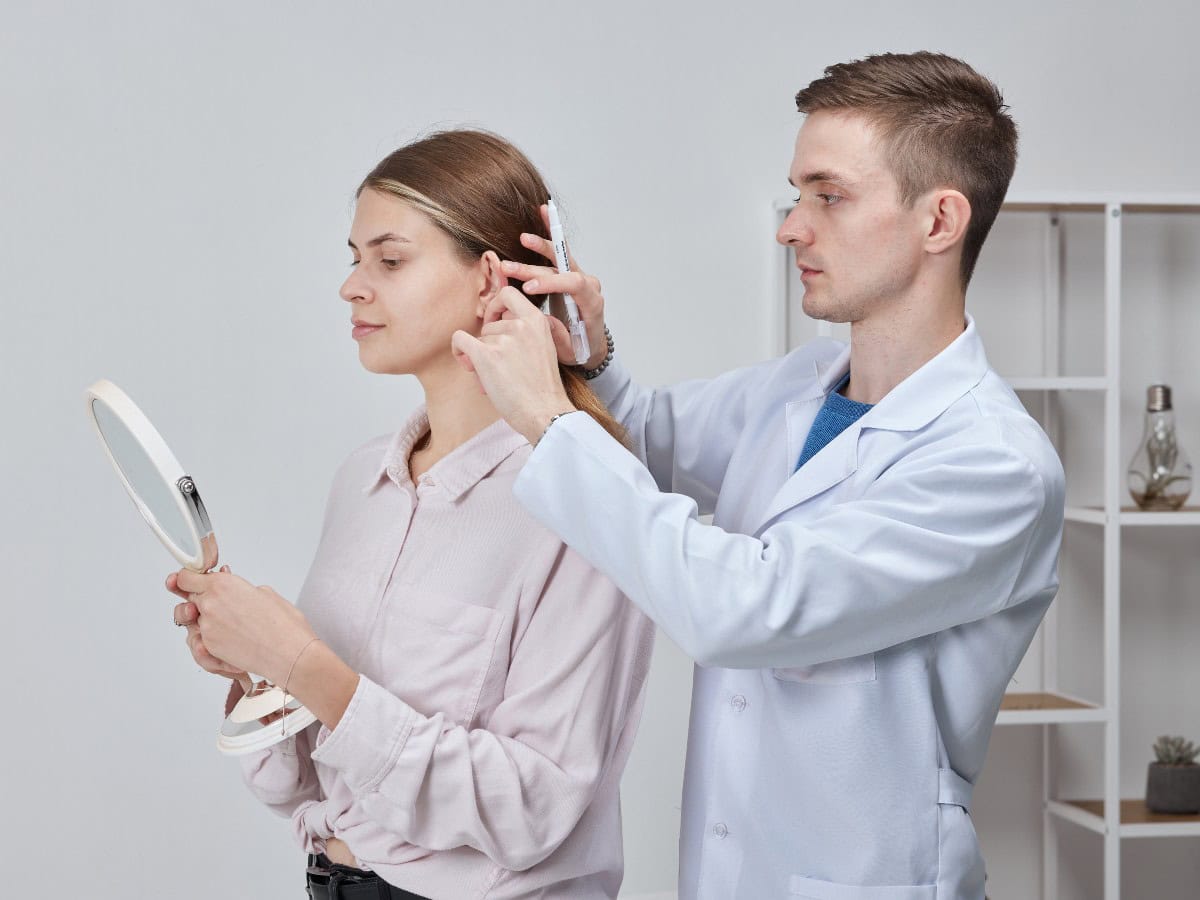
Implantation is the separate step of placing harvested grafts into the recipient area, regardless of which harvesting method was used. This is done either with forceps, placing each graft gently into a pre-made incision, or with an implanter tool, which can be “dull” (used for pre-made incisions) or “sharp” (which makes the incision and implants the graft in one motion).
This is where the term “DHI” comes in, and it’s worth being precise about what it actually describes. Some practitioners use “direct hair implantation” or “DHI” to refer to immediate implantation following extraction, usually using a sharp implanter tool like a Choi pen. According to the ISHRS, DHI is not a distinct hair transplant method and shouldn’t be marketed as such, it describes an implantation approach, not a separate way of harvesting or transplanting hair. A clinic offering “DHI” is still using FUE (or occasionally FUT) to harvest the grafts; DHI describes what happens next.
None of this means DHI-marketed approaches are ineffective, it means the terminology is promotional rather than a separate clinical category, and it’s worth asking any clinic to explain, in plain terms, exactly which harvesting method they use and which implantation approach, rather than accepting a single branded term as the full answer.
Thailand vs. Turkey: What’s Actually Comparable, and What Isn’t
Both Thailand and Turkey are major destinations for hair transplants, and both have excellent clinics at the top end of the market. A few things are reasonably well-documented:
| Factor | Thailand | Turkey |
|---|---|---|
| Hair transplant techniques available | FUE, FUT, DHI-marketed approaches | FUE, FUT, DHI-marketed approaches |
| Primary appeal | Lower cost than UK/Europe/Australia, resort-style recovery environment | Lower cost than UK/Europe/Australia, highly developed clinic infrastructure in Istanbul |
| Language | English widely spoken in medical/tourism settings | English availability varies by clinic |
Rather than ranking the two countries on regulation or surgeon quality broadly, which varies enormously clinic to clinic within each country, it’s more useful to ask any specific clinic the verification questions above, regardless of which country you’re considering. A well-run clinic in either country will answer them clearly; a poorly run one in either country won’t.
Why Thailand Is a Strong Choice for Your Hair Restoration Journey
Thailand’s medical tourism reputation goes beyond competitive pricing. Physicians practicing in Thailand must hold a license from the Medical Council of Thailand, the country’s statutory medical licensing and regulatory body. The Council has also moved to tighten enforcement around who may legally perform medical and cosmetic procedures, including a regulation that took effect in mid-2026 requiring clinics to display treating doctors’ real names and license numbers in advertising for cosmetic services, part of a broader crackdown on unlicensed practitioners performing medical procedures.
For international patients seeking hair restoration, Thailand offers experienced surgeons, modern facilities, and a recovery environment suited to healing. Clinics like Dr. Top Hair Hospital combine licensed, specifically-certified practice with a medical team that continues training to stay current with hair transplant advancements.
Conclusion
Choosing a hair transplant clinic abroad doesn’t have to feel like a gamble. The most reliable path isn’t picking a country, it’s asking the right questions of any specific clinic: who performs each step, what their actual credentials are, what aftercare looks like, and what’s genuinely included in your quote. Clinics that answer clearly, and separate their licensing, memberships, and certifications honestly, are the ones worth trusting.
Wondering if you’re a good candidate? Take our free 2-minute assessment to find out, no obligation, and your details stay completely private.