
So you have booked your FUE hair transplant in Bangkok. The surgery is done, the grafts are in, and you are sitting in your hotel room wondering, “Now what?” That first week can feel a little uncertain, but it does not have to be. Here is a practical, day-by-day guide to help you get through it.
Key Takeaways:
- The first seven days after your hair transplant are the most critical for graft survival, so following your aftercare routine carefully is non-negotiable.
- Bangkok makes recovery surprisingly manageable, with clinics offering post-op follow-ups, low-level laser therapy (LLLT), and English-speaking support for international patients.
- Light activities like visiting malls, temples, and restaurants are generally fine within a day or two, but anything that causes heavy sweating or direct sun exposure should wait.
Why Bangkok Is a Smart Place to Recover
Before getting into the day-by-day breakdown, it is worth understanding why so many people from the UK, Australia, Germany, and across Asia choose to have their hair transplant in Thailand and then stay for their recovery.
Bangkok is one of the most well-equipped medical tourism destinations in the world. Clinics here, including ours at Dr. Top Hair Hospital, are set up specifically to support international patients from consultation all the way through to post-op care. English-speaking staff, follow-up appointments, LLLT sessions, and take-home aftercare kits are standard. Medical treatments in Thailand can cost significantly less than equivalent procedures in Western countries, making the overall trip, flights and hotel included, a cost-effective decision for many.
Free Assessment
Not Sure How Many Grafts You Need?
Get a personalized treatment plan from Dr. Top's team. Takes 2 minutes to complete — no cost, no obligation.
Beyond the clinic, Bangkok simply makes recovery comfortable. Air-conditioned malls, relaxed rooftop restaurants, tranquil temples, and a city culture built around hospitality mean you are not stuck staring at four walls while you heal. You can take it easy without being bored.
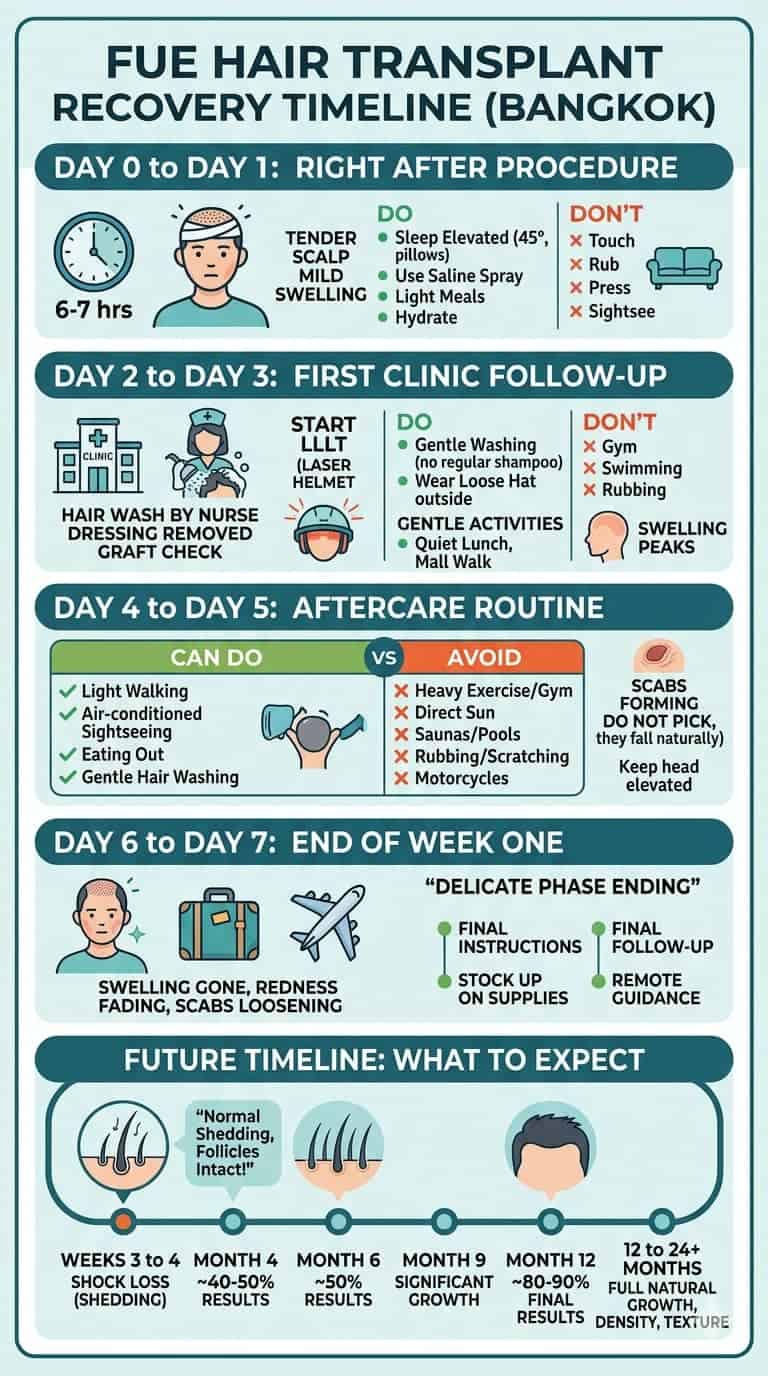
Day 0 to Day 1: Right After Your Procedure
A standard FUE hair transplant procedure typically runs around six to seven hours. Once it is done, your scalp will feel tender, and you may notice mild swelling around the forehead and hairline. This is completely normal and expected.
What to do on day one:
- Sleep with your head elevated at least 45 degrees to reduce swelling and prevent fluid from pooling around the forehead and eyes. A travel neck pillow or extra pillows work well.
- Avoid touching, rubbing, or pressing anything against the recipient area. The transplanted hair follicles are at their most fragile in these first 24 hours.
- Use the saline spray provided by your clinic to keep the graft area moist. At Dr. Top Hair Hospital, patients receive a post-op aftercare kit that includes everything they need for those first critical days.
- Stay hydrated, eat light meals, and rest. Skip the ambitious sightseeing for now.
At this stage, your scalp will look a bit raw and you may see small dots of dried blood around the grafts. Do not be alarmed. This is a natural part of the process.
Day 2 to Day 3: Your First Clinic Follow-Up
Most reputable hair clinics in Bangkok will ask you to come in for a follow-up appointment around day two. During this visit, your hair will be washed by a trained nurse using a gentle technique, the dressing will be removed, and your surgeon will check that the grafts are settling properly.
This is also when Low-Level Laser Therapy (LLLT) typically begins. LLLT sessions are used post-procedure to promote healing, reduce swelling, increase blood flow to the scalp, and support early graft survival. At Dr. Top Hair Hospital, these sessions are part of the post-operative care plan and are done over several consecutive days.
A few things to keep in mind:
- When washing your hair at the clinic or at home, use only the prescribed shampoo. No regular shampoo, no conditioner, and absolutely no rubbing.
- Swelling around the forehead often peaks around day two to three. This is temporary and usually resolves by the end of the first week.
- You can go out, but keep it gentle. A quiet lunch or a slow walk through an air-conditioned mall is fine. Skip the gym, the rooftop pool, and anything that will make you sweat heavily.
By day three, many patients are already feeling well enough to enjoy some light Bangkok activities. Just take it easy and wear a loose hat outdoors to protect the scalp from direct sun.
Day 4 to Day 5: Getting Into Your Aftercare Routine
By this point, you should be settling into a rhythm. Your scalp will likely be showing small scabs or crusting around the grafts, which is completely normal. These scabs are protective. Do not pick them. They will fall off naturally over the following days.
Continue your LLLT sessions if your clinic has scheduled them. These sessions help minimize the risk of complications and support natural hair growth in the weeks ahead.
| What You Can Do | What to Avoid |
|---|---|
| Light walking | Heavy exercise or gym sessions |
| Air-conditioned sightseeing | Direct sun exposure without a hat |
| Eating out, visiting malls | Saunas, steam rooms, or swimming pools |
| Gentle hair washing as instructed | Rubbing, scratching, or touching the scalp |
| Low-key temple visits | Motorcycle rides or anything with heavy vibration |
Sleep hygiene still matters at this stage. Keep your head elevated and avoid sleeping face down. Your donor area, the back or sides of the scalp where grafts were extracted, may still feel slightly sore or tight. This is normal and will ease on its own.
Day 6 to Day 7: The End of Week One
By the end of your first week, most of the visible signs of your FUE hair transplant will have calmed down considerably. The swelling should be gone. The redness is fading. The scabs are beginning to loosen. You are not fully healed yet, but you are well past the most delicate phase.
This is also the point where many international patients start planning their flight home, or extend their stay to enjoy Thailand a little more. If you are heading to the islands or planning some beach time before flying out, just keep in mind that direct sun on the scalp and saltwater submersion should still be avoided at this stage.
Before you leave Bangkok, make sure you have:
- Received your full set of post-op instructions from your clinic
- Had your final follow-up appointment with your surgeon
- Stocked up on any prescribed medications, shampoos, or sprays for the weeks ahead
- Asked about remote follow-up options if you are an international patient
At Dr. Top Hair Hospital, we support patients across 11+ countries after they return home, so you are never left without guidance once you are back in your own country.
What to Expect in the Weeks and Months After
The first week is just the beginning of your hair restoration journey. Here is what the broader timeline typically looks like based on what we consistently see at our clinic:
| Timeframe | What Typically Happens |
|---|---|
| Weeks 3 to 4 | Transplanted hair sheds. This is normal, it is called shock loss. The follicles remain intact beneath the scalp. |
| Month 4 | Approximately 40 to 50% of visible results are noticeable. New hair will appear thin and fine at first. |
| Month 6 | Around 50% of the final result is visible. Hair gradually thickens. |
| Month 9 | Significant growth is evident. Most people notice a clear improvement by this stage. |
| Month 12 | Roughly 80 to 90% of the final result is visible. |
| 12 to 24 Months | Full final results, including natural hair growth pattern, density, and texture. |
The shedding phase around weeks three and four often catches patients off guard. It looks like the transplanted hair is falling out entirely, and naturally that can feel alarming. But the hair follicles themselves are still firmly in place beneath the scalp. What you are seeing is just the hair shaft cycling out before new growth begins. This is a normal and well-documented part of the hair transplantation process.
FUE vs. Other Hair Transplant Methods: What Changes During Recovery
Bangkok clinics offer several hair transplant techniques, and the one you choose can influence what your recovery looks like, particularly in that critical first week.
FUE (Follicular Unit Extraction) is the most widely used method and is the technique we specialize in at Dr. Top Hair Hospital. Individual hair follicles are extracted one by one from the donor area and implanted into the recipient zone. Because there is no linear incision, the donor area heals faster and there is no visible linear scar. FUE is well-suited to patients who want a faster recovery and plan to wear their hair short.
DHI (Direct Hair Implantation) uses a specialized implanting tool to place grafts directly without creating incisions in advance. It is precise and also minimally invasive, with recovery characteristics similar to FUE. DHI hair techniques are a popular option for patients looking to maximize density in smaller areas.
FUT (Follicular Unit Transplantation), sometimes called the strip method, involves removing a strip of scalp tissue from the donor area. This allows for a large number of grafts in a single session but does leave a linear scar at the back of the head. Recovery from a FUT hair transplant typically takes a little longer, as the stitched donor wound needs time to heal properly.
For most international patients visiting Bangkok, FUE remains the preferred choice because of its cleaner recovery profile and the fact that it fits neatly into a seven to ten day trip.
Why Thailand Specifically for Hair Restoration
Thailand has built a genuine reputation in advanced hair restoration, not just as a budget alternative to clinics in Western countries. The combination of highly trained surgeons, internationally accredited clinics, and a well-developed medical tourism infrastructure gives Bangkok a strong edge.
At Dr. Top Hair Hospital, our lead surgeon is ABHRS-certified, one of approximately 300 surgeons worldwide and roughly 20 in all of Thailand who hold this certification. With over 20 years of experience in hair restoration and more than 10,000 procedures performed, our team brings a depth of clinical expertise that goes well beyond what most clinics in Thailand can offer. We have been recognized at global platforms including the HOFS Awards 2024 and have been invited to speak at the IMCAS World Congress 2026 in Paris.
When you combine that level of expertise with Bangkok’s affordability, it becomes clear why patients from the UK, Australia, Germany, France, and across Asia continue to choose Thailand for their hair transplant surgery.
Practical Tips for International Patients Coming to Bangkok

If you are flying in specifically for your procedure, here are a few things worth planning ahead:
- Arrive a day early. You will want to be rested before your procedure, not jet-lagged from a long-haul flight.
- Book accommodation close to your clinic. You will need to travel back and forth for follow-up appointments in the first few days, so staying nearby makes life much easier.
- Bring a loose-fitting cap. You will want something to cover the scalp outdoors without pressing down on the grafts. A loose bucket hat works better than a tight baseball cap.
- Plan your sightseeing before the procedure. If you want to do anything active, climb temples, visit night markets, or do a cooking class, do it before surgery. After, keep things calm and low-effort.
- Do not rush to fly home. Most Bangkok hair clinics recommend staying for at least seven to ten days. This gives time for the initial critical healing phase to pass and allows your surgeon to check that everything is on track before you board your flight.
If you’re planning to know more about the full costs of hair transplants in Thailand, see: Hair Transplant Cost in Thailand: Complete Pricing Guide for 2026
Conclusion
Your first week of hair transplant recovery in Bangkok is very manageable when you know what to expect and have the right team behind you. From the day of your procedure through to your final follow-up before you fly home, every step has a clear purpose, and none of it has to feel overwhelming. With the right clinic, the right aftercare, and a city as welcoming as Bangkok, recovery becomes far less of a hurdle and far more of a turning point.
Wondering if you are a good candidate? Take our 2-minute hair assessment to find out and get a clearer picture of what is possible for your hair. No obligation, and your details stay completely private. Reviewed by Dr. Top, ABHRS-certified, with 10,000+ procedures performed across patients from 11+ countries.