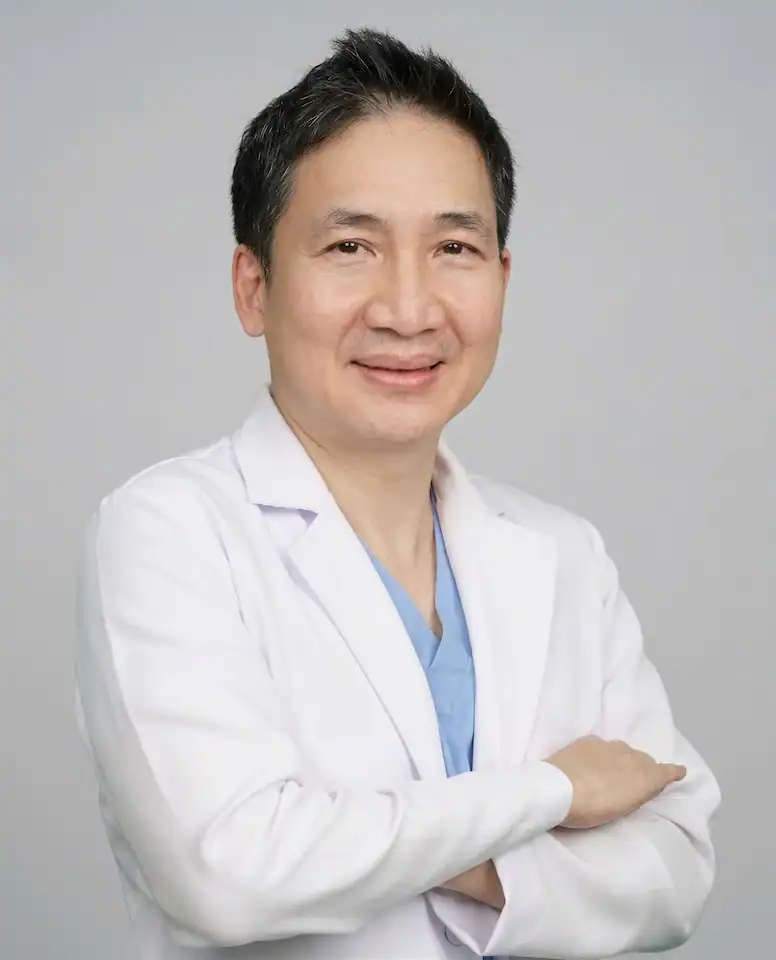

Almost every week, a patient asks me the same question before their consultation: “How do I know I can trust the surgeon I choose?” It is a fair question, and honestly, it is the right one to ask. So let me answer it directly by telling you exactly what my ABHRS certification means, why I pursued it, and why it should matter to your decision.
Key Takeaways
- Dr. Top holds a Diplomate of the American Board of Hair Restoration Surgery (ABHRS), the certifying board for hair restoration surgery.
- ABHRS certification requires documented surgical experience, case log submission, and passing both written and oral examinations — it is not awarded automatically with a medical license.
- Choosing an ABHRS-certified surgeon in Thailand means you get world-class surgical standards alongside the well-known advantages of Bangkok as a medical destination: skilled specialists, modern facilities, and significantly more accessible costs compared to Western countries.
What Is the ABHRS and Why Does It Exist?
Here is something most patients do not realize: in many countries, any physician with a general medical license can legally perform hair restoration surgery. There is no universal requirement for specialized training. No mandatory board exam. No minimum case volume. The American Board of Hair Restoration Surgery (ABHRS) was established specifically to address that gap.
The ABHRS is the only internationally recognized certifying board dedicated exclusively to hair transplant surgeons. It is also the only board recognized by the International Society of Hair Restoration Surgery (ISHRS), which is the largest hair restoration education society in the world. Its purpose is straightforward: to identify surgeons who have met a rigorous, independently verified standard of training, experience, and clinical knowledge.
Free Assessment
Not Sure How Many Grafts You Need?
Get a personalized treatment plan from Dr. Top's team. Takes 2 minutes to complete — no cost, no obligation.
When I tell a patient I hold a Diplomate of the ABHRS, I am not referencing a membership or a participation certificate. I am referencing a credential that required me to prove, on paper and in examination, that I meet a globally defined standard of surgical competence.
What It Actually Takes to Earn ABHRS Certification
This is where I want to be specific, because the word “certification” gets used loosely in this industry. The ABHRS Diplomate designation is not given out lightly.
To qualify, a surgeon must meet all of the following:
- Documented training and post-training experience — proof of structured learning and hands-on surgical experience in hair restoration
- Case log submission — operative reports and before-and-after photographs for actual patient cases, reviewed by the credentialing committee
- Written examination — a comprehensive, psychometrically validated exam covering the full scope of hair restoration surgery
- Oral examination — a face-to-face assessment of clinical judgment and decision-making
The ABHRS examination is the only psychometrically and statistically validated exam dedicated specifically to hair restoration surgery. That means it is structured to reliably differentiate between surgeons who genuinely understand the specialty and those who do not. Passing it requires more than knowing the names of procedures. It requires demonstrating that you can apply clinical knowledge to real patient scenarios.
Certification also does not last forever. Surgeons must recertify by passing an exam every ten years. That requirement exists for a reason: the field evolves, and a surgeon’s knowledge should evolve with it.
How Many Surgeons Hold This Credential?
That is roughly 25% of an already specialized group.
To put that in context, Bangkok is a city of over 10 million people, home to hundreds of hair clinics.
| Scope | Number |
|---|---|
| Dr. Top’s years of experience | 20+ |
| Procedures performed | 10,000+ |
I share these numbers not to impress, but to give you a realistic picture of how rare this credential is — and why it is worth asking about when you research any clinic.
What Dr. Top ABHRS Certification Means in Practice
The certification itself is a threshold. It tells you that a surgeon has met a defined standard. But what I want to explain is how that standard actually shows up in how I work.
- Every procedure is surgeon-performed. I oversee every procedure, performed by a rotating team of specialist doctors, all of whom have extensive hair restoration experience. No technicians perform surgical steps at my clinic. This is not standard across the industry. Many high-volume clinics rely on non-physician staff for the most critical parts of the procedure: extraction and implantation. That is not how I work, and it is not something I will compromise on.
- Graft survival is the metric that matters. In my experience, the real measure of a procedure is not how many grafts were implanted, but how many survived and grew. Our FUE graft survival rate is approximately 90%, and we use an ATP graft preservation solution that maintains over 95% cell viability while grafts are outside the body. Every minute a graft spends outside the scalp is a minute that matters. The reason I built a rotating doctor team model is specifically to reduce that out-of-body time.
- Transparency is built into every procedure. Every surgery at Dr. Top Hair Hospital is video recorded, and patients receive that recording. It documents who performed each step, how many grafts were extracted, how many were damaged, and how many were implanted. For a patient flying in from overseas who cannot verify credentials in person, that video is as close to certainty as this process allows.
- Long-term planning, not just one procedure. Your donor area, the zone at the back and sides of the scalp where grafts are harvested, is finite. Once those follicles are removed, they do not regenerate at the extraction site. A surgeon who over-harvests today to produce a high graft count is borrowing from your future. I plan every procedure with 10 to 20 years in mind, because the decisions made in your first transplant directly affect what options remain if you need another one.
Why Thailand and Why Dr. Top
Thailand has become one of the most credible destinations in the world for hair restoration, and not just because of cost. The country has invested heavily in medical infrastructure, attracts internationally trained surgeons, and has a long-standing culture of hospitality that genuinely shapes the patient experience.
Medical procedures in Thailand are typically 50 to 80% more affordable than comparable procedures in Western countries, and that gap exists without any compromise in clinical quality at properly credentialed clinics. The Thai government has actively positioned the country as a leading medical hub, with infrastructure, language accessibility, and support systems that make the experience practical for international patients arriving from Europe, North America, and beyond.
At Dr. Top Hair Hospital, we have 7 clinics across Bangkok, with our flagship located at Thonglor. We see patients from over 11 countries, including the UK, Australia, Germany, Italy, France, Canada, and across Asia. Many come for first-time procedures. Some come specifically for corrective work after unsatisfactory results elsewhere. In both cases, the starting point is the same: an honest assessment of what is possible based on your specific situation.
Beyond the ABHRS Diplomate, I hold membership in the ISHRS and was recognized with the Best Hair Restoration Award at the Aesthetic and Anti-Aging Medicine World Congress (AMWC 2025) in Monaco, selected from over 1,000 submissions across 60 countries. I was also an invited speaker at IMCAS World Congress 2026 in Paris. I share this not as a list of accolades, but because continuing to participate in international medical conferences is part of how I stay current. The field moves. I move with it.
My training background spans Mahidol University, Saint Louis University in the USA, and DHI Medical Group in London. That combination of Thai medical education and international surgical training is a direct reason I was able to earn the ABHRS certification, and why I continue to see patients from around the world at my Bangkok clinic.
How to Evaluate Any Hair Transplant Surgeon
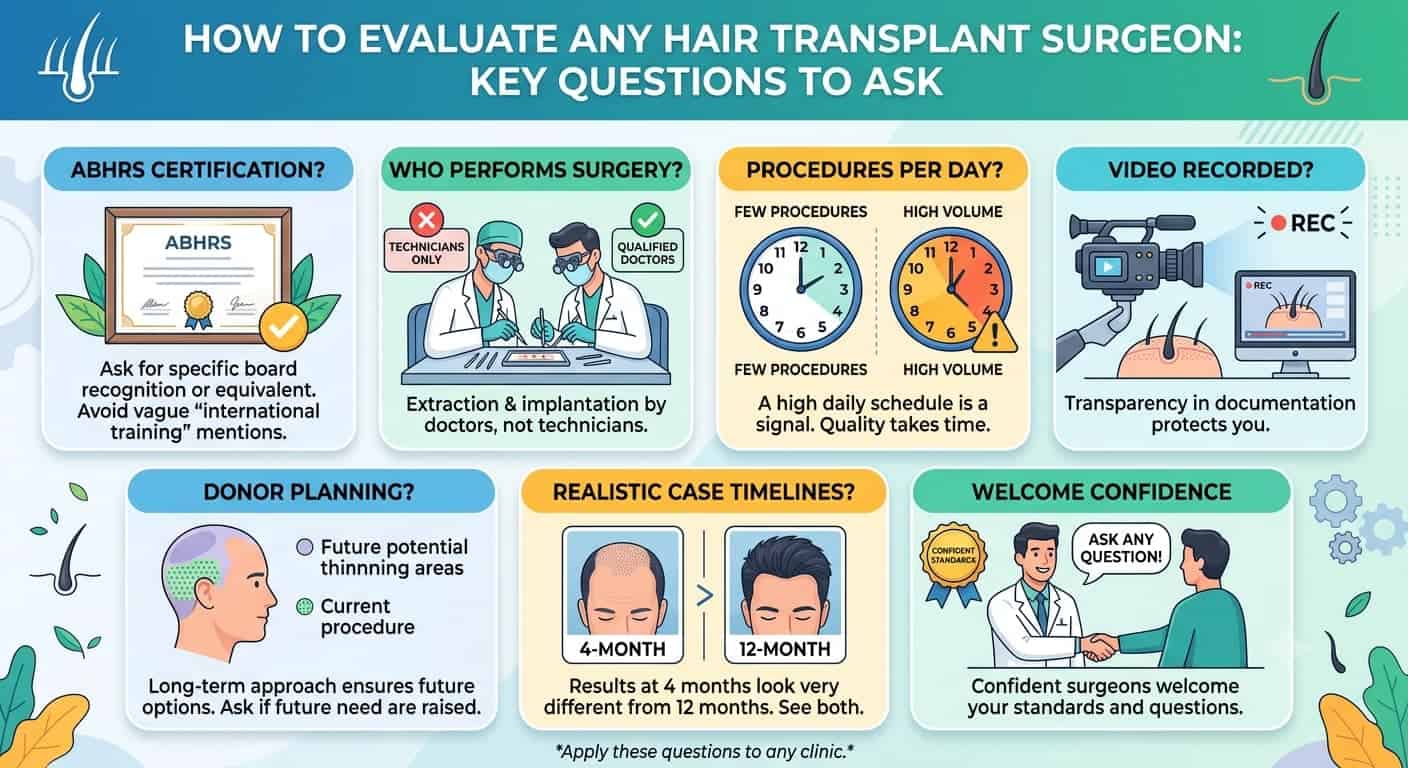
Whether you are considering Dr. Top Hair Hospital or doing broader research, here is what I recommend you actually ask before booking anyone:
- Does the surgeon hold ABHRS certification or equivalent board recognition? Ask specifically. Do not accept vague mentions of “international training.”
- Who performs the surgical steps? Extraction and implantation should be performed by qualified doctors, not technicians.
- How many procedures does the surgeon perform per day? A high-volume daily schedule is a signal worth understanding. Quality work takes time.
- Is the procedure video recorded? Transparency in documentation protects you.
- What is the clinic’s approach to long-term donor planning? If nobody raises your future options, that is worth noting.
- Can you see case documentation with realistic timelines? Results at 4 months look very different from results at 12 months. Both should be shown.
I encourage every patient to apply these questions to my clinic as well. A surgeon who is confident in their standards will welcome them.
Conclusion
If you are researching hair transplants and trying to figure out who you can actually trust, I understand exactly why that feels complicated. The industry is not consistently regulated, credentials are often vague, and the stakes are real, your donor area is not replaceable. My ABHRS certification is one verifiable signal that I have been independently assessed and that I meet a globally recognized standard. Combined with over 20 years of practice, more than 10,000 procedures, and a clinic model built around surgical quality rather than volume, it is the clearest answer I can give you when you ask: “How do I know I can trust you?”
Wondering if you are a good candidate? Take our quick 2-minute hair assessment to find out; no obligation, and your details stay completely private. Get My Personalized Hair Assessment