

So you’ve just had a hair transplant, or you’re about to schedule one, and the big question on your mind is: when can you go back to work? It is one of the most common things patients ask us at Dr. Top Hair Hospital, and honestly, it’s one of the most practical ones too. Life does not stop just because your scalp is healing. Let’s walk through everything you need to know.
Key Takeaways:
- Most patients with office or desk jobs can return to work within 3 to 7 days after a hair transplant, while those in physically demanding roles should wait at least 2 full weeks.
- Your recovery timeline depends on several factors, including the type of work you do, how well your scalp heals, and whether you had an FUE hair transplant procedure.
- Planning your schedule around your transplant, including considering remote work options in the first few days, can make the entire recovery process significantly smoother.
The Short Answer
The truth is, there is no single answer to when you can go back to work after a hair transplant because it really comes down to what kind of work you do. Hair transplant recovery looks very different for a freelance designer working from a laptop than it does for someone on a construction site or a nurse on their feet all day.
Here is a general breakdown:
Free Assessment
Not Sure How Many Grafts You Need?
Get a personalized treatment plan from Dr. Top's team. Takes 2 minutes to complete — no cost, no obligation.
| Job Type | Recommended Time Off |
|---|---|
| Remote work / work from home | 1 to 3 days |
| Office / desk / admin work | 5 to 7 days |
| Customer-facing or public roles | 7 to 10 days |
| Light physical work | 10 to 14 days |
| Physically demanding jobs (lifting, fieldwork, labor) | At least 2 weeks |
These are general guidelines, and your surgeon will always give you a more personalized recommendation based on how your procedure went and how your scalp is healing.
Medically able to work vs. comfortable with how you look
These are genuinely two different milestones, and it helps to treat them that way. “Medically able” means your scalp is stable enough that ordinary activity won’t damage your grafts or slow healing. “Comfortable with your appearance” means the redness, scabbing, or shaved area no longer bothers you around other people. Most patients hit the first milestone well before the second — you can typically return to low-key work sooner than you’ll feel ready to sit across from a client with no hat on.
Why You Cannot Just Jump Back Into Work Immediately
Right after your hair transplant surgery, your scalp is in a sensitive and critical state. The newly implanted grafts have not yet secured themselves into the recipient area. During the first few days, those follicles are essentially just sitting in place, anchored only by the clotting process. Any friction, sweat, or physical impact could dislodge them, and a dislodged graft is a lost graft.
Here is what typically happens during the first week of hair transplant recovery:
- Day 1 to 3: The recipient area will have small scabs forming around each graft site. Swelling and redness in both the donor area and recipient area are completely normal. Some patients experience mild swelling on the forehead.
- Day 3 to 5: Swelling and redness begin to subside. Scabs are hardening. This is when many patients with desk jobs start to feel ready to ease back into lighter responsibilities.
- Day 5 to 7: For most FUE hair transplant patients, the visible signs of the procedure are starting to fade. Scabs are still present but much less obvious. Work from home setups are very manageable at this point.
- 7 days after hair transplant: Many patients with non-physical roles are cleared to return to their regular workplace. You may still have some residual redness and scabbing, but these are largely manageable.
Going Back to Work After an FUE Hair Transplant
FUE (Follicular Unit Extraction) is the most widely used hair transplant technique today, and for good reason. It involves extracting individual donor hair follicles from the back and sides of the scalp and implanting them one by one into the thinning areas. Because there is no linear incision, the recovery time after FUE is generally faster compared to older methods.
Most patients who work in an office can return to work after an FUE procedure within five to seven days. If you work remotely, you may even be able to resume light duties within just a few days. That said, it is still important to keep the scalp clean, avoid any activity that causes excessive sweating, and stay away from direct sun exposure during the initial recovery period.
At Dr. Top Hair Hospital, our procedures typically take six to seven hours, and our team will walk you through exactly what to expect day by day before you leave the clinic. We perform over 300 hair transplant procedures annually, and one of the most consistent pieces of feedback we receive is that patients wish they had taken just a little more time off in that first week.
Returning to work by job type
Working from home
This is the easiest case. Many patients handle emails and video calls the day after surgery, though a webcam-off day or two is common simply because of swelling and grogginess from any prescribed medication. By around day 3-5, most people feel back to a normal remote work rhythm. You can also read more about the basics of recovery from the American Society of Plastic Surgeons and general post-op guidance from Mayo Clinic.
Office and customer-facing roles
This is where the two milestones above tend to separate. You may be medically fine to sit at a desk within a few days, but redness and scabbing are usually still visible at that point. Patients who don’t mind colleagues noticing often return around day 5-7. Patients who’d rather not explain a hair transplant at work typically wait 10-14 days, by which point scabbing has generally cleared and redness has faded to something easily covered by regrowing hair or a light hairstyle.
Physically demanding jobs: Wait It Out
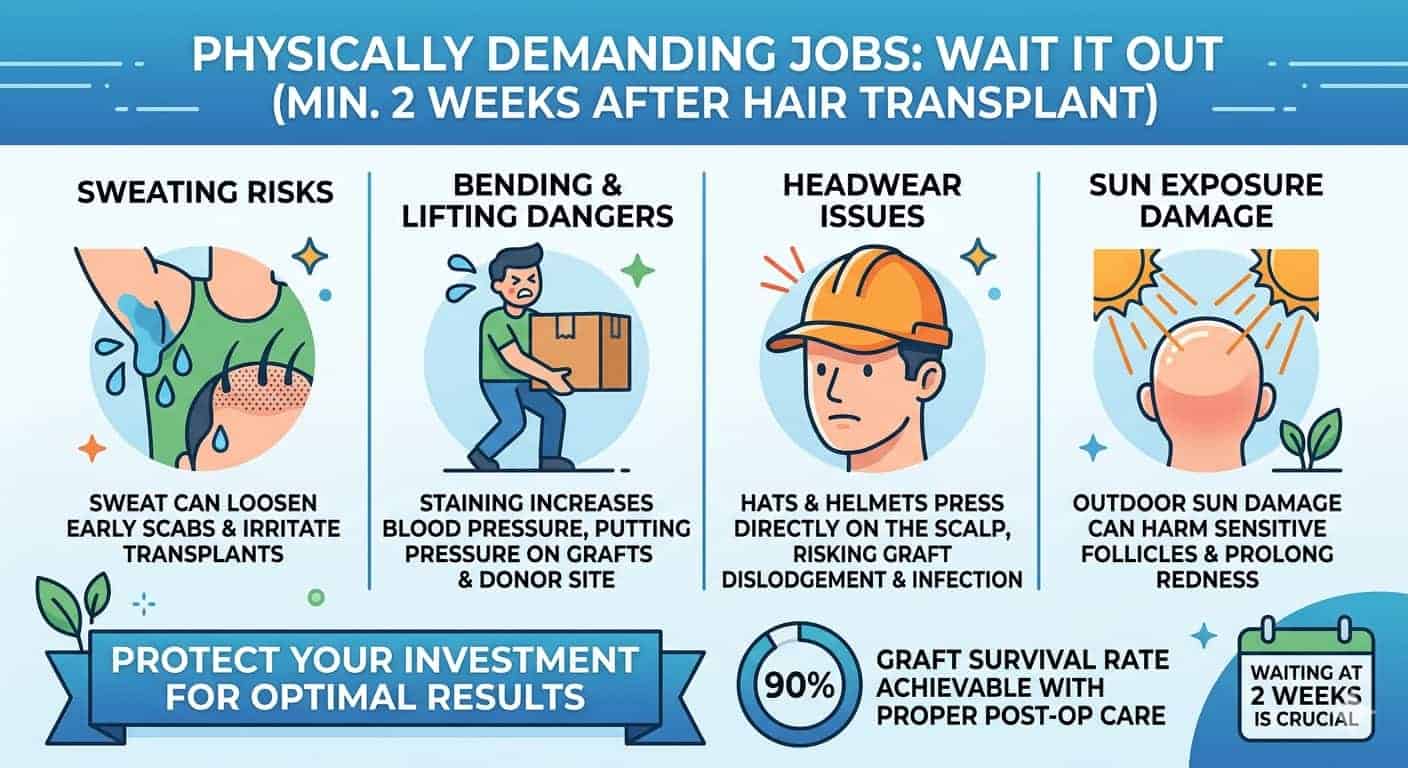
If your job involves heavy lifting, bending over repeatedly, contact sports, or heavy sweating, plan on a longer break (commonly two full weeks) before returning at full intensity. Increased blood pressure and pressure on the scalp from bending or straining can dislodge grafts in the first days after surgery, and grafts are still not fully secure at the one-week mark.
- Sweating can loosen early-stage scabs and irritate the transplanted area.
- Bending, lifting, and straining can increase blood pressure and put pressure on grafts in the donor area and recipient site.
- Hats and helmets press directly on the scalp, risking graft dislodgement and increasing infection risk.
- Outdoor sun exposure without protection can cause damage to the sensitive newly implanted follicles, prolonging redness and potentially affecting graft survival.
It might feel frustrating to take that much time off, but the reality is that protecting those first two weeks is protecting your investment. A graft survival rate of approximately 90% is achievable with proper post-operative care, and physical stress in those early days is one of the most common reasons patients see less than optimal results.
Common concerns, addressed
Visible redness or scabbing
Redness in the recipient area and small scabs around each graft are a normal, expected part of healing — not a sign anything went wrong. Scabs typically loosen and shed on their own within a week to ten days; picking at them is discouraged, since it risks dislodging a graft underneath.
Shaving
If your transplant required shaving the donor or recipient area, that hair typically grows back to a length that blends in within one to two weeks, depending on how short it started. Non-shave and long-hair techniques avoid this concern almost entirely, since existing hair can be styled to cover the treated area from the first days.
Commuting
Public transport and taxis are generally fine once you’re cleared to leave the hotel or home, but avoid anything that puts pressure on the back of your head — a headrest on a long flight or a tightly packed BTS car at rush hour, for instance. Walking is usually the gentlest option in the first few days.
What About Hiding the Visible Signs?
Let’s be real: even when you are physically ready to go back to work, the visible signs of having had a hair transplant might still be there, and not everyone wants to explain themselves to coworkers.
Here are a few practical tips:
- Scabs typically clear up naturally between days 7 and 14. Taking a week and a half off often means returning with a scalp that looks relatively normal.
- Redness can linger a little longer but can often be minimized with tinted moisturizer or careful styling.
- A loose-fitting hat can be worn after about 10 days post-procedure, which is useful for more casual work environments. Avoid tight caps or anything that puts direct pressure on the scalp.
- Short hair beforehand can make the difference between your procedure being obvious and barely noticeable.
The key is not rushing back just to prove a point. Taking a week off allows you to heal in private and return looking and feeling more like yourself.
Hair Transplant Recovery Timeline
Work is just one piece of the bigger picture. Here is what the broader recovery and growth timeline typically looks like so you know what to plan around:
| Timeframe | What to Expect |
|---|---|
| Days 1 to 3 | Swelling, redness, scab formation |
| Days 5 to 7 | Redness and swelling begin to subside |
| Days 7 to 14 | Scabs fall off naturally, scalp looks cleaner |
| 1 month | Transplanted hair may shed (this is normal, called “shock loss”) |
| 3 to 4 months | New hair growth begins, approximately 40 to 50% visible results |
| 6 months | Around 50% visible results, hair texture improving |
| 9 months | Significant growth, hairline taking proper shape |
| 12 months | 80 to 90% of final result visible |
| 12 to 24 months | Full final results |
Shock loss, where the transplanted hair sheds before it regrows, is a completely normal and temporary part of the process. It can be alarming if you are not prepared for it, but it is simply part of the hair growth cycle resetting itself.
Planning Your Return to Work
Before you schedule your procedure, it is worth thinking through these points:
- Talk to your employer early. Most people find that giving some advance notice makes the whole process far less stressful.
- Schedule your hair transplant before a natural break. A long weekend, a quiet period at work, or a planned holiday can be an ideal buffer.
- Set up a work from home arrangement if possible for the first week, even if just part-time.
- Avoid scheduling any high-stakes meetings or presentations in the first 7 to 10 days if visible signs are a concern.
- Prepare your aftercare supplies before your procedure so you can focus entirely on healing when you get home.
- Follow your surgeon’s aftercare instructions to the letter. Washing your hair the right way, sleeping with your head elevated, and avoiding sun exposure are all non-negotiable in those first 10 days.

Why Patients Choose Dr. Top Hair Hospital
At Dr. Top Hair Hospital, we know that the question of returning to work is not just about recovery. It is about your life, your schedule, and your confidence. Our lead surgeon is an ABHRS Diplomate with over 20 years of experience in hair restoration and more than 10,000 procedures performed. Our medical team trains continuously in both Europe and Asia to ensure every treatment reflects the latest international standards.
We work with patients from over 11 countries, and we understand that planning around travel, work schedules, and recovery is a very real part of the decision. Whether you’re flying in from the UK, Australia, or anywhere across Asia, we are here to help you plan a recovery timeline that actually fits your life.
Conclusion
You do not have to put your life on hold to get a hair transplant. With the right planning, most people are back to work within a week, sometimes sooner. The key is listening to your body, following post-care instructions, and being realistic about your job demands.
Wondering if you’re a good candidate? Take our 2-minute hair assessment to find out, with no obligation and your details kept completely private. Your assessment will help you understand what may be possible for your hair and the next best step for your plan.