
As a hair restoration specialist, I’ve seen it more times than I can count — patients arriving at my clinic after a nightmare experience somewhere else, desperate to fix what a bargain procedure destroyed. The appeal of low hair transplant cost in Thailand is completely understandable. But there’s a significant difference between affordable and cheap, and opting for cheap could cost you far more than money. Before you book that suspiciously low-priced package, I need to tell you what those clinics aren’t putting in their brochures.
Key Takeaways:
- Hair transplant cost in Thailand varies wildly — reputable clinics charge fairly for good reason, while bargain prices often signal dangerous shortcuts in staffing, equipment, and technique.
- Cheap hair transplant risks are real and severe, ranging from poor graft survival and unnatural hairlines to serious infections and irreversible scarring.
- The true cost of a botched transplant almost always exceeds what you would have spent at a quality clinic from the start — revision surgery is expensive, complicated, and not always possible.
The Real Landscape of Hair Transplant Cost in Thailand
Why Thailand Attracts Hair Transplant Patients
I understand the logic completely regarding the need to undergo thorough research before selecting a clinic. Thailand has built a legitimate, world-class medical tourism industry. The country’s hospitals and clinics are genuinely competitive on a global scale, the weather is pleasant, the hospitality is exceptional, and the cost of living keeps overhead low. For many procedures — orthopedic surgeries, dental work, cosmetic procedures — Thailand delivers outstanding results at prices that make the flight worthwhile.
Hair transplants are no different in terms of the demand. Patients from Australia, Europe, the Middle East, and the United States fly in regularly because hair transplant cost in Thailand at a reputable clinic can run 60 to 70 percent cheaper than back home. A 2,000-graft FUE procedure at a well-regarded Bangkok clinic might cost between $2,500 and $4,500 USD. The same procedure in the United States or United Kingdom often runs anywhere from $8,000 to $15,000.
That gap is real, and when done correctly, traveling for a hair transplant makes complete financial sense.
Free Assessment
Not Sure How Many Grafts You Need?
Get a personalized treatment plan from Dr. Top's team. Takes 2 minutes to complete — no cost, no obligation.
Where the Price Floor Falls Apart
Here is where I need you to pay close attention. That $2,500 to $4,500 range I mentioned? That’s the reputable end. The bargain end of the Thai hair transplant market goes significantly lower — advertisements promising full procedures for $800, $1,000, or $1,200 are not uncommon, particularly targeting patients through social media, discount tourism platforms, and aggressive online ads.
The economics simply don’t work otherwise. Quality FUE requires skilled surgical staff, sterile operating environments, specialized extraction and implantation tools, microscopes for graft preparation, and significant post-operative support. None of that is cheap to provide, especially when opting for cheap treatment overseas. When the price is that low, someone — or something — is being sacrificed to make the numbers work.
The Hidden Costs Nobody Warns You About
The Technician Problem
One of the most common ways bargain clinics slash costs is by replacing qualified surgeons with minimally trained technicians for the bulk of the procedure. In an ethical clinic, a licensed physician oversees and performs the critical phases of hair transplant surgery — extraction, site creation, and implantation. In a budget operation, the surgeon may appear briefly for a consultation or a photo opportunity and then hand everything off to technicians who handle the actual work.
There are a lot of cases where the doctor isn’t the one performing the procedure. Patients assume the person making incisions is a qualified surgeon. Often, they are not, particularly if they lack the necessary expertise. And in many bargain clinics, this arrangement is standard practice rather than an exception.
Technicians without proper surgical training make predictable mistakes. Grafts are extracted at the wrong angle, damaging the follicle before it’s ever implanted. Implantation depth becomes inconsistent, leading to poor survival rates, especially if the procedure is performed by an inexperienced surgeon. The hairline design lacks the nuanced understanding of facial symmetry that takes years of formal training to develop. These are not minor errors — they are the difference between a result you’re proud of and one you spend years trying to hide.
Graft Survival Rates: The Number That Changes Everything
When evaluating hair transplant cost in Thailand, patients almost always focus on the price per graft. What they don’t ask — and what bargain clinics don’t volunteer — is what percentage of those grafts will actually survive.
In a properly executed procedure performed by an experienced team with appropriate equipment, graft survival rates should range between 90 and 95 percent. In substandard conditions, that rate can drop to 50 or 60 percent. Sometimes lower.
Think about what that means in practice. You pay for 3,000 grafts. At a quality clinic with a 93 percent survival rate, you get roughly 2,790 functioning grafts producing hair. At a budget clinic with a 55 percent survival rate, you get approximately 1,650. The visual difference between those two outcomes is enormous. And because you’ve already depleted your donor area — which is finite and cannot be regenerated — you may not have enough healthy follicles remaining for a corrective procedure.
You didn’t save money. You spent money to reduce your options permanently.
The Infrastructure You Can’t See
Sterility is not negotiable in surgery. Period. Contaminated instruments, improperly sterilized equipment, or an operating environment that doesn’t meet clinical standards can lead to infections that range from uncomfortable to genuinely dangerous.
Post-surgical scalp infections following a hair transplant can destroy grafts, cause abscess formation, and in severe cases spread systemically, which is a danger for inexperienced patients. I’ve consulted with patients who developed infections following procedures at clinics that were, to be frank, not built to perform surgery. They were built to look like they were built to perform surgery. The photos on the website showed gleaming equipment and professional-looking staff. The reality was a converted room with insufficient ventilation and instruments that raised serious questions about sterilization protocol.
Treating a serious post-transplant infection doesn’t just add medical expenses. It adds psychological and emotional cost at a time when you were supposed to be recovering and looking forward to results.

What Aftercare Actually Costs
Standard hair transplant packages at bargain clinics often advertise a price that covers the procedure and nothing else. The aftercare — the part that actually determines whether your results succeed or fail — is either absent, inadequate, or charged separately in ways that weren’t clearly disclosed.
Proper aftercare following an FUE procedure includes detailed post-op instructions, prescribed medications including antibiotics and anti-inflammatory drugs, follow-up consultations to monitor healing and graft survival, and access to the surgical team if complications arise. At a reputable clinic, this is built in.
At a budget clinic, you may receive a printed sheet and a wave goodbye. If you’re a medical tourist flying home within days, managing complications from abroad becomes an expensive and stressful ordeal. Seeking emergency care at home, consulting local dermatologists unfamiliar with your procedure, and potentially flying back to Thailand for corrections — none of that was in the original price.
The Cheap Hair Transplant Risks That Follow You Home
Unnatural Results and Design Failures
A hairline is one of the most defining features of a human face. Designing one that looks natural requires an understanding of facial proportion, the natural direction of hair growth, density gradients, and how a hairline will age over the coming decades, which an expert should know. It is an art form that sits at the intersection of aesthetics and surgical precision.
Bargain clinics frequently produce hairlines that look — and I will use the word directly — fake. Grafts placed in straight lines, hairlines positioned too low or too high for the patient’s facial structure, unnatural density distribution that creates obvious transplant patterns. These are not subtle issues. They are visible to anyone looking at you in conversation.
Correcting an unnatural hairline is one of the most complex challenges in revision hair restoration. It often requires removing misplaced grafts, an extremely delicate procedure with its own risks, and reimplanting them correctly — assuming the grafts are even viable after removal. Sometimes the damage is simply not correctable to the standard the patient deserves.
Scarring That Changes Your Options Forever
FUE, when performed correctly, is valued precisely because it leaves minimal scarring — tiny circular marks in the donor area that are essentially invisible to anyone not looking for them. When performed incorrectly, the extraction process leaves larger, irregular scars that become visible at shorter hair lengths and can significantly limit a patient’s styling options.
Beyond donor area scarring, improper implantation technique can cause trauma to the recipient scalp that results in surface scarring affecting hair texture and coverage in the very area you were trying to improve.
I want to be direct about this: cheap hair transplant risks around scarring are not minor cosmetic concerns. For many patients, scarring from a poor procedure creates a new problem on top of the original one — often one that is harder to address than natural hair loss would have been.
The Psychological Cost
This part doesn’t appear in any financial breakdown, but it matters enormously. Patients who experience a failed hair transplant don’t just lose money. They lose months of emotional anticipation. They often feel embarrassed, ashamed, and reluctant to seek help. They may avoid social situations during the difficult in-between period of poor results following their hair transplant procedure. They experience the grief of lost donor hair that cannot be recovered.
I see the full weight of this in my consultations. People come in having already been through one experience they trusted, and the burden of that broken trust makes them hesitant to believe that better results are possible. Rebuilding that confidence is part of my job, and it’s one I take seriously. But I would far rather be having a different conversation with them — one where we talk about their natural, successful results rather than repair options.
How to Identify a Reputable Clinic in Thailand
What to Look For
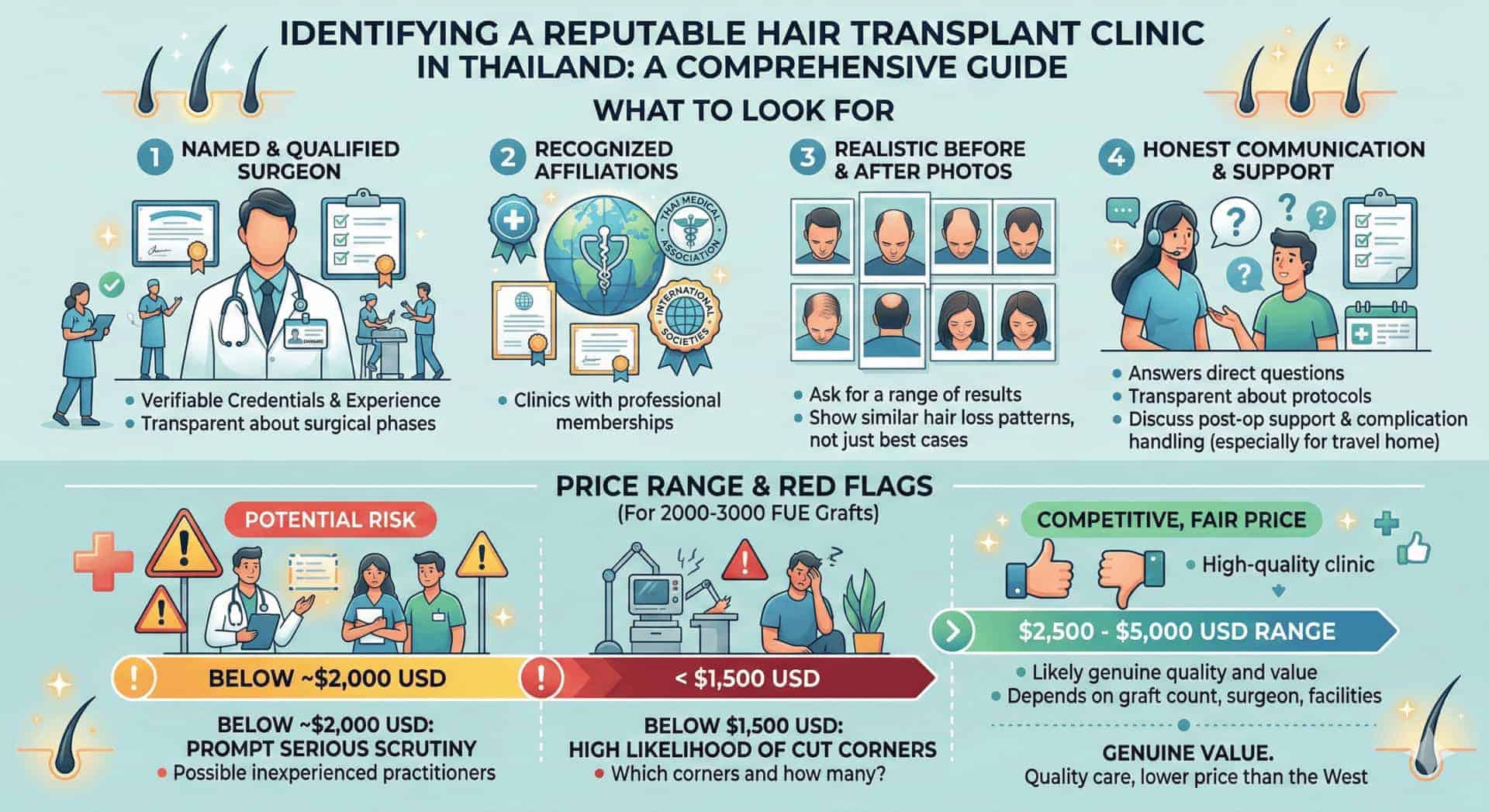
Thailand does have exceptional hair transplant clinics, and I want you to be equipped to find them. A reputable clinic will have a named, qualified surgeon whose credentials you can independently verify. They will be transparent about who performs each phase of the surgery and will answer direct questions about their protocols without deflecting.
Look for clinics affiliated with recognized medical associations, either Thai or international. Ask for before and after photographs of patients with similar hair loss patterns to yours — not just the best-case results, but typical results. A confident, ethical clinic will provide these willingly.
Ask specifically about graft survival rates, post-operative support, and what happens if complications arise after you return home. The answers to these questions tell you a great deal about how a hair transplant procedure clinic operates.
The Price Range That Should Concern You
I’m not going to tell you that the most expensive option is always the best. That’s not true, and it’s not useful advice. What I will tell you is that certain price thresholds in Thailand should prompt serious scrutiny.
For a standard FUE hair transplant involving 2,000 to 3,000 grafts, anything advertised below approximately $2,000 USD warrants very careful investigation to avoid inexperienced practitioners. Below $1,500, the question isn’t whether corners have been cut — it’s which corners and how many. A competitive, fair price from a quality Thai clinic will likely land in the $2,500 to $5,000 range depending on graft count, surgeon experience, and clinic facilities. That is still dramatically lower than equivalent care in the West, and it represents genuine value for a hair transplant procedure.
Conclusion
The patients who struggle most are rarely those who spent too much on a reputable procedure. They are the ones who spent just enough on the wrong clinic. The hidden costs of a botched transplant, the revisions, the lost donor hair, the emotional toll, almost always exceed what was saved upfront.
Your donor hair is finite. It cannot be replaced. That reality deserves a decision made with complete information, not one driven by a price tag alone.
If you want to understand what a properly performed procedure could realistically achieve for you, a short personalized assessment is the clearest place to begin. No commitment, no pressure, just an honest look at where you stand.
Wondering if you’re a good candidate? Take our free 2-minute assessment to find out — no obligation, and your details stay completely private.
Reviewed by Dr. Top, ABHRS-certified.
When you are ready to ask the right questions, we are ready to answer them honestly.