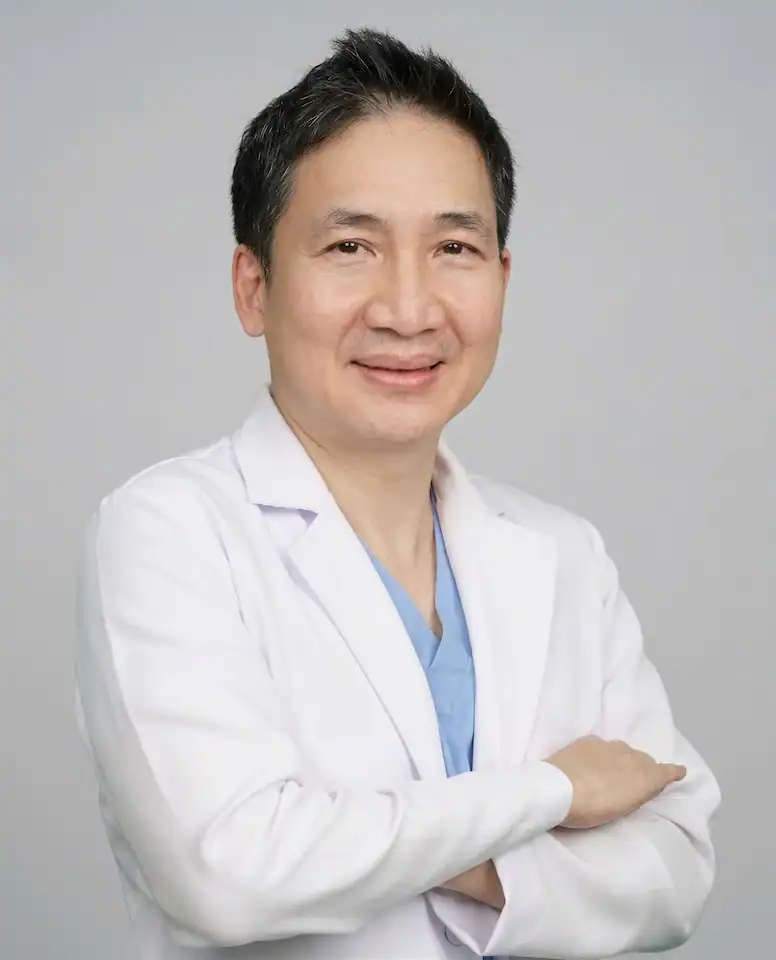

Almost every week, I get a message from someone asking me the same question: “Dr. Top, what should I choose for an Asian hair transplant in Thailand vs Turkey?” It is a fair question, and I want to give you a fair answer. If you have Asian hair, the answer matters more than you might think. This is not just about price or location. It is about whether the surgeon in front of you has actually worked with your hair type before.
Key Takeaways
- Asian hair has unique biological demands including a thicker shaft, lower follicular density, and tighter scalp tissue, making surgeon expertise and technique selection critically important for safe, lasting results.
- Thailand’s specialist-led, lower-volume clinics offer per-graft precision pricing, internationally certified surgeons, and a surgical philosophy built around long-term donor planning rather than high-volume throughput.
- Turkey’s all-inclusive packages are more affordable upfront, but for Asian patients specifically, the higher clinical risk tied to volume-focused models and limited familiarity with Asian hair types can cost far more in the long run.
Why Asian Hair Requires a Different Surgical Approach
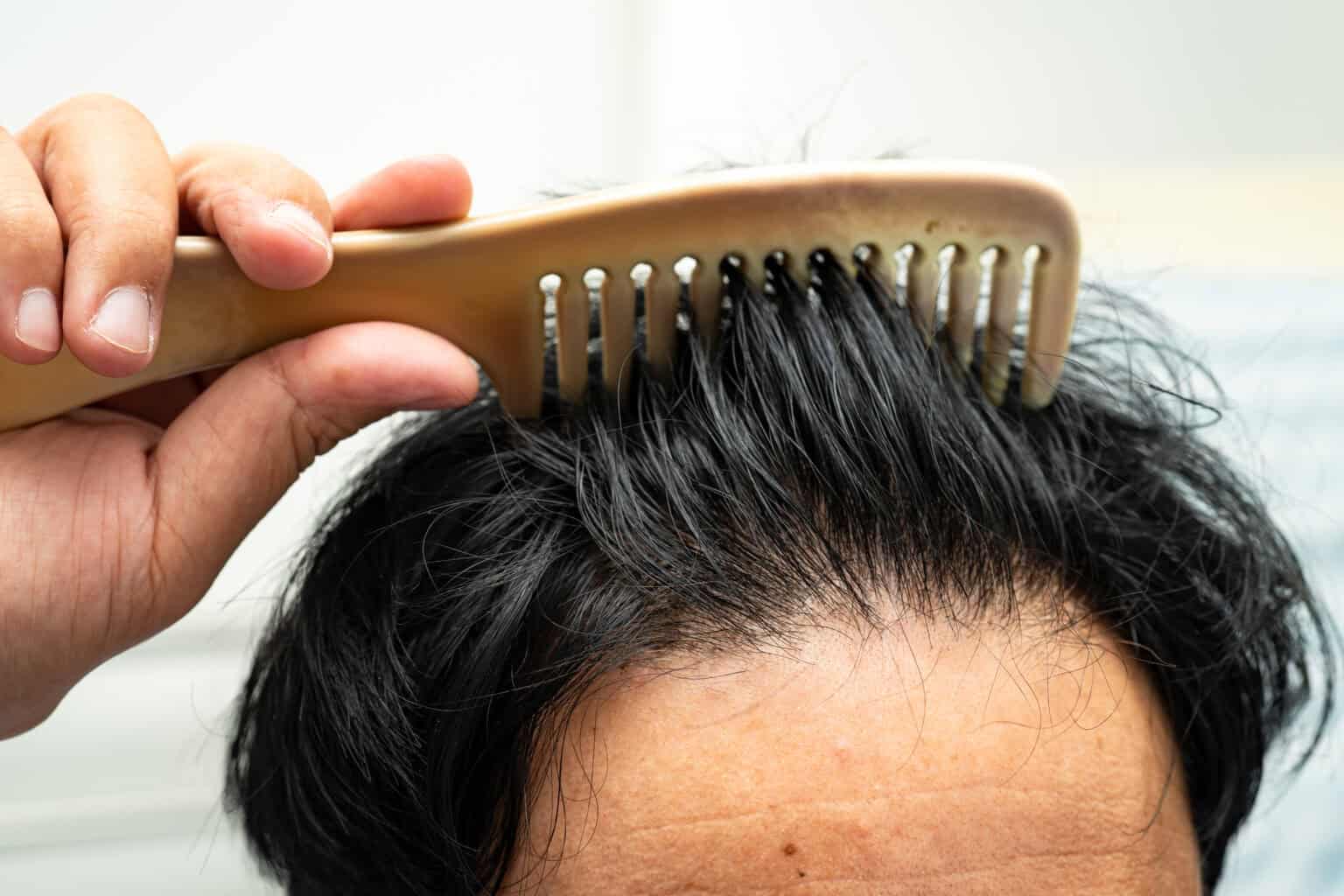
Hair loss is not a one-size-fits-all condition, and hair transplantation is not a one-size-fits-all procedure. When it comes to Asian hair specifically, the biological differences from Caucasian hair are significant enough to change every step of the surgical process.
Asian hair has a thicker shaft diameter, often reaching around 100 microns, compared to approximately 70 microns in Caucasian hair. That thickness is not a benefit during surgery. It increases the risk of transection, which is the accidental cutting of the follicle during extraction. A transected graft is permanently destroyed and cannot be replanted. Every graft lost at extraction is a loss that cannot be undone.
Asian scalps also tend to be tighter, which makes follicle harvesting more technically demanding. The follicular density in Asian scalps averages around 175 follicles per square centimeter, notably lower than the 200-plus seen in Caucasian scalps. When you start with fewer grafts available in the donor area, there is simply no room for procedural waste.
Free Assessment
Not Sure How Many Grafts You Need?
Get a personalized treatment plan from Dr. Top's team. Takes 2 minutes to complete — no cost, no obligation.
The high contrast between dark Asian hair and lighter scalp skin adds another layer of complexity. Any hairline that is off-angle, poorly spaced, or unnaturally dense becomes immediately visible. Hairline design for Asian patients is a specific surgical skill that requires direct, hands-on experience with Asian facial structure and hair growth patterns.
What Asian Hair Traits Mean for Surgery
| Asian Hair Trait | Why It Matters Surgically |
|---|---|
| Shaft diameter up to 100 microns | Increases transection risk during FUE extraction |
| Fewer follicles per cm² (approx. 175) | Demands precise graft planning; no margin for waste |
| Tighter scalp tissue | Makes harvesting more technically demanding |
| High hair-to-scalp contrast | Any angle or placement error is highly visible |
| Straight, flat growth direction | Implantation angle must mirror natural direction exactly |
Hair Transplant Cost: Thailand vs Turkey
I want to be direct about this because cost is often the first thing people compare. Hair transplant cost in Turkey is generally lower. FUE procedures there typically range from around $1,700 to $3,800, and most clinics bundle the cost into all-inclusive packages that include accommodation and airport transfers. Cost per graft in Turkey runs approximately $0.70 to $1.50.
Hair transplant cost in Thailand tends to be higher, ranging from approximately $3,500 to $7,000 for FUE, with pricing typically structured per graft rather than as a flat fee. All-inclusive packages are less standardized. The per-graft model is something I personally believe in, because it means your plan is built around what your scalp actually needs, not what fills a fixed-price session.
Here is what I tell patients who focus entirely on the upfront number: the more relevant calculation is the total cost of getting the right result. A failed or suboptimal procedure that depletes your donor area is not recoverable with a second procedure at a higher price. It may not be recoverable at all. Revision surgery is harder, more expensive, and the outcomes are less predictable.
For Asian patients where every graft is precious and the margin for error is low, the price of getting it right the first time is always worth the comparison.
Hair Transplant Cost at a Glance
| Factor | Turkey | Thailand |
|---|---|---|
| Average FUE cost | $1,700 – $3,800 | $3,500 – $7,000 |
| Approximate cost per graft | $0.70 – $1.50 | $1.50 – $5.00 |
| All-inclusive packages | Common | Less standardized |
| DHI technique available | Yes | Yes |
| Sapphire FUE available | Widely offered | Available at select clinics |
Hair Transplant Techniques: What Is Used in Thailand vs Turkey
Both countries offer FUE (Follicular Unit Extraction) and DHI (Direct Hair Implantation). Sapphire FUE is also commonly used across Turkish clinics. In Thailand, DHI has become the preferred technique at many specialist clinics for Asian patients.
DHI uses a specialized device called a Choi implanter pen to place each individual follicular unit directly into the scalp without creating pre-made incisions first. This reduces the time each graft spends outside the body, which is one of the most critical variables in graft survival. Grafts begin to deteriorate from the moment they are extracted. Minimizing that window is the entire reason I built a rotating doctor team model at Dr. Top Hair Hospital rather than relying on a single surgeon and technician assistants.
At Dr. Top Hair Hospital, I use a combination technique that merges advanced FUE extraction with DHI-style implantation and ALMI Nano Fat therapy. ALMI, or Autologous Micro-Lipoid Injection, involves processing a small amount of the patient’s own fat cells into a nano-fat solution and injecting it into the transplant area. This supports graft survival and promotes a healthier scalp environment for long-term hair growth. It is a technique I pioneered here in Bangkok, and it is not standard in most clinics, whether in Turkey or elsewhere.
The most important technical question is not which technique is listed on a clinic’s website. It is who is performing each step of the procedure. In my clinic, only qualified doctors perform every surgical step. No technicians, no exceptions. The video recording of every procedure is given to the patient, so there is no ambiguity about who did what.

Surgeon Expertise and Daily Patient Volume
Turkey has built an enormous global hair transplant tourism industry and trained a large number of hair transplant surgeons in the process. Many Istanbul clinics are well-equipped and offer genuinely skilled care. That is true, and I will not pretend otherwise. But the scale of the Turkish hair transplant market has also produced a high-volume clinical model where several patients may be treated simultaneously, with rotating technical staff handling significant portions of the extraction and implantation work.
For Caucasian hair, where the follicular structure is more forgiving during extraction, that model can still produce acceptable results. For Asian hair, where the transection risk is higher and each graft is more limited, the quality of attention at each step of the procedure carries far greater consequence.
Thailand’s hair transplant market is more selective. The clinics that specialize in hair restoration surgery here generally see fewer patients per day, which translates to more deliberate surgical planning and more time per case. Bangkok’s medical community has also had decades of direct clinical exposure to East and Southeast Asian hair types, which shapes the surgical instincts of every experienced hair transplant surgeon working here.
I personally perform one to two procedures per day. My team consists of specialist doctors with extensive hair restoration experience who rotate through each case specifically to minimize graft out-of-body time. I hold a Diplomate of the American Board of Hair Restoration Surgery (ABHRS), a certification held by approximately 300 surgeons globally and around 20 in Thailand. I am also a member of the International Society of Hair Restoration Surgery (ISHRS) and received the Best Hair Restoration Award at AMWC 2025 in Monaco. I mention these not to list credentials, but because for an Asian patient comparing clinics across countries, these are the benchmarks that matter.
Medical Tourism: Travelling to Thailand vs Turkey
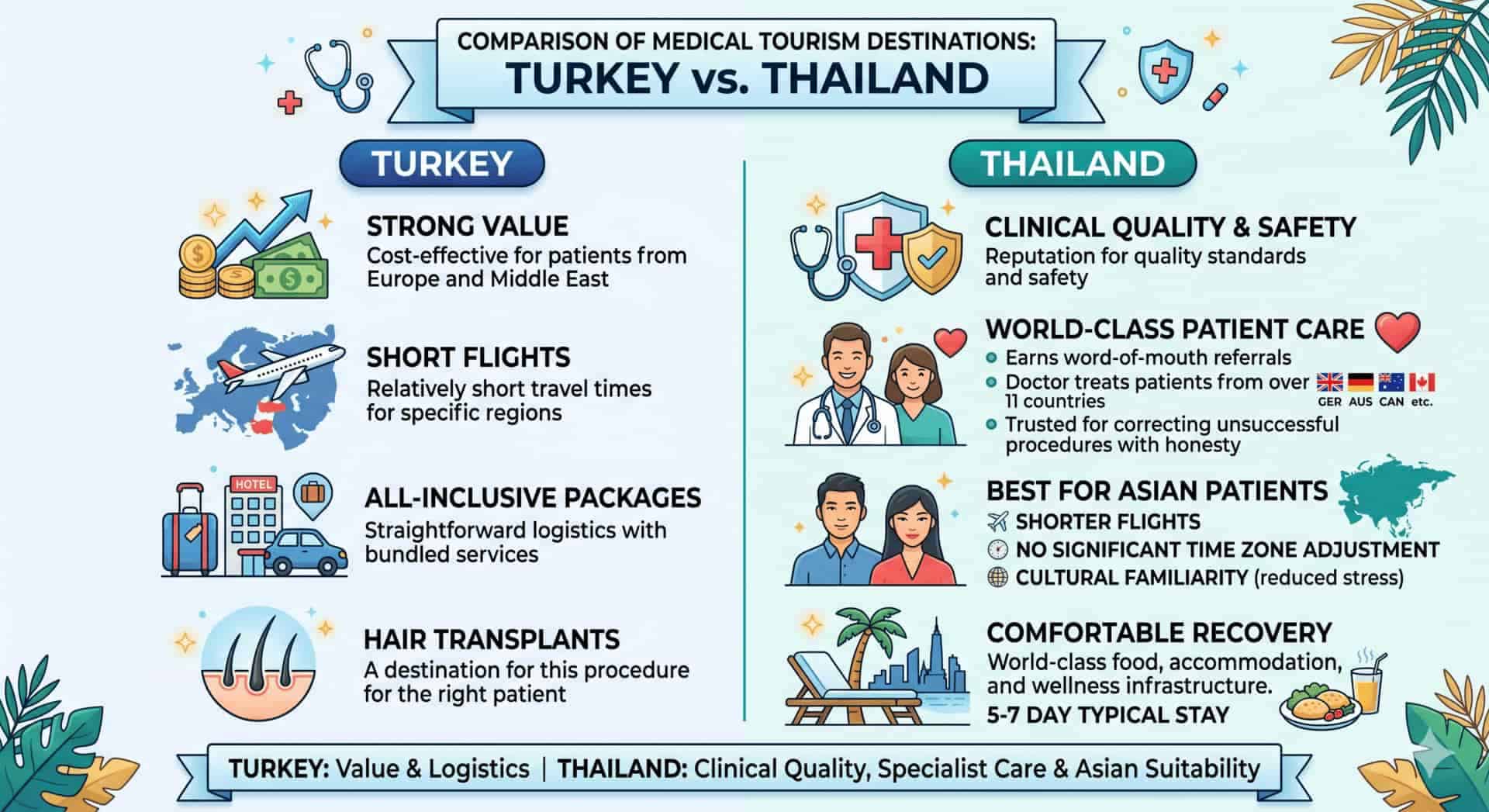
Both Thailand and Turkey are mature, well-developed medical tourism destinations with a genuine track record of serving international patients. Turkey offers strong value, especially for patients travelling from Europe or the Middle East, where it is a relatively short flight and all-inclusive packages make the logistics straightforward.
Thailand has built its medical tourism reputation on clinical quality, safety standards, and the kind of patient care that earns word-of-mouth referrals across continents. I have treated patients from over 11 countries, including the UK, Germany, Australia, New Zealand, Italy, France, Spain, India, Kenya, Canada, and across Asia. Many of them found me after an unsuccessful procedure somewhere else and were looking for a clinic that would be honest with them about what was still possible.
For Southeast Asian patients specifically, travelling to Thailand means shorter flight times, no significant time zone adjustment, and a cultural familiarity that genuinely reduces pre-procedure stress. Recovery in Bangkok is comfortable. The food, accommodation, and wellness infrastructure in this city are genuinely world-class. Most international patients plan a stay of five to seven days to cover the procedure and the critical early recovery phase before returning home.
Turkey may be the right destination for hair transplants on the right patient. But for Asian patients where the surgical demands of the procedure are specific, and the cost of an unsuccessful result is high, Thailand’s specialist-led approach offers something that price alone cannot replace.
How to Choose the Right Hair Transplant Clinic
Whether you are considering Thailand, Turkey, or anywhere else, these are the questions I believe every patient should get clear answers to before they commit to a clinic:
- Is the surgeon personally performing the entire procedure, or only the consultation and possibly the initial incisions?
- How many procedures does the lead surgeon perform each day, and is that surgeon present for the full duration of your case?
- What hair transplant technique is recommended for your specific hair type, and what is the clinical reasoning behind that recommendation?
- Does the clinic have documented experience with Asian hair transplantation, including before-and-after cases for patients with comparable hair structure and scalp density?
- What does post-operative care include, and is the clinic reachable after you return home?
- Is the procedure video-recorded, and will you receive a detailed graft count showing how many were extracted, how many were usable, and how many were implanted?
- What is the clinic’s approach if results do not meet the agreed plan, and how are revision cases handled?
A reputable clinic, whether in Thailand or Turkey, will answer every one of these questions without hesitation. If a clinic deflects, gives vague answers, or makes results sound guaranteed, that is important information.
Conclusion
If you are reading this and comparing your options, I want you to leave with one thought. The question of Thailand vs Turkey for a hair transplant is ultimately a question about what you are optimizing for. If the primary goal is the lowest upfront cost, Turkey offers packages that are hard to match. I respect that budget is a real consideration for most people.
But if you have Asian hair, and you understand that your donor follicles are a finite, non-renewable resource, then the more important question is: which option gives you the best chance of getting the right result without sacrificing the donor supply you will need for the rest of your life?
If you are weighing your options, the most useful next step is not more research. It is an honest, specific assessment of your own scalp, your donor supply, and what a realistic plan looks like for you.
A short personalized assessment takes about two minutes, carries no obligation, and gives you a clearer picture of where you stand before you commit to any clinic or country.
Wondering if you’re a good candidate? Take our free 2-minute assessment to find out — no obligation, and your details stay completely private.
Your donor supply is finite. Make the first decision count.
Reviewed by Dr. Top, ABHRS-certified, one of approximately 20 ABHRS-certified surgeons in Thailand and 300 globally. Best Hair Restoration Award recipient, AMWC Monaco 2025. Over 10,000 procedures performed across more than 20 years, with patients from over 11 countries including the UK, Germany, Australia, India, Kenya, and across Asia.