
So you’re thinking about getting a hair transplant abroad and you’ve narrowed it down to two options: Thailand or Turkey. Both countries have built strong reputations in the global hair restoration space, and both attract thousands of international patients every year. But which one is actually the right fit for you? In this guide, I’ll walk you through the key differences so you can make a clear, confident decision.
Key Takeaways
- Turkey is well-known for lower prices and high-volume hair transplant clinics, while Thailand offers a more personalized, precision-focused approach with internationally trained surgeons in a world-class medical tourism environment.
- Hair transplant costs in Turkey generally range from $1,500 to $4,000, whereas Thailand typically ranges from $3,000 to $7,000, though the value, quality of care, and long-term results can differ significantly between individual clinics.
- Choosing the right destination comes down to more than just price: surgeon credentials, technique availability, post-op support, and your own comfort matter just as much as the number on the invoice.
Why These Two Countries Keep Coming Up
When people start researching hair transplant destinations, Turkey and Thailand almost always rise to the top. And it makes sense. Both countries sit at the intersection of affordable pricing and solid medical infrastructure, making them attractive alternatives to the steep costs you’d face in the UK, Australia, or the US.
Turkey has dominated the global hair transplant conversation for well over a decade. Istanbul alone processes a significant volume of procedures annually, earning Turkey a reputation as a leading destination for hair restoration surgery. Hundreds of clinics now cater almost exclusively to international patients, and the country has developed a recognizable “hair tourism” ecosystem built around that demand.
Thailand, on the other hand, has quietly built its own impressive track record. With JCI-accredited hospitals, internationally trained surgeons, and a well-developed medical tourism infrastructure, it attracts patients looking for a more premium, boutique experience combined with one of the world’s most beloved travel destinations.
Free Assessment
Not Sure How Many Grafts You Need?
Get a personalized treatment plan from Dr. Top's team. Takes 2 minutes to complete — no cost, no obligation.
Hair Transplant Cost in Thailand vs Turkey: What You Actually Pay
Cost is almost always the first thing people ask about, so let’s get into the numbers.
| Feature | Turkey | Thailand |
|---|---|---|
| FUE Average Cost | $1,500 to $3,000 | $3,000 to $6,000 |
| DHI Average Cost | $2,125 to $3,000 | $3,500 to $6,000 |
| Cost Per Graft | $0.55 to $2.50 | $1.50 to $5.00 |
| All-Inclusive Packages | Common (hotel, transfers, aftercare) | Less standardized |
| Package Add-ons | Usually included | Often charged separately |
Hair transplant in Turkey clearly wins on paper when it comes to sticker price. Hair transplant packages in Turkey frequently include accommodation, airport transfers, and post-op care, which brings real value for international travelers. But those rock-bottom prices can sometimes reflect a trade-off in surgeon experience or personalized care, particularly at high-volume clinics where patient turnover is extremely fast.
Thailand’s hair transplant cost is higher, yes. But what that price often reflects is a more individualized approach: fewer patients per surgeon per day, more time on the table, and a medical team that isn’t rushing to the next case before yours is finished. At a clinic like Dr. Top Hair Hospital, for instance, procedures are performed by an ABHRS-certified surgeon, one of approximately 300 in the world and roughly 20 in all of Thailand, with 20+ years of experience and over 10,000 procedures completed. That kind of credential isn’t priced into a budget package.
Comparing Hair Transplant Techniques
Both Turkey and Thailand offer FUE (Follicular Unit Extraction), which is the gold standard in modern hair transplantation. However, the depth and quality of technique application can vary widely.
Techniques commonly available:
- FUE (Follicular Unit Extraction): Available in both countries; results depend heavily on surgeon skill and graft handling protocol
- DHI (Direct Hair Implantation): Offered in both countries, though more consistently available in premium Thai clinics
- Sapphire FUE: More common in Turkish clinics
- Long Hair FUE: A specialized technique allowing patients to return to normal life within approximately 24 hours post-procedure, available at select clinics in Thailand
- FUT (Follicular Unit Transplantation): Still used in some clinics in both countries, though largely being phased out in favor of FUE
One area where Thailand tends to shine is graft preservation. At Dr. Top Hair Hospital, grafts are preserved using an ATP graft preservation solution that maintains greater than 95% cell viability. This is not a universal standard, and it matters enormously for hair transplant results. A graft that isn’t properly preserved during extraction and implantation is a graft that may not survive, and that directly affects your final outcome.
Turkey has also been at the forefront of adopting newer techniques, and many Turkish clinics have invested in sapphire blades and DHI pens. But the technique is only as good as the hands performing it, which brings us to the next key factor.
Surgeons in Thailand vs Turkey: Who Is Actually Holding the Scalpel?
This is one of the most important questions you can ask, and one that doesn’t get nearly enough attention in the standard Turkey-vs-Thailand conversation.
In Turkey, the sheer volume of clinics means quality varies dramatically. Some clinics use fully qualified hair transplant surgeons; others delegate much of the procedure to medical technicians under loose supervision. Turkish clinics often run multiple procedures simultaneously, which can limit the direct surgeon involvement you receive. It’s worth asking very specifically: who will be in the room and what will they be doing?
Thailand’s top-tier clinics tend to maintain a much higher standard of direct surgeon involvement. Board-certified surgeons often personally oversee or perform key steps of the procedure, and team sizes are kept manageable. Membership in organizations like the International Society of Hair Restoration Surgery (ISHRS) is a strong indicator of a surgeon’s commitment to global best practices. When evaluating any clinic, ask specifically: will the named surgeon be physically present for my entire procedure? That single question can tell you a great deal.
Hair Transplant Results in Thailand vs Turkey
Hair transplant success rates are cited frequently, but context matters. Turkey generally reports FUE success rates between 90% and 98%, while Thailand’s top clinics report rates in the range of approximately 85% to 95% depending on the clinic’s specific protocols.
At Dr. Top Hair Hospital, the FUE graft survival rate is approximately 90%, supported by strict implantation timelines. Grafts are implanted within 6 hours of extraction, a critical window that significantly affects how many follicles survive and ultimately grow. The procedure typically runs 6 to 7 hours, with up to 5,000 grafts possible in a single Long Hair FUE session.
As for the hair growth timeline, here is what you can realistically expect after a well-performed procedure:
| Timeline | What to Expect |
|---|---|
| 4 months | Approximately 40 to 50% visible results |
| 6 months | Around 50% visible results |
| 9 months | Significant visible growth |
| 12 months | 80 to 90% of your final result |
| 12 to 24 months | Full final results |
Both countries can deliver excellent outcomes when the clinic and surgeon are the right fit. The difference is largely in consistency. Thailand’s leading clinics, especially those with internationally certified surgeons, tend to produce more predictable, natural-looking hairlines because of the precision and time invested per patient.
Safety in Thailand vs Turkey: What International Patients Should Know
Safety is non-negotiable when you’re going under any kind of medical procedure abroad. Both countries have established frameworks for medical tourism, but they differ in how consistently those standards are applied.
Turkey has strong regulatory bodies, but the massive number of hair transplant clinics means oversight isn’t uniform. Some clinics operate to the highest standards; others cut corners. Doing thorough due diligence, including reading verified patient reviews and checking surgeon credentials directly, is essential before booking.
Thailand’s medical tourism ecosystem is well-regulated overall. Many Thai hospitals and clinics serving international patients hold JCI (Joint Commission International) accreditation, the gold standard in global healthcare quality. Thailand also has a strong track record in medical tourism more broadly, with clear legal frameworks governing patient rights and clinical standards. For Dr. Top Hair Hospital specifically, the complication rate sits at approximately 2% or less, and the failure rate is approximately 5% or less, reflecting what’s possible when you combine credentialed surgical leadership with rigorous post-op support.
Tourism in Thailand vs Turkey: The Full Trip Experience
Let’s be honest: getting a hair transplant abroad is also a travel experience. The destination matters, especially if you plan to recover and spend a few days enjoying your surroundings.
Thailand offers:
- Bangkok as a world-class city with exceptional food, hospitality, and wellness infrastructure
- English widely spoken in medical and tourist settings
- Tropical beaches, temples, and cultural experiences within easy reach
- A strong reputation for warmth and patient-centered service
- Outstanding value for money outside of medical costs, including accommodation and dining
Turkey offers:
- Istanbul’s rich history and vibrant culture
- Strong flight connections from Europe and parts of Asia
- A well-established “hair tourism” ecosystem with dedicated patient coordinators
- Proximity for European travelers looking to minimize transit time
Both Thailand and Turkey are genuinely enjoyable places to visit. If you’re coming from Southeast Asia, Australia, or New Zealand, Thailand is often the easier, shorter, and more cost-effective journey overall. If you’re based in Europe, Turkey may offer more convenient direct flights and a shorter total trip.
How to Actually Decide: A Practical Framework
Here’s a straightforward way to think through the decision:
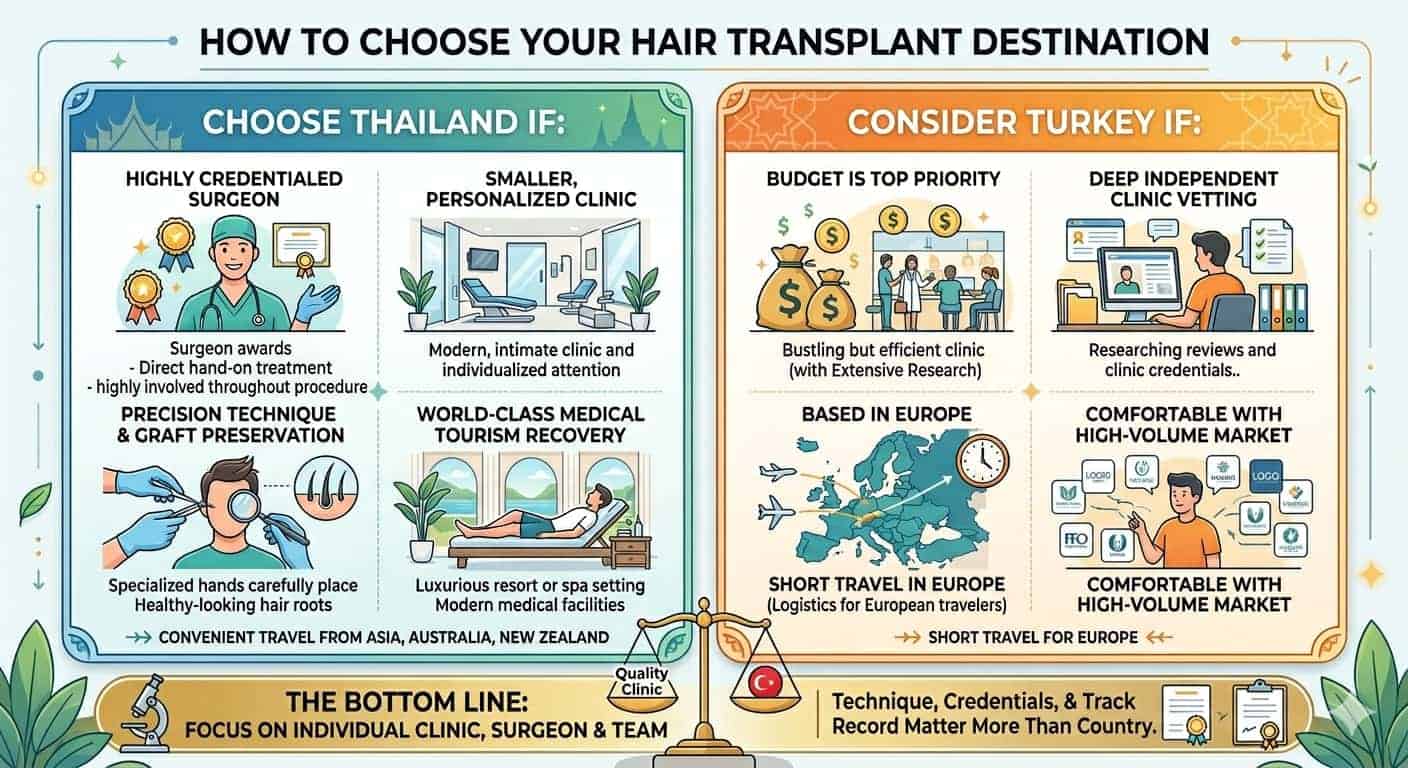
Choose Thailand if:
- You want a highly credentialed surgeon with direct involvement throughout your procedure
- You prefer a smaller, more personalized clinic environment
- You value precision technique and graft preservation protocols
- You want to recover in a genuinely world-class medical tourism destination
- You’re already traveling from Asia, Australia, or New Zealand
Consider Turkey if:
- Budget is your absolute top priority and you’re comfortable doing deep research on individual clinics
- You’re based in Europe and the flight logistics work better for you
- You’re comfortable navigating a higher-volume market and vetting clinics independently
The bottom line is that the best hair transplant destination is the one with the best surgeon and team for your specific hair type, degree of hair loss, and desired outcome. Country of origin matters far less than the individual clinic’s credentials, technique, and track record.
If you want to fully compare Thailand vs Turkey hair transplants, read our dedicated blog: Thailand vs Turkey Hair Transplant: Honest Price & Quality Comparison
Conclusion
At the end of the day, this decision isn’t really about Turkey vs. Thailand. It’s about finding a surgeon you can trust, a clinic with verifiable credentials, and a team that will take care of you before, during, and after your procedure. Both countries have clinics that meet that standard, and both have clinics that don’t. Do your research, ask the hard questions, and don’t let a low price tag be the deciding factor for something this permanent.
Wondering if you’re a good candidate for a hair transplant procedure? Take our 2-minute hair assessment to find out and get a personalized read on your situation. No obligation, and your details stay completely private.