

If you are asking, How Long Does a Hair Transplant Take? What to Expect on the Day, you are not alone. One of the most common concerns I hear is not just about results, but about the actual hair transplant duration on procedure day. The good news is that the process is usually straightforward, well-planned, and easier to manage when you know what each stage looks like.
Key Takeaways
- Most hair transplant procedures take about 6 to 7 hours, though smaller sessions may take around 4 hours and larger cases can take up to 8 hours.
- You stay awake during the procedure with local anesthesia, and most of the day is spent on graft extraction and implantation.
- The exact timeline depends on the number of grafts, the technique used, and your hair restoration goals.
How long does a hair transplant take?

In most cases, a hair transplant takes about 6 to 7 hours from start to finish. Smaller procedures may take closer to 4 hours, while larger sessions can take up to 8 hours to complete, especially when a higher number of grafts is involved.
That range can sound broad, but it makes sense once you understand what happens during the day. A hair transplant is a detailed procedure, not a rushed one. The surgeon and medical team need enough time to remove healthy hair follicles, preserve them properly, and implant them with precision for natural-looking results.
At Dr. Top Hair Hospital in Thailand, the typical procedure duration is around 6 to 7 hours. The goal is not simply speed. It is balancing efficiency, graft care, and careful placement so the transplanted hair has the best chance to grow well.
Free Assessment
Not Sure How Many Grafts You Need?
Get a personalized treatment plan from Dr. Top's team. Takes 2 minutes to complete — no cost, no obligation.
What affects hair transplant duration?
The biggest factor is the number of grafts needed. If the area of hair loss is small and the hairline work is limited, the transplant usually takes less time. If there is more thinning hair to cover, or if a fuller head of hair is the goal, the procedure naturally takes longer.
A few key factors shape the timeline:
- Number of grafts needed
- Size of the recipient area
- Hair density goals
- Donor area quality
- Whether the procedure is FUE or FUT
- The experience of the surgeon and medical team
Here is a simple breakdown:
| Factor | How it affects the timeline |
|---|---|
| Number of grafts | More grafts usually mean a longer procedure |
| Technique used | FUE often takes longer than FUT |
| Density goals | Higher density requires more careful implantation |
| Donor area | Easier access to healthy follicles can speed things up |
| Hairline design | Detailed hairline work can add time |
Hair transplant procedure timeline on the day
When people ask about hair transplant duration, they usually want to know what actually fills those hours. The day is normally divided into a few main stages, and each one plays an important role in the final result.
Consultation and design
The day usually begins with a final consultation and treatment review. This is when the surgeon confirms the plan, examines the scalp, checks the donor area, and marks the hairline or thinning areas to be treated.
This part is important because even if you have already had a consultation, the treatment design still needs to be finalized on the day itself. If the goal is natural-looking hair restoration, careful planning comes first.
Local anesthesia
Before the transplant begins, local anesthesia is used to numb the donor area and the recipient area. You remain awake during the procedure, but the scalp becomes numb so the surgery is much more comfortable.
Most patients are relieved to learn they do not need general anesthesia. You can usually talk to the team, listen to music, rest, or watch something while the procedure is underway.
Graft extraction
This stage often takes a large portion of the day. In an FUE hair transplant, the surgeon removes individual hair follicles from the back or sides of the scalp. Because each graft is removed carefully, this takes time.
In FUT, or follicular unit transplantation, a strip of scalp is removed from the back of your head, and the grafts are then separated under magnification. This can sometimes be quicker for larger sessions, but it does leave a linear scar.
Graft preparation
Once the grafts are removed, they are sorted and prepared before implantation. This step is less visible to the patient, but it matters a lot. The quality of graft handling can affect survival and hair growth later on.
At Dr. Top Hair Hospital, graft preservation is treated as a critical part of the procedure. The clinic notes a typical procedure duration of 6 to 7 hours and a critical implant window within 6 hours of extraction, which is why workflow and team coordination matter so much.
Implantation
After preparation, the grafts are implanted into the recipient area. This phase also takes several hours because each graft must be placed at the right angle, direction, and depth.
This is where artistry meets surgical technique. A natural-looking hairline, soft density transitions, and even placement across thinning areas all depend on careful implantation, not speed.
FUE vs FUT and how long each transplant takes
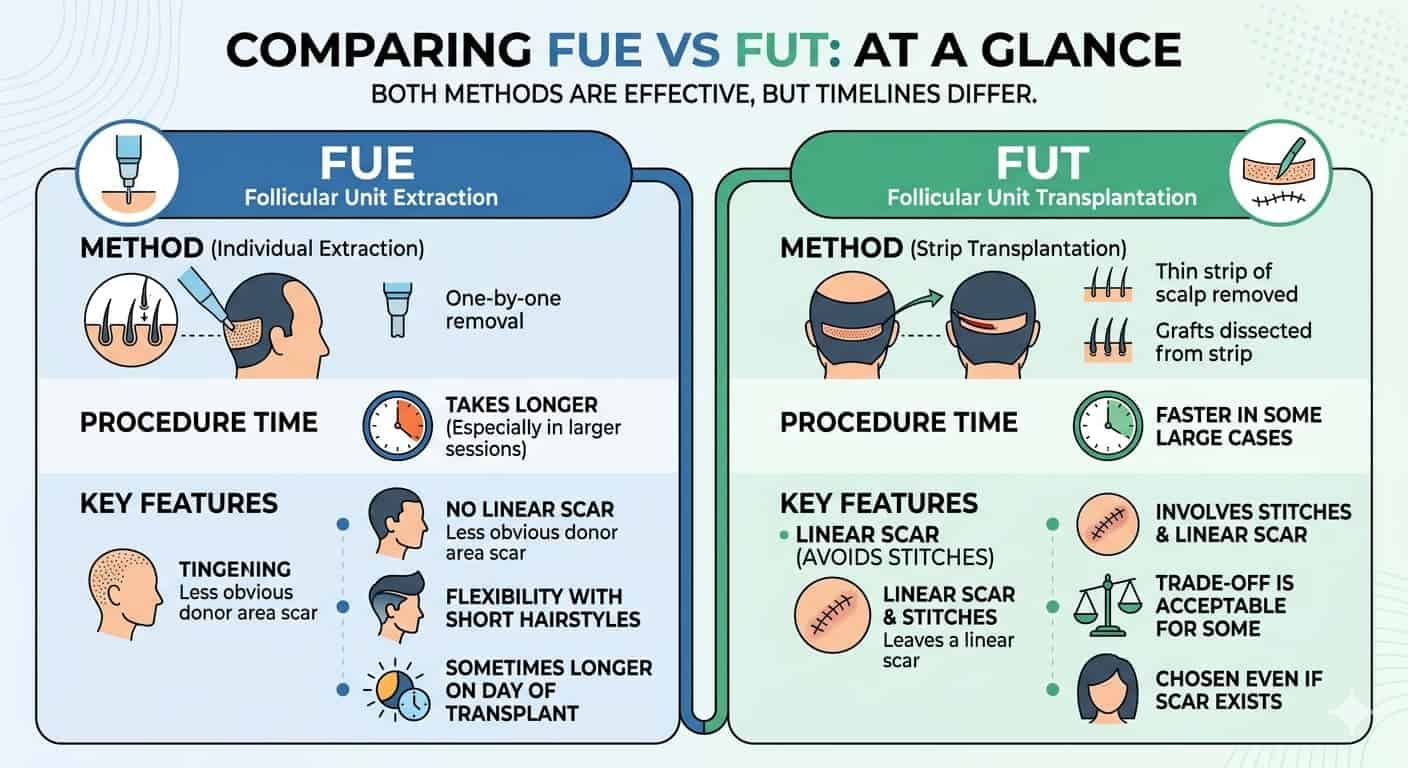
Both methods can be effective, but the timeline can differ.
FUE
FUE stands for follicular unit extraction. In this method, individual hair follicles are removed one by one from the donor area. Because of that, FUE can take longer, especially in larger sessions.
Patients often choose FUE because it does not involve removing a strip of skin and usually avoids a long linear scar. It is commonly used for patients who want flexibility with shorter hairstyles or a less obvious donor area scar.
FUT
FUT stands for follicular unit transplantation. In this technique, a thin strip of scalp is removed from the back of the head, and grafts are dissected from that strip.
FUT may be faster in some larger cases, but it involves stitches and a linear scar. For some patients, that trade-off is acceptable. For others, FUE is the better fit even if the hair transplant takes longer on the day.
What to expect during the day
Knowing what the day feels like is often just as helpful as knowing the timeline. Most patients do not spend the day in pain. They spend the day being still, taking breaks, and moving through each stage of the procedure.
Here is what to expect in practical terms:
- You arrive in the morning for preparation and review
- Your scalp is cleaned and numbed with local anesthesia
- The donor hair is removed
- The grafts are prepared
- The grafts are implanted into the scalp
- You receive aftercare instructions before going home
Because you remain awake, comfort matters. Most clinics allow breaks for stretching, water, snacks, or lunch depending on the session length. If your procedure takes 6 to 7 hours, those breaks help the day feel more manageable.
Is a hair transplant painful?
This is one of the biggest worries before hair transplant surgery. In most cases, the uncomfortable part is the local anesthesia at the beginning. After that, the scalp is numb, and the procedure becomes much easier to tolerate.
At Dr. Top Hair Hospital, patient-reported pain is approximately 2 out of 10. That does not mean there is zero discomfort, but it does tell you that most patients find the surgery much more manageable than expected.
You should expect to remain awake, but not to suffer through the day. The experience is usually more about patience than pain.
Hair transplant recovery after the procedure day
Although the main focus here is hair transplant duration on the day itself, it helps to know what happens right after. Once the surgery is over, recovery begins immediately, even if the first stage is relatively simple.
The scalp may feel tender, tight, or slightly swollen. Tiny scabs form around the transplanted hair, and the donor area needs gentle care. If you have had FUE, many patients are able to get back to normal life quickly. Dr. Top Hair Hospital notes that patients who undergo Long Hair FUE typically return to normal life within 24 hours.
What happens after that is a longer timeline:
| Time after surgery | What to expect |
|---|---|
| 2 to 4 weeks | Transplanted hair may shed |
| 4 months | About 40 to 50% visible results |
| 6 months | Around 50% visible results |
| 9 months | Significant growth |
| 12 months | About 80 to 90% of final result |
| 12 to 24 months | Full final results |
This is worth remembering because some patients mistake shedding for failure. In reality, shedding is a normal part of the hair growth cycle after transplant. New hair growth takes time.
How to prepare for your transplant day
A smoother day often starts with simple preparation. If you know your procedure may take most of the day, plan around comfort and convenience.
A few practical tips can help:
- Wear a button-up or zip-up top
- Eat a good meal before arriving, unless told otherwise
- Avoid smoking if your surgeon advises it
- Follow all medication instructions from the clinic
- Bring something to listen to or watch
- Arrange your ride home in advance
If you are traveling to Thailand for treatment, give yourself enough time before and after the procedure so you are not rushed. International patients often do better when they build in some breathing room rather than trying to fit surgery into a tight travel schedule.
Why choosing the right clinic matters

Hair transplant duration is not just about how long you are in the chair. It is also about how well the clinic manages each step. Efficient timing, careful graft handling, and experienced implantation all affect the outcome.
Dr. Top Hair Hospital positions itself as a leading hair transplant center in Thailand, serving both local and international patients. According to the clinic’s verified first-party data, the team includes around 20 medical professionals across 7 Bangkok locations, with more than 10,000 procedures performed and over 20 years of experience in hair restoration.
The clinic also reports approximately 300+ hair transplant procedures annually, a typical procedure duration of 6 to 7 hours, an approximate FUE graft survival rate of 90%, and an approximate complication rate of 2% or less. Those details matter because a well-run team can make a long procedure feel more organized, more comfortable, and more predictable.
Conclusion
Hair transplant duration is usually easier to handle once you know what the day actually involves. In most cases, the procedure takes about 6 to 7 hours, you remain awake under local anesthesia, and the time is divided between planning, extraction, graft preparation, and implantation. When the process is explained clearly, the day feels much less intimidating.
Wondering if you are a good candidate? Take our 2-minute assessment to find out, with no obligation and complete privacy for your details. It is a simple way to see what may be possible for your hair before taking the next step.