

There is no single best age for a hair transplant. Age is one piece of a bigger picture. The better question is whether your hair loss has been properly diagnosed, how it is likely to progress, whether your donor area can support the plan, and whether your expectations match what surgery can offer. A clinician reaches that view by examining you, not by checking your age against a chart.
Younger and older adults can both be assessed. What changes with age is how much is known about the pattern of loss and how much donor hair remains, and both vary from person to person. Think of age as a prompt for questions, not an answer to them. The questions below are the ones worth taking to an assessment.
Key Takeaways
- The best age for a hair transplant is typically between 25 and 50, when hair loss pattern has stabilized and donor hair quality remains strong
- Younger patients under 25 face higher risks of unnatural results as progressive hair loss may continue after surgery
- There is no strict upper age limit for hair transplantation as long as you have good health and adequate donor hair
What Is the Best Age for a Hair Transplant?

If you’re experiencing thinning hair or balding, you’ve probably searched for the best age hair transplant procedures work best. The truth is, timing matters just as much as technique when it comes to hair restoration success.
After performing over 10,000 hair transplant procedures at Dr. Top Hair Hospital in Thailand, our team has observed clear patterns about when patients achieve their most satisfying results. The ideal age for a hair transplant isn’t about reaching a specific number. It’s about understanding your hair loss progression, donor hair quality, and whether your balding has stabilized.
Free Assessment
Not Sure How Many Grafts You Need?
Get a personalized treatment plan from Dr. Top's team. Takes 2 minutes to complete — no cost, no obligation.
Generally, individuals in their late 20s to early 40s make the strongest candidates for hair transplantation. By this age range, most people have developed a predictable pattern of hair loss, which allows our surgeons to plan strategically for long-term outcomes.
Why Age Matters for Hair Transplant Success
Age affects hair transplant outcomes in three critical ways:
| Factor | Younger Patients (Under 25) | Ideal Age Range (25-50) | Older Patients (50+) |
|---|---|---|---|
| Hair Loss Pattern | Often still progressing | Typically stabilized | Stable but may have limited donor hair |
| Donor Hair Quality | Usually excellent | Strong and plentiful | May be reduced but often sufficient |
| Future Hair Loss Risk | High – may need additional procedures | Moderate – better predictability | Lower – pattern largely established |
| Recovery Speed | Faster | Good | Slower but still effective |
The data shows that 87.3% of hair transplant patients are men aged between 25–50, with men 30–39 representing the most common age group at 29.3%. This isn’t coincidence. It reflects the sweet spot where hair loss has progressed enough to be predictable but hasn’t depleted your donor area yet.
Understanding Hair Loss Progression Before Surgery
Before considering hair transplant surgery, you need to understand your cause of hair loss and whether it has stabilized. Androgenic alopecia, also known as male pattern baldness, is progressive and continues throughout your life if left untreated.
The Problem with Surgery Too Early
Getting a hair transplant in your early 20s or late teens carries significant risks. Here’s why surgeons typically recommend waiting:
- Unpredictable hair loss pattern: Younger patients often haven’t reached their final balding pattern, making it difficult to design a hairline that will look natural decades later
- Continued progressive hair loss: Even after transplant, you’ll continue losing existing hair around the transplanted grafts, potentially creating an unnatural island of hair
- Limited donor hair reserves: Using donor hair too early may leave you without enough follicles for future procedures as balding advances
- Need for multiple procedures: Approximately 30–40% of patients undergo a second treatment to enhance density or address continued hair loss
According to the International Society of Hair Restoration Surgery (ISHRS), 95% of first-time hair restoration surgery patients in 2024 initiated treatment between ages 20-35, with surgeons increasingly seeing younger adults. However, this trend doesn’t mean everyone should rush into surgery immediately.
When Hair Loss Has Stabilized
The right time for a hair transplant is when your hair loss has stabilized. This typically occurs around age 25 for most men with androgenetic alopecia. At this point:
- Your pattern of hair loss becomes more predictable
- You can more accurately estimate future balding areas
- Medical treatment with finasteride and minoxidil has had time to show effectiveness
- You’ve developed the emotional maturity for realistic expectations
At Dr. Top Hair Hospital, we’ve successfully treated patients aged 19 to 80, but we always carefully evaluate whether younger patients truly need immediate intervention versus waiting.
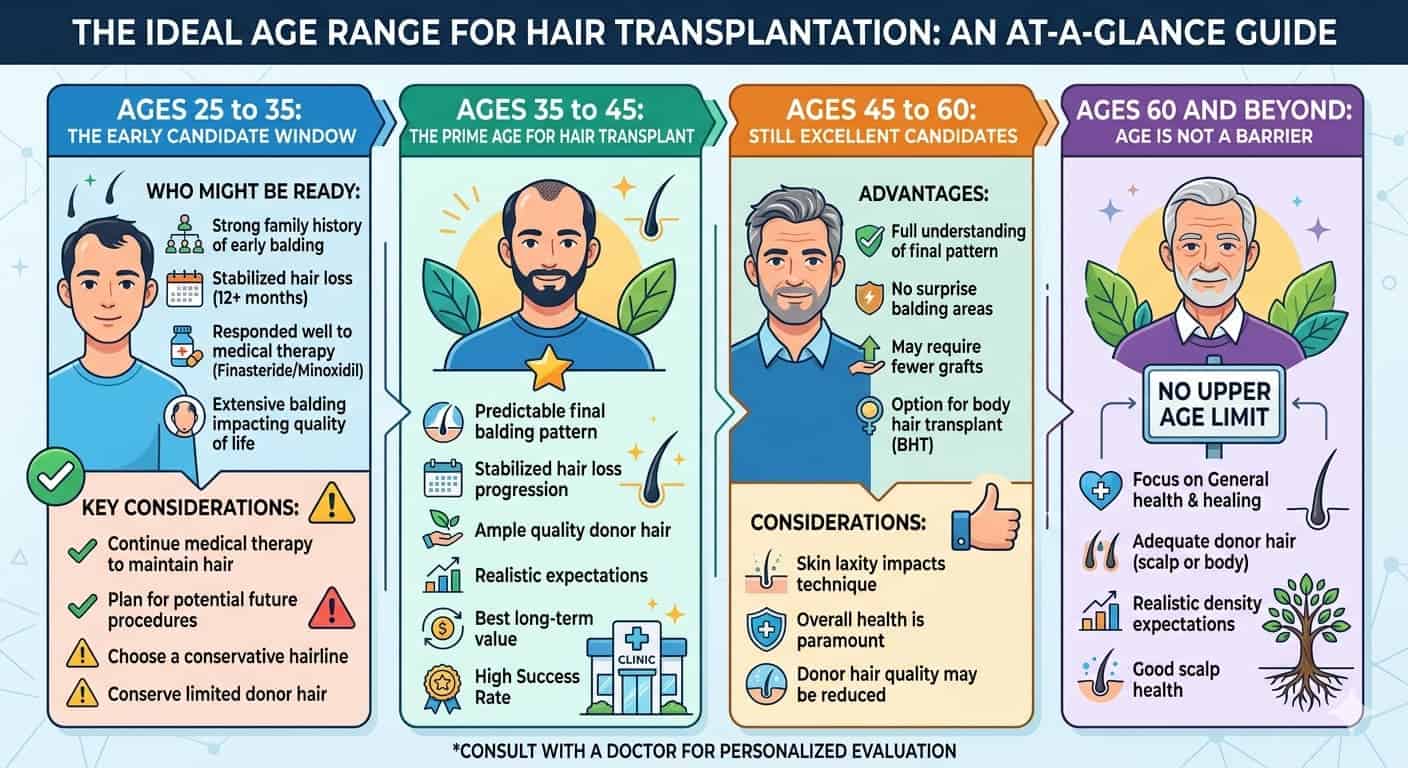
The Ideal Age Range for Hair Transplantation
Ages 25 to 35: The Early Candidate Window
This age range represents an important decision point for younger patients experiencing significant hair loss. While 25 is considered the minimum age for a hair transplant operation by most experts, each case requires individual evaluation.
Who might be ready:
- Men with strong family history of early balding (father/brothers bald by age 25)
- Patients whose hair loss has clearly stabilized for 12+ months
- Those who’ve tried finasteride and minoxidil with good response (~70% of patients respond)
- Individuals with extensive balding that significantly impacts quality of life
Important considerations:
- You’ll likely need medical therapy to maintain non-transplanted hair
- Plan for potential future procedures as you age
- Choose a conservative hairline that will age naturally
- Understand that donor hair is limited and must be conserved strategically
Ages 35 to 45: The Prime Age for Hair Transplant
Many surgeons consider this the best age to get a hair transplant. Here’s why:
- Predictable pattern: Your male pattern baldness has usually reached its Norwood scale stage, making planning straightforward
- Stable hair loss: Progression of hair loss has typically slowed significantly
- Ample donor hair: Your donor area still has sufficient follicles for good density
- Medical maturity: You understand the procedure and have realistic expectations
- Best value: One well-planned procedure often provides decades of satisfaction
At our Bangkok clinic, we perform approximately 300+ hair transplant procedures annually, with the majority falling in this age range. Our FUE graft survival rate of ~90% reflects the importance of patient selection and proper timing.
Ages 45 to 60: Still Excellent Candidates
You’re definitely not old for a hair transplant in your 40s or 50s. Many people successfully undergo hair transplants in their 40s, 50s, or 60s with outstanding results.
Advantages at this age:
- Complete understanding of your final hair loss pattern
- No surprise future balding areas
- Often requires fewer grafts than younger patients
- Can combine with body hair transplantation if needed
Considerations:
- Skin laxity may affect technique selection
- Overall health becomes more important than chronological age
- Donor hair quality may be slightly reduced but typically adequate
Ages 60 and Beyond: Age Is Not a Barrier
There is no applicable maximum age for a hair transplant as long as your body can promote hair growth. We’ve treated patients up to age 80 successfully at Dr. Top Hair Hospital.
What matters most:
- General health and ability to heal
- Availability of donor hair (scalp or body)
- Realistic expectations about density
- Good scalp health without active dermatitis
An academic study suggests that the ability to benefit from hair transplantation is not limited by age but by the body’s ability to regenerate. If you’re healthy with adequate donor hair, age 60, 70, or even older can still be the right age for a hair transplant.
Factors That Matter More Than Age Alone
While age for hair transplants is important, these factors often determine success more than your chronological age:
These are the points I would bring to a consultation. A clinician can answer them for you. A general article cannot.
Health and scalp:
Is there anything about my general health, medicines or scalp that affects planning? Tell the clinician everything, even if it seems unrelated.
Diagnosis:
What is causing my hair loss? Different causes behave differently, and a plan depends on knowing which one applies. A diagnosis needs an examination.
Progression:
Is my hair loss still changing, and how might it progress? Ask how the clinician judges this and what it means for planning a hairline that still makes sense in future.
Donor assessment:
Is my donor area suitable for this plan? Ask how it is assessed, what it can realistically supply, and how future needs would be considered.
Expectations:
What can surgery realistically achieve for me, and what is uncertain? Ask what results look like for your hair type and loss pattern, how long they take to appear, and what happens if hair loss continues.
Special Considerations for Younger Patients
If you’re in your early 20s or late teens experiencing hair loss, you might feel frustrated waiting. Here’s what to consider:
When Immediate Intervention Might Be Necessary
While we typically recommend waiting until age 25, exceptions exist:
- Traumatic hair loss: Accidents, scarring, or burns causing localized baldness
- Alopecia areata: Stable patches that aren’t progressive pattern baldness
- Extreme psychological impact: Severe depression or social withdrawal from appearance
- Rapid progression: Obvious balding within 6-12 months with strong family history
Even in these cases, we combine surgery with aggressive medical therapy including finasteride and minoxidil to protect existing hair.
Strategies for Younger Candidates Who Proceed
If you and your surgeon decide to proceed before age 25:
- Conservative hairline design: Place it higher than you want to accommodate future recession
- Focus on central crown: Prioritize areas that will look most obvious
- Commit to medication: Non-negotiable for preserving non-transplanted hair
- Plan financially: Budget for possible second procedure in 5-10 years
- Choose experienced surgeon: Look for ABHRS certification and 10,000+ procedures performed
Our ABHRS certified surgeon is 1 of approximately 300 globally and ~20 in Thailand, ensuring world-class expertise.
Why Thailand Offers Excellent Hair Transplant Value
Many international patients choose Thailand for their hair transplantation, and for good reason. Dr. Top Hair Hospital represents the best of Thai medical excellence:
- Globally recognized credentials: ABHRS Diplomate, winner of Best Hair Restoration at AMWC 2025 Monaco
- International standards: Team completes continuous training in Europe and Asia
- Experienced team: ~20 medical professionals across 7 Bangkok locations
- Proven results: 90% graft survival rate, ~2% complication rate or less
- Global patients: Successfully treated patients from 11+ countries including UK, Germany, Australia, Canada
When you’re ready, here’s what a hair transplant costs in Thailand.
Common Mistakes When Choosing Timing
Avoid these pitfalls when deciding your age to get a hair transplant:
- Waiting too long: Advanced baldness may exceed available donor hair
- Rushing too early: Unstable hair loss leads to unnatural results
- Ignoring family history: Your genetic pattern predicts your future
- Skipping medical trial: Not testing finasteride/minoxidil first
- Chasing lowest price: Poor quality clinics cause permanent damage
- Ignoring donor limitations: Using too many grafts too early
Treatment failure typically results from poor-quality clinics, improper graft handling, or unregulated practices. Our complication rate remains ~2% or less through strict protocols.
Conclusion
Determining the best age hair transplant procedures deliver lasting results requires personalized evaluation. At Dr. Top Hair Hospital in Bangkok, Thailand, our ABHRS certified surgeon has performed 10,000+ procedures with ~90% graft survival. Whether you’re 25 or 65, the right age for a hair transplant is when your hair loss pattern is predictable and your donor hair is sufficient. Don’t guess. Get expert assessment.
Wondering if you’re a good candidate? Take our free 2-minute assessment to find out — no obligation, and your details stay completely private. Reviewed by Dr. Top, ABHRS-certified with 10,000+ procedures and patients from 11+ countries.