Pillar One

The 6-Hour Rule

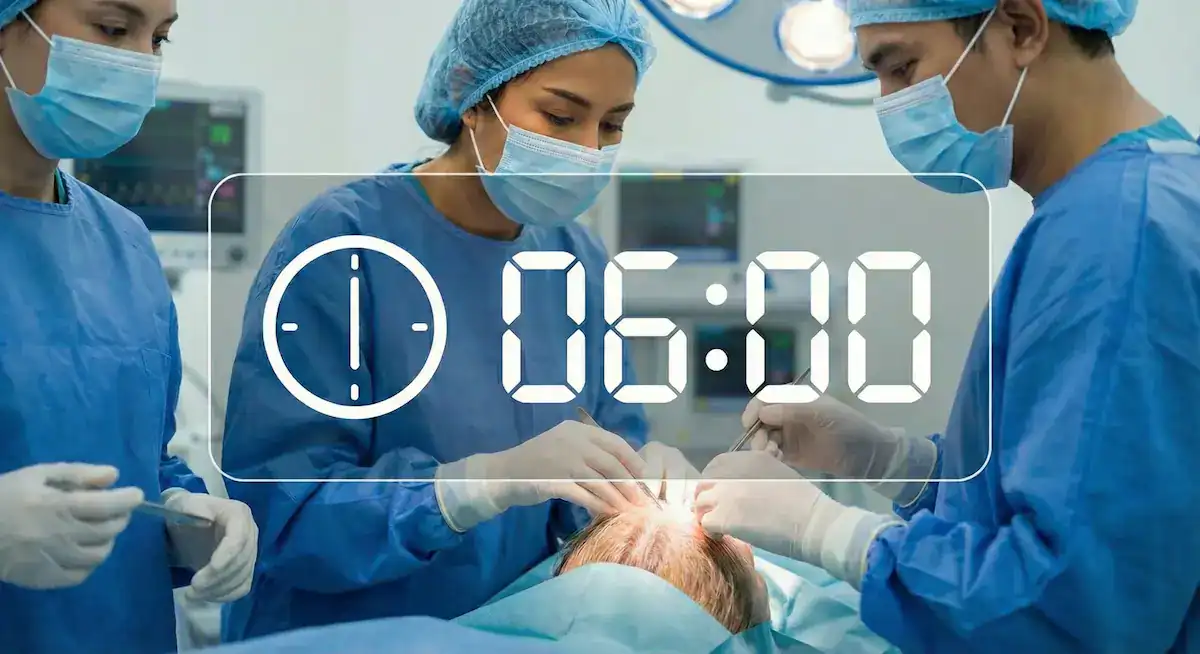
The question almost no patient asks, but should, is how long their procedure will take. The answer reveals how much a clinic values graft survival. At Dr. Top, no session exceeds about six hours.
6 hour rule
6 Hours
The session cap we hold.
4 Hours
The out-of-body window per graft.
100%
Surgeon-performed, start to finish.
The science

What happens to a graft outside the body
A hair graft is living tissue. From the moment it leaves the scalp it is separated from its blood supply, and it is on a clock. Deprived of oxygen and nutrients, its cells begin to deteriorate, and the longer that continues, the fewer grafts survive to grow.
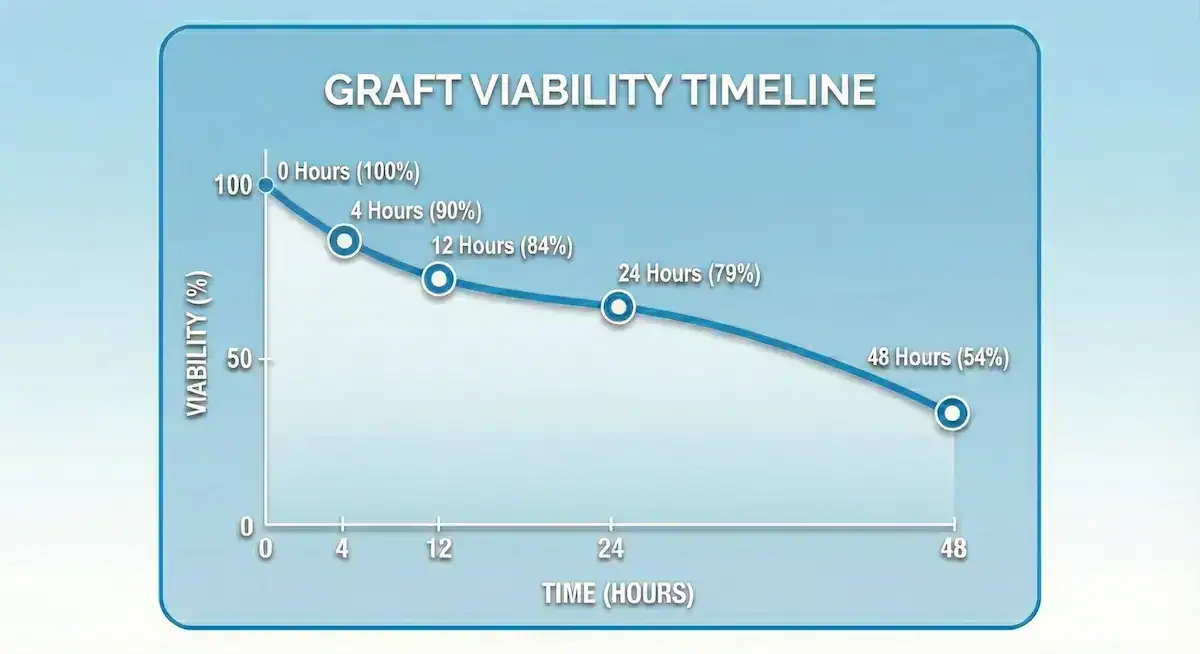
This is not opinion. The Limmer Study1, foundational research in hair restoration, established that graft viability declines in direct proportion to the time a graft spends out of the body. Every additional hour outside the scalp is paid for in survival.
6 hour rule graft viability timeline
The threshold that matters

The critical 4-hour window

Our goal is simple: keep every graft inside a four-hour out-of-body window. The Limmer data shows viability falls by roughly one percent for every hour a graft waits, so the eight to twelve hour mega sessions other clinics run quietly cost you grafts that never grow.
90%
Survival at the four-hour mark. The out-of-body window we keep every graft inside.
~1%
Lost per hour a graft waits outside the body. Across a long session, the loss compounds.
Figures from the Limmer Study.1
The trade-off nobody mentions

Why long "mega sessions" exist, and why they cost you

Marathon sessions are a business decision before they are a clinical one. Volume economics reward doing everything in a single sitting, technician-led work lets one surgeon oversee several chairs at once, and fatigue is treated as the patient's problem rather than the clinic's. A surgeon or technician nine hours into a procedure is simply not operating at the same precision as one who is fresh.
In practice

How we hold the line

Pre-surgical graft planning

The session is mapped before the first incision, so time is spent placing grafts, not deciding.

Chilled storage, minimal handling

Grafts are kept in optimal holding solution and touched as little as possible.

Live time monitoring

Out-of-body time is tracked through the procedure, not estimated afterwards.

Post-procedure graft check

Placement and density are reviewed before you leave the chair.
$0
No extra cost
Large cases

Two sessions, one standard, no extra charge

For cases needing roughly 5,000 or more grafts, we split the work across two consecutive days. No session exceeds six hours, and no graft exceeds its four-hour window, even on the largest procedures.
We do this at no additional cost, because capping a session is a clinical decision, not a billing one. The standard does not bend for volume, and you do not pay more to receive it.
The payoff

What the 6-Hour Rule means for your result

higher graft survival

Higher graft survival

More of what is transplanted lives to grow.
more even density

More even density

No drop-off in the grafts placed late in a long day.
consistent precision

Consistent precision

The last graft is placed with the same care as the first.
fewer revisions

Fewer revisions

Getting it right once is the cheapest transplant you can have.
Common questions

The 6-Hour Rule, answered

For larger cases of around 5,000 or more grafts, we split the work across two sessions on consecutive days, for example the hairline and mid-scalp on day one and the crown the next day. Each session is planned and timed under the 6-Hour Rule, at no extra cost.

Most do not. Many clinics run sessions of eight, ten, or even twelve hours, partly because technicians perform much of the work and partly because a volume-driven model prioritises high graft counts in one sitting. The 6-Hour Rule is our response to that.

By capping each session at six hours and rotating three qualified surgeons through short, focused shifts, we avoid the quality decline that comes with fatigue. In a single long operation, precision can deteriorate as fatigue builds. Our model keeps the operating surgeon fresh.

Not at all. Three surgeons working in rotation can typically achieve around 3,000 to 4,000 grafts in a single six-hour session. For patients needing more, the two-session approach delivers larger cases across consecutive days with no compromise on quality.

Great question. At Dr. Top Hair Hospital, the 6-Hour Rule is actively monitored throughout every procedure with real-time tracking. Our team tracks extraction rate, processing volume, and implantation progress – and makes adjustments immediately if the timeline is at risk.

Extracted grafts are immediately placed in a chilled, isotonic solution and held at a consistent temperature. A dedicated graft team handles each unit with minimal contact to reduce trauma, and time and temperature are monitored throughout.

No – the 6-Hour Rule is unique to the Dr. Top Protocol and isn’t widely practised in the hair transplant industry. Most clinics don’t publish or enforce any maximum session time, which is one of the things that sets us apart.

The 6-Hour Rule is our firm commitment that no hair transplant session will ever exceed six hours. This keeps every graft within the critical 4-hour out-of-body window identified by the Limmer Study, giving your grafts the best chance of survival and a denser final result.

The next step

Find out what is achievable for you

Complete the free online assessment and our surgeons will tell you whether you are a candidate, what the Protocol would involve, and roughly what it costs. No pressure, no sales script.
Free Hair Assessment
Sources
1. Limmer BL. Elliptical donor stereoscopically assisted micrografting as an approach to further refinement in hair transplantation. J Dermatol Surg Oncol. 1994;20(12):789-793. View on PubMed
Explore the ProtocolPillar 01 of 04 · The 6-Hour Rule