
If you’ve been considering traveling to Thailand for medical treatment, you’ve probably asked yourself the same question thousands of others ask every year: is Bangkok medical tourism safe? It’s a fair concern, and it deserves a real, straightforward answer. Let me walk you through everything international patients need to know before making travel plans, from hospital accreditations to travel advice and everything in between.
Key Takeaways:
- Bangkok is one of the top medical tourism destinations in the world, with world-class medical facilities, Joint Commission International-accredited hospitals, and highly trained medical staff that meet global standards.
- Medical travellers should prepare thoroughly before entering Thailand, including securing proper travel insurance, getting up-to-date vaccines, and understanding current visa requirements.
- Safety and security in Bangkok are generally strong for international patients, though staying informed through the latest travel advice and following practical precautions goes a long way.
Why Bangkok Has Become a Top Medical Tourism Destination

Thailand has firmly positioned itself as one of the most sought-after destinations for medical tourists globally, and Bangkok sits right at the center of that reputation. Each year, millions of medical tourists travel to Thailand seeking everything from complex cardiac procedures and orthopedic surgeries to dental care, cosmetic treatments, and hair restoration. The numbers speak for themselves, and they keep growing.
What continues to make Thailand an attractive destination for medical travellers isn’t just the cost of medical procedures, though that certainly plays a role. It’s the full package: internationally accredited private hospitals, shorter waiting times compared to Western healthcare systems, a highly skilled and often multilingual medical staff, and the chance to experience Thai hospitality during recovery.
Free Assessment
Not Sure How Many Grafts You Need?
Get a personalized treatment plan from Dr. Top's team. Takes 2 minutes to complete — no cost, no obligation.
A few of the aspects that draw medical tourists to Bangkok each year are:
- Significantly lower cost of medical procedures compared to the US, UK, and Australia
- Shorter waiting times for consultations, diagnostics, and surgeries
- High concentration of internationally accredited private hospitals
- English-speaking and multilingual medical staff across most major facilities
- Strong infrastructure for international patients, including dedicated patient services and airport transfers
- The ability to recover in a world-class travel destination
The Thai government has been deliberate about cultivating Bangkok’s status as a global medical hub. The Ministry of Public Health sets and enforces regulations across hospitals in Thailand, ensuring that standards of care remain consistent and internationally competitive. This institutional backing has helped Thailand’s medical tourism market grow into one of the most robust in all of Asia, attracting patients from the Middle East, Europe, Australia, and beyond.
Is Bangkok Safe for Medical Travellers?
Let’s get straight to the core question. Safety and security are valid concerns for anyone planning international travel, and it would be dismissive to wave them away without a proper answer. Bangkok is generally considered safe for medical travellers, especially when your time in the city is centered around reputable hospitals, recovery accommodations, and well-frequented tourist areas.
The most common safety concerns in Bangkok are:
- Petty theft and pickpocketing in crowded markets and transit areas
- Taxi scams or overcharging, particularly near tourist hotspots
- Misleading tour packages or unsolicited offers from strangers
These are manageable with basic awareness. Using ride-hailing apps, keeping your belongings secure, and staying cautious of unsolicited offers goes a long way. None of this is unique to Bangkok, and none of it should discourage medical travel.
For short-term travel centered on medical treatment, your daily routine is actually quite contained. You’re moving between your accommodation, your hospital in Bangkok, and nearby recovery spots. That structured routine reduces exposure to many of the risks that come with more adventurous travel styles.
Good to know: Most private hospital districts in Bangkok are modern, well-lit, and purpose-built with international patients in mind. They are consistently among the most comfortable and secure urban environments the city has to offer.
That said, it’s always wise to monitor the latest travel advisories issued by your home country’s embassy or foreign affairs department before and during your trip. Thailand has experienced occasional political demonstrations in certain parts of Bangkok, and while these are typically peaceful and localized, staying informed is just part of smart travel planning.
Parts of Thailand Worth Knowing About
Thailand is a geographically diverse country with distinct regions, and not all of them are equally relevant to medical travellers. Bangkok and Phuket are the primary hubs for medical tourism in Thailand, and the bulk of the country’s internationally accredited hospitals are concentrated in and around Bangkok. Chiang Mai in the north and Koh Samui in the south are popular tourist destinations but offer fewer specialized medical facilities.
Southern Thailand, near the border areas of the deep south, has historically experienced security concerns, and the latest travel advice for those specific parts of Thailand typically recommends caution. However, for international patients traveling to Bangkok and Phuket for medical treatment, these areas are far removed from the standard medical travel experience and should not factor into your decision at all.
The areas around Bangkok where most hospitals and specialist clinics are located are among the most developed and well-connected parts of Thailand. Getting between your accommodation and your medical center is straightforward, infrastructure is solid, and the support services for medical travellers are well-established.

World-Class Medical Facilities and Standards of Care
One of the most compelling arguments for Bangkok medical tourism being safe is the caliber of its hospitals. Thailand has one of the most impressive collections of internationally recognized medical facilities in Southeast Asia, many of which offer a standard of care that rivals top hospitals in Europe and North America.
Bumrungrad International Hospital is perhaps the most famous among global medical tourists. Bumrungrad offers a comprehensive range of medical specialties and has long been designed with international patients in mind. Multilingual staff, streamlined international patient services, and investment in advanced medical technologies make it a benchmark for what quality care can look like abroad. Many other private hospitals in Bangkok have followed a similar model, making the broader healthcare landscape in Thailand increasingly impressive.
Joint Commission International (JCI) accreditation is the most widely recognized global standard for evaluating hospitals, and several hospitals in Bangkok carry this certification. When a hospital holds JCI accreditation, it means the facility has undergone rigorous evaluation against the same criteria applied to leading hospitals in the United States, the United Kingdom, and Australia. For international patients making decisions about where to seek medical treatment, that kind of third-party validation matters enormously.
What JCI Accreditation Actually Means for Patients
| What It Evaluates | Why It Matters to You |
|---|---|
| Patient safety protocols | Reduces risk of medical errors and complications |
| Infection prevention standards | Ensures a clean, controlled clinical environment |
| Qualifications of medical staff | Confirms doctors and nurses meet global benchmarks |
| Patient rights and communication | Guarantees you are informed and treated with respect |
| Facility management and equipment | Ensures tools and technology are properly maintained |
Thai hospitals, especially private hospitals in Bangkok, are known for continuously investing in the latest medical technologies. From minimally invasive surgical equipment to advanced diagnostic imaging, the infrastructure you’ll find at top Bangkok hospitals is genuinely world-class. This combination of technology, trained medical staff, and institutional accountability is what has made Thailand a compelling proposition for medical tourism for patients worldwide.
Travel Advice Before You Head to Bangkok
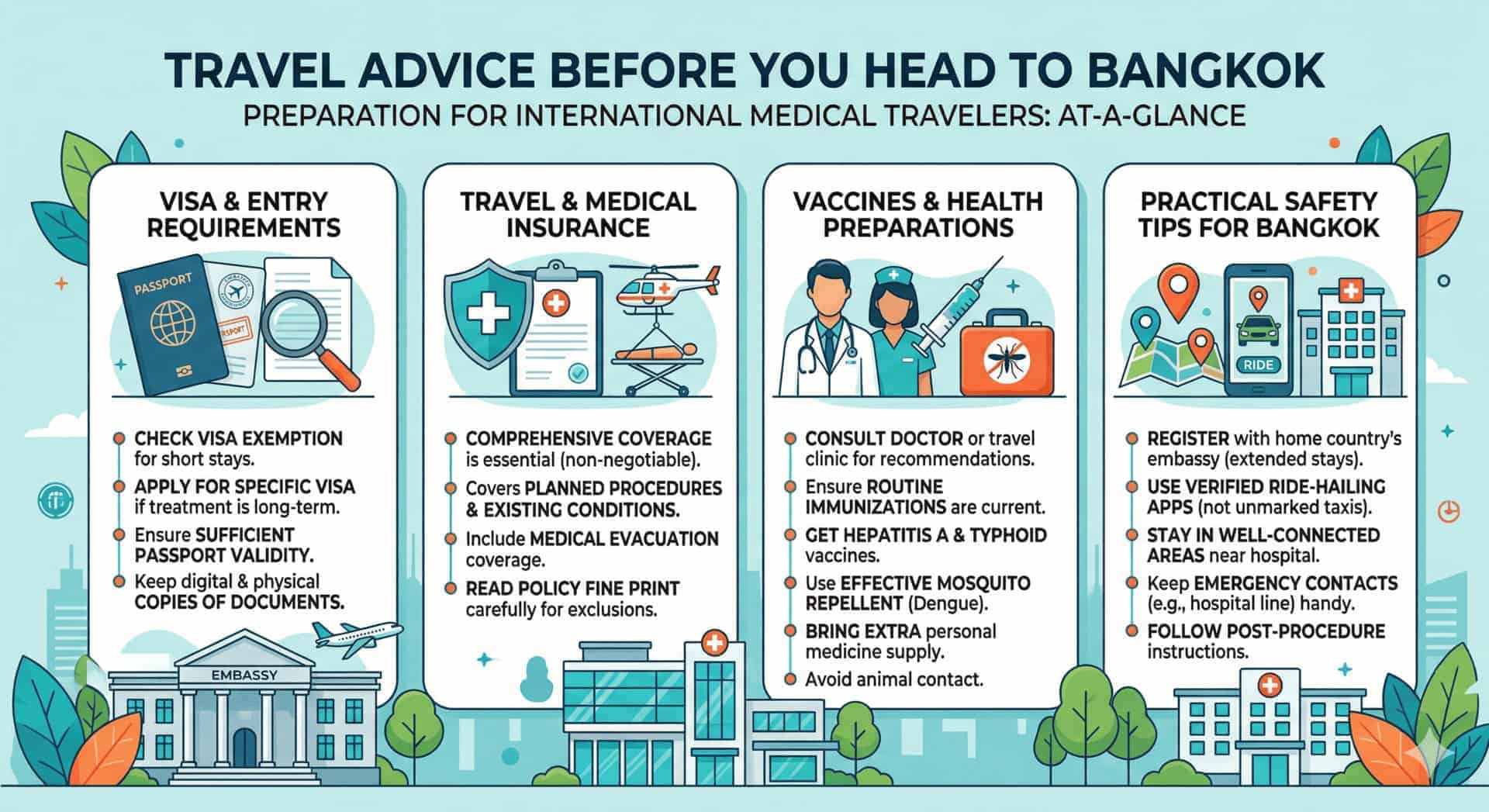
Preparation is one of the most important parts of any medical travel experience. Here’s what international patients need to have sorted before traveling to Thailand.
Visa and Entering Thailand
Thailand offers a visa exemption for citizens of many countries, making short-term travel relatively straightforward. If your treatment and recovery period extends beyond the standard exemption window, you may need to apply for an appropriate visa category. It’s worth contacting the Royal Thai Embassy or consulate in your home country well before your departure to confirm the current entry requirements for your nationality.
Ensure your passport has sufficient validity remaining, and keep both digital and physical copies of all your travel documents. Your hospital in Bangkok may also request copies as part of the admissions and registration process.
Travel Insurance and Medical Evacuation
This is non-negotiable for anyone traveling abroad for medical treatment. Comprehensive travel insurance that explicitly covers your planned procedures, your existing medical conditions, and potential complications is essential before entering Thailand. Medical evacuation coverage is also worth including, as the cost of returning home for follow-up care or emergencies without it can be severe.
Read your policy carefully before purchasing. Some travel insurance plans exclude pre-existing medical conditions or specific elective procedures, which could leave you exposed. Make sure your coverage aligns with the actual medical treatment you’re planning.
Vaccines and Health Preparations
Before traveling to Thailand, consult your doctor or a travel health clinic about recommended vaccines. Routine immunizations should be up to date. Hepatitis A and typhoid vaccines are recommended for most travelers, and depending on your itinerary or any travel to rural areas of Thailand, Japanese encephalitis may also be advised.
Mosquito bites can transmit dengue fever in Thailand, so packing effective repellent and wearing appropriate clothing is a practical precaution. If you’re scratched by a dog or come into contact with animals during your stay, seek medical attention promptly. Bringing enough medicine for your trip, plus a few extra days’ supply in case of delays, is always a sensible move.
Practical Safety Tips for Bangkok
- Register with your country’s embassy upon arrival for extended stays
- Use verified ride-hailing apps rather than unmarked taxis
- Stay in well-connected areas around Bangkok close to your hospital
- Keep emergency contact numbers, including your hospital’s international patient line, saved and accessible
- Follow all post-procedure instructions from your medical team during recovery
The Real Cost of Medical Care in Bangkok
The cost of medical treatment in Bangkok is significantly lower than in most Western countries, often by 40 to 70 percent depending on the procedure. This cost advantage applies across a wide range of treatments including hair transplants, dental care, cosmetic procedures, and more involved surgical interventions. For many international patients, the total cost of medical care, flights, and accommodation in Bangkok still comes to less than what the procedure alone would cost back home.
That said, price should never be the only factor guiding your decision. Choosing a facility based solely on the lowest quote without verifying credentials, international accreditations, and the qualifications of the medical staff is a risk not worth taking. Thailand’s top hospitals and specialist clinics are cost-effective because of scale and operational efficiency, not because they cut corners on quality.
Conclusion
Bangkok medical tourism is safe, well-established, and backed by genuinely world-class facilities. International patients who do their research, choose accredited providers, and prepare properly consistently find that Thailand delivers quality care at a level that meets or exceeds their expectations. It’s not just a destination for medical treatment; it’s a place where the entire experience, from arrival to recovery, is designed with patients in mind.
At Dr. Top Hair Hospital, we have seen firsthand what it means for patients to travel thousands of kilometers in search of quality care they can trust. If a hair transplant is part of your plans, the clearest first step is finding out whether you are a strong candidate before committing to anything else. Our short personalized assessment gives you an honest picture of your options in about two minutes, with no obligation and no pressure to move forward until you are ready.
We have worked with patients travelling from numerous countries, and we understand the weight of making that decision from thousands of kilometers away. We take that trust seriously.
Wondering if you’re a good candidate? Take our free 2-minute assessment to find out — no obligation, and your details stay completely private.
Reviewed by Dr. Top, ABHRS-certified.
When you are ready to talk through your options, we are here.