
If you’ve been researching hair transplant surgery, you’ve probably come across the term “ABHRS certified, but what does it actually mean? And more importantly, why should you care? When it comes to hair loss treatment, the credentials behind your surgeon matter far more than most people realize. In this guide, we break down everything you need to know about ABHRS certification, what it takes to earn it, and how it protects you as a patient.
Key Takeaways
- ABHRS (American Board of Hair Restoration Surgery) is the only board certification recognized by the ISHRS, the largest hair restoration education organization in the world.
- Earning the Diplomate designation requires years of documented surgical experience, verified case logs, before-and-after photo evidence, and passing both written and oral examinations.
- Not every physician performing hair transplant surgery holds recognized board certification, and knowing how to verify your surgeon’s credentials can make all the difference in your results.
What Is ABHRS and Why Does It Exist?

ABHRS stands for the American Board of Hair Restoration Surgery, a surgical certifying board organized specifically to examine physicians in the area of hair restoration surgery and to promote its safe practice. It was established to address a very real gap in medicine: in many countries and jurisdictions, any licensed physician can legally perform hair transplant surgery, even without specialized training in hair restoration.
That’s a serious concern. Although genetic hair loss is common and usually straightforward to diagnose, hair transplantation is a nuanced surgical procedure that demands far more than a general medical degree. It requires aesthetic judgment, technical precision, and a comprehensive clinical understanding of hair loss; its causes, its progression, and the full range of treatment modalities available.
The ABHRS was created to set a clear, verifiable standard for the practice of hair restoration surgery, giving patients a reliable benchmark for evaluating the qualifications of the surgeons they consider.
Free Assessment
Not Sure How Many Grafts You Need?
Get a personalized treatment plan from Dr. Top's team. Takes 2 minutes to complete — no cost, no obligation.
What ABHRS Certification Actually Means
ABHRS certification, formally known as the Diplomate of the American Board of Hair Restoration Surgery, is awarded to physicians who have demonstrated exceptional training, documented surgical experience, aesthetic skill, and a thorough knowledge of hair restoration surgical techniques. It is not simply handed out; it is earned through a rigorous, multi-stage process.
To qualify, a physician must present case logs and operative reports with surgical details, along with before-and-after photographs providing evidence of high-quality cosmetic and aesthetic results. The candidate then must pass a comprehensive examination consisting of both a written and oral component, covering the full scope of the specialty.
What makes this certification particularly meaningful is that the ABHRS exam stands as the only psychometrically and statistically validated examination dedicated to the specialty of hair restoration surgery. No other examination in this field has been held to that level of scientific rigor. Approximately 270 hair restoration surgeons worldwide have successfully earned this designation, making it a genuinely exclusive mark of expertise in hair transplantation.
The Goals and Objectives Behind the Certification
The goals and objectives of the ABHRS go beyond simply testing knowledge. The board aims to promote the safe practice of hair restoration surgery, protect patients from unqualified practitioners, and uphold truth in representation and advertising.
Physicians who claim ABHRS certification without having earned it, or who are caught misrepresenting board certification status in their marketing, can violate various state and federal laws. The ABHRS takes trademark infringement seriously. Republishing or otherwise representing an ABHRS designation without proper authorization, or using language designed to imply ABHRS certification, can mislead the public and violate various state and federal regulations. That’s exactly why the ABHRS credentialing committee maintains strict oversight and bases its evaluations on generally accepted methods of hair restoration surgery as published in current hair transplant journals and textbooks.
Why an ABHRS Certified Surgeon Matters for You
Here’s the honest truth: the surgical and aesthetic skill level of a physician offering hair transplant surgery can vary significantly. Without recognized board certification, there’s no standardized way for a patient to evaluate whether their surgeon truly knows what they’re doing.
Choosing an ABHRS certified surgeon means you’re selecting someone who has:
- Documented years of hands-on experience as the physician of record in hair restoration surgery
- Submitted detailed operative reports and verified patient case outcomes reviewed by the ABHRS credentialing committee
- Demonstrated a comprehensive clinical understanding of hair loss, including causes beyond typical genetic hair loss, such as conditions that require accurate diagnosis and tailored treatment
- Proven proficiency in techniques like follicular unit extraction (FUE) and other accepted methods of hair restoration surgery
- Passed the only validated board examination in the specialty of hair restoration surgery
This level of vetting doesn’t happen by accident. It’s the result of years of dedicated practice and study, and it’s something every patient deserves to know before trusting someone with their health and appearance.
Routes to Certification
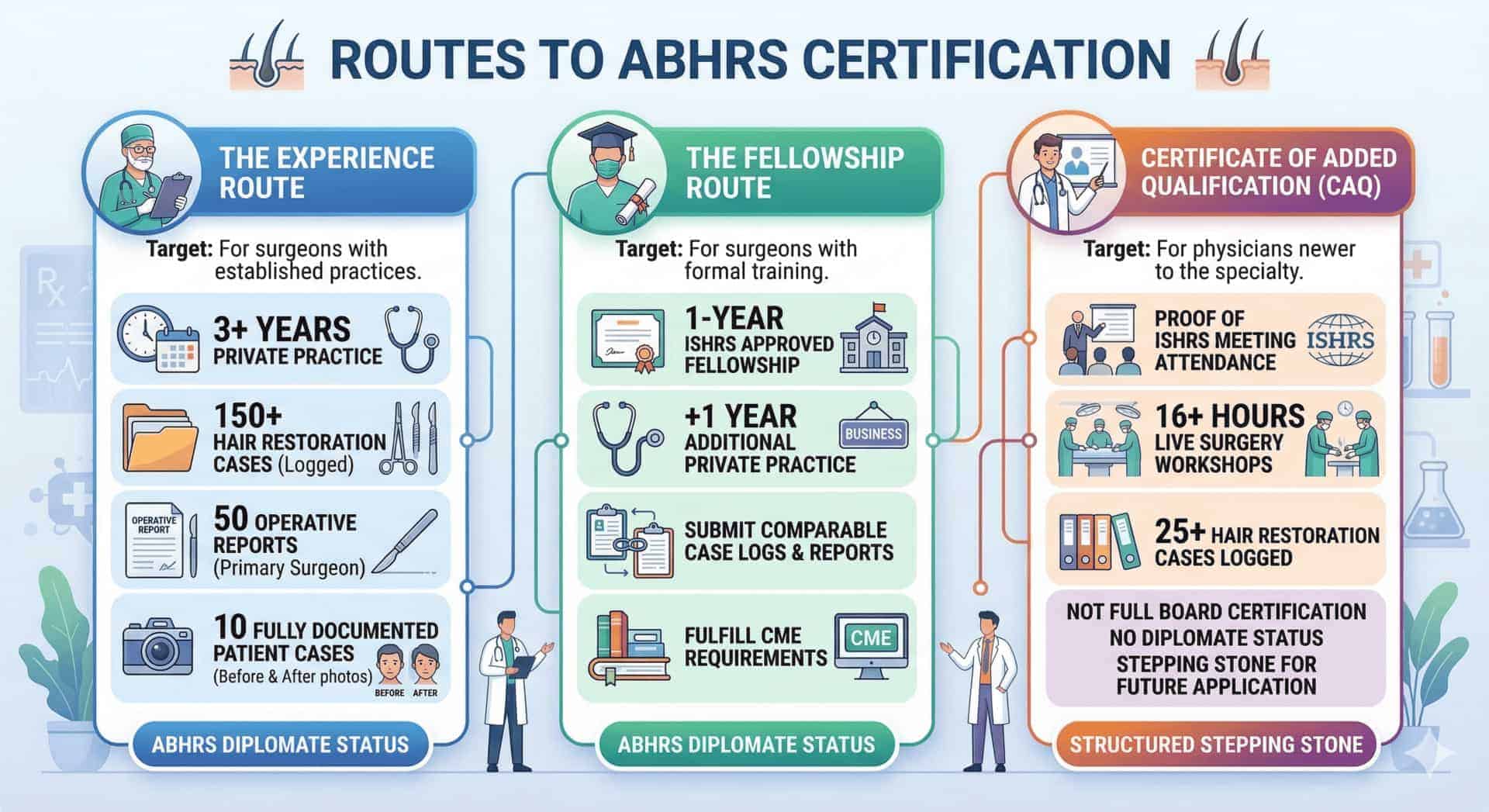
One of the things worth appreciating about the ABHRS framework is that it acknowledges different paths to becoming a qualified surgeon, without compromising on standards. There are multiple routes to certification, each with distinct requirements.
The Experience Route
Designed for surgeons who have already built a substantial practice in the field of hair restoration surgery, this route requires documenting at least three years of private practice experience, submitting case logs for a minimum of 150 hair restoration cases, 50 operative reports with the applicant listed as primary surgeon, and 10 fully documented patient cases complete with before-and-after photo sets. The ABHRS credentialing committee evaluates these materials based on generally accepted methods of hair restoration surgery as published in current hair transplant journals and textbooks.
The Fellowship Route
This route is for surgeons who have completed a one-year approved fellowship in hair restoration surgery recognized by the ISHRS. After completing the fellowship, the surgeon must also demonstrate an additional year of private practice experience, submit comparable case logs and operative reports, and fulfill CME requirements. This route reflects the board’s recognition that structured formal training is a rigorous and legitimate pathway for hair transplant surgeons.
Certificate of Added Qualification
For physicians newer to the specialty who don’t yet meet the criteria for the routes above, the ABHRS offers a Certificate of Added Qualification (CAQ). This requires proof of attendance at ISHRS annual meetings, completion of at least 16 hours of live surgery workshops, and case logs for a minimum of 25 hair restoration cases. Importantly, a CAQ is not the same as full board certification and does not grant Diplomate status, it is a structured stepping stone for those who plan to apply for certification at the full Diplomate level in the future.
ABHRS and IBHRS — Two Sides of the Same Standard
You may also come across the term IBHRS, the International Board of Hair Restoration Surgery. While the ABHRS primarily certifies physicians in the United States, the IBHRS extends that same rigorous framework to hair transplant surgeons practicing internationally. Both the ABHRS and IBHRS operate under the same examination process and credentialing standards, making the designation globally relevant for patients seeking internationally recognized expertise.
For patients choosing treatment at hair restoration centers outside of the US, the ABHRS and IBHRS designations serve as equally strong and verifiable indicators that a surgeon has met the highest standards in the field.
Recognized by the ISHRS — The Largest Hair Restoration Society
The ISHRS, or International Society of Hair Restoration Surgery, is the largest hair restoration educational organization in the world. Its recognition of the ABHRS carries significant weight because the ISHRS does not lend its endorsement lightly; it considers the ABHRS, alongside the IBHRS, as the only recognized board certification in the specialty of hair restoration surgery.
This connection matters for patients because it means the certification isn’t just a domestic credential; it is globally validated. ABHRS-certified surgeons are part of an international community committed to advancing the science and ethics of hair loss treatment. Many of the board’s exam preparation resources, including the ABHRS board review course and advanced lecture bundles, are developed and administered in collaboration with the ISHRS.
Why Certification Matters More Than You Might Think

One issue that doesn’t get enough attention is the problem of misrepresentation in the hair transplant industry. Because demand for hair restoration surgery has grown substantially, the market has also attracted practitioners who may overstate their qualifications.
Using language that implies ABHRS certification, without actually holding it, or claiming ABHRS designation without proper verification, can mislead the public and violate various state and federal laws. The ABHRS has clear policies surrounding ISHRS trademark violations and misrepresenting board certification. Any surgeon claiming ABHRS status should be directly verifiable through the official ABHRS directory on abhrs.org. If a surgeon’s name doesn’t appear there, that’s worth investigating before you move forward.
This is precisely why certification matters at a practical level: it gives you, as a patient, a transparent and independently verifiable way to confirm your surgeon’s credentials. You shouldn’t have to take anyone’s word for it.
Conclusion
At the end of the day, a hair transplant is an investment in yourself, in your appearance, and in your confidence. Knowing that your surgeon holds ABHRS certification means knowing that they’ve done the work, logged the cases, and passed the only validated board examination in the specialty. That’s not a small thing; it’s the difference between guessing and knowing you’re in qualified hands.
At Dr. Top Hair Hospital, we’re here to answer your questions and guide you through every step of the process. A credential only means something when it is applied to your specific situation. If you have been researching surgeons and want an honest, qualified assessment of where you stand, the clearest next step is a short personalized quiz. It takes about two minutes, there is no obligation, and it gives you a real starting point before any commitment is made.
You deserve to know your options from someone who has actually earned the right to assess them.
Wondering if you’re a good candidate? Take our free 2-minute assessment to find out — no obligation, and your details stay completely private.
Reviewed by Dr. Top, Diplomate of the American Board of Hair Restoration Surgery (ABHRS), with over 10,000 procedures performed across more than 20 years.
Whenever you are ready, we are here.