
If you traveled abroad for your hair restoration procedure, the question of flying isn’t really optional. It is a practical concern you have to plan around. And if you’re like most of our international patients here at Dr. Top Hair Hospital, you’ve probably already searched something like “is it safe to fly after a hair transplant” before you even booked your flight to Bangkok.
The short answer is yes, flying after a hair transplant is generally safe. But the timing, your aftercare routine, and a few simple precautions can make the difference between a smooth recovery and an unnecessarily stressful one.
Key Takeaways
- Most patients can fly 2 to 5 days after a hair transplant procedure, but waiting 5 to 7 days is the safer, more comfortable option for most.
- Cabin pressure alone does not destroy grafts, but the dry cabin air, dehydration, and swelling risks that come with flying too soon can slow your recovery.
- Following your post-operative instructions carefully, staying hydrated, and avoiding any contact with your scalp during the flight are the simplest ways to protect your results.
When Is It Actually Safe to Fly After a Hair Transplant?
This is the core question, and the answer depends on how far out from surgery you are.
Here is a general timeline most hair restoration specialists agree on:
Free Assessment
Not Sure How Many Grafts You Need?
Get a personalized treatment plan from Dr. Top's team. Takes 2 minutes to complete — no cost, no obligation.
| Timeframe | Flight Safety | Notes |
|---|---|---|
| First 24 hours | Not recommended | Grafts are still highly vulnerable; swelling has not yet peaked |
| 2 to 3 days post-op | Possible with caution | Short-haul flights may be okay if cleared by your surgeon |
| 4 to 5 days post-op | Generally safe | Swelling is reducing; grafts are beginning to anchor |
| 7+ days post-op | Recommended window | Safer for long-haul flights; scabs are stabilizing |
According to the International Society of Hair Restoration Surgery, waiting at least a few days before flying after a hair transplant procedure is the standard recommendation. For longer journeys, most surgeons suggest waiting closer to 7 to 10 days, especially after extensive sessions involving a large number of grafts.
At Dr. Top Hair Hospital, our typical procedure involves up to 5,000 grafts in a single session using FUE or DHI techniques, and our team provides specific post-op travel guidance based on each patient’s individual situation.
What Does Cabin Pressure Actually Do to Your Scalp?
One of the biggest concerns patients raise is cabin pressure. The idea that flying creates some kind of vacuum effect on your scalp sounds alarming, but the reality is a bit more nuanced.
Modern commercial aircraft maintain cabin pressure at a level equivalent to an altitude of roughly 6,000 to 8,000 feet. These pressure changes are gradual and are not strong enough to pull transplanted hair follicles out of the scalp. The grafts themselves, once properly placed and given a short window to stabilize, are not going to be displaced by the air pressure inside a plane cabin.
That said, cabin pressure does do a few things worth noting:
- It can worsen existing swelling. If you already have forehead swelling from your transplant (which is very common in the first 3 to 5 days after surgery), the shift in air pressure can cause that fluid to expand slightly, making swelling more pronounced around the brow and eyes.
- It dries out the cabin air. The humidity inside an aircraft cabin is typically very low, often around 10 to 20 percent. This dry air can dry out your scalp and make the early healing process more uncomfortable.
- It encourages dehydration. Lower humidity combined with recycled air means your body loses moisture faster than you might realize, and dehydration slows tissue recovery.
None of these risks are severe, but they are real enough to take seriously.
FUE vs. DHI: Does the Technique Affect When You Can Fly?
Both FUE (Follicular Unit Extraction) and DHI (Direct Hair Implantation) are minimally invasive procedures, and neither requires the longer recovery windows that older strip-method surgeries did. That is one of the reasons traveling abroad for hair transplant surgery has become so common.
With FUE, the surgeon extracts individual follicles from the donor area and implants them into channels created in the recipient area. With DHI, a specialized implanter pen is used to place grafts directly without pre-made channels. Both result in a scalp that begins healing quickly, but the first few days after surgery are still the most critical window for graft survival.
Because the critical implant window (the time grafts remain viable outside the body) is within 6 hours of extraction, the actual surgical process is time-sensitive and precise. After that window, healing takes over, and your scalp begins the process of anchoring those newly transplanted follicles into place.
By days 4 to 5, most grafts have begun to stabilize. By day 7, the risk of displacement from everyday movement (including flying) drops significantly.
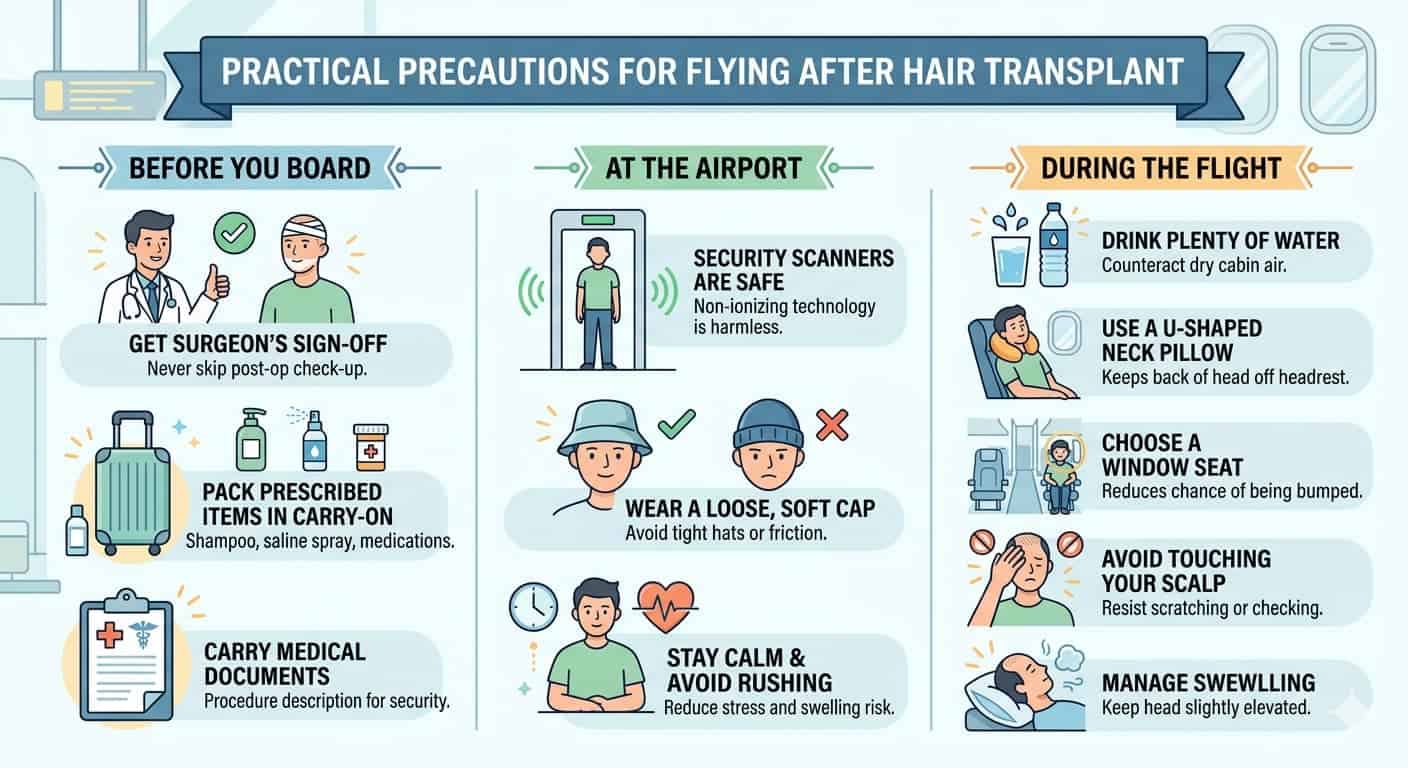
Practical Precautions for Flying After Hair Transplant
Whether you are catching a short domestic flight or heading home on a long-haul journey across continents, there are a few things you can do to make the flight safer and more comfortable.
Before You Board
- Get your surgeon’s sign-off. Never skip your post-op check before heading to the airport.
- Pack your prescribed shampoo, saline spray, and any medications in your carry-on.
- Carry your medical documents and a brief description of your procedure in case airport security or customs asks questions.
At the Airport
- Airport security scanners are completely safe. They use non-ionizing technology that does not interact with your scalp or grafts in any meaningful way.
- If you want to cover your head, use a loose, soft cap that does not press directly onto the recipient area. Avoid tight hats, beanies, or anything that creates friction.
- Do not rush. Avoid stressful situations that raise your blood pressure, as this can contribute to swelling.
During the Flight
- Drink plenty of water throughout the flight. Hydration is one of the simplest ways to support your recovery and counteract the dry cabin air.
- Bring a U-shaped neck pillow. This keeps the back of your head off the headrest and protects the donor area from unnecessary pressure.
- Choose a window seat if possible. This reduces the chance of someone bumping or brushing against your head in the aisle.
- Avoid touching your scalp. It sounds simple, but the urge to scratch or check the transplanted area is common and worth consciously resisting.
- If you feel forehead swelling building, try to keep your head slightly elevated and avoid leaning it flat against any surface.
Long-Haul Flight After Hair Transplant: Extra Considerations
If you are flying home from Thailand after getting your procedure done, there is a good chance your journey involves a long-haul flight of 6 hours or more. These flights carry slightly more risk simply because you are in the cabin environment for longer, and sitting still for extended periods can worsen swelling.
For long-haul flights, the recommended waiting period is generally 7 to 10 days post-surgery. This gives your scalp enough time to:
- Reduce initial swelling significantly
- Allow scabs to form and begin loosening naturally
- Lower the risk of infection from prolonged exposure to dry, recycled cabin air
If your schedule does not allow for a 7-day stay, discuss this with your surgeon before your procedure date. At Dr. Top Hair Hospital, we work with patients from over 11 countries including the UK, Germany, Australia, France, and more, and we factor travel plans into the recovery discussion from the very beginning. We offer online consultations so you can plan your timeline before you even arrive in Bangkok.
Why Thailand Is a Practical Choice for International Hair Transplant Patients
It is worth mentioning that traveling to Thailand for a hair transplant has real logistical advantages beyond the quality of care. Bangkok is one of the most well-connected cities in Asia, with direct or one-stop flights from most major cities in Europe, Australia, and Southeast Asia.
That means when your recovery window allows you to fly, getting home is relatively straightforward. And because Thailand is known for its post-operative hospitality infrastructure, comfortable accommodations, local support, and a healthcare system experienced with international patients, the recovery stay is often more pleasant than people expect.
At Dr. Top Hair Hospital specifically, our medical team is led by an ABHRS Diplomate with over 20 years of experience in hair restoration and more than 10,000 procedures performed. Our aftercare protocols are designed with international patients in mind, because a significant portion of our patients are traveling home after their procedure, and we want that journey to be as smooth as possible.
What to Do If Something Feels Off After Your Flight
Recovering from a hair transplant is rarely dramatic, but some patients do notice increased swelling, tenderness, or redness after a flight. Here is how to approach it:
- Mild forehead swelling after flying is common and usually resolves within a day or two. Keep your head elevated when resting and follow any swelling management instructions your clinic provided.
- Unusual redness, warmth, or discharge around the recipient or donor area should be flagged to your clinic immediately. These can be signs of infection, and catching them early matters.
- Itching around the transplanted area is normal during healing. Avoid scratching and use your prescribed saline spray or shampoo as directed.
- Graft loss from flying is rare when the correct waiting period is observed. Clinical data consistently shows that complication rates for well-managed hair transplant procedures remain very low, approximately 2% or less at clinics following international standards.
Planning your trip? See our complete Thailand pricing and travel guide.
Conclusion
Flying after a hair transplant is completely manageable when you give your scalp the time it needs and stay on top of your aftercare from the moment you leave the clinic. The biggest mistake most patients make is not the flight itself but rushing it. A few extra days of patience in Bangkok can mean the difference between grafts that thrive and a recovery that stalls before it even starts.
Wondering if you’re a good candidate for a hair transplant in Thailand? Take our 2-minute assessment to find out and get a clearer picture of what’s possible for your hair. No obligation, and your details stay completely private.