

So you have decided to go through with a hair transplant. That is a big step, and honestly, a smart one. But here is a question most people do not think about until after they book their procedure: what actually happens during recovery? Understanding the hair transplant recovery timeline before you go in makes the whole journey so much less stressful. Let me walk you through it, stage by stage.
Key Takeaways
- Hair transplant recovery follows a predictable progression: initial healing in the first two weeks, a shedding phase around weeks three to four, early new hair growth starting near months three to four, and more complete results visible by nine to twelve months.
- Shock loss (the temporary shedding of transplanted hair) is a completely normal part of the healing process and does not mean the procedure failed.
- Full, final results from a hair transplant typically take between twelve and twenty-four months to develop, with approximately 80 to 90% of results visible by the twelve-month mark.
Why the Hair Transplant Recovery Timeline Matters
A lot of patients focus almost entirely on the procedure itself, and that is fair. But the recovery process is just as important as the surgery. How you care for your scalp in the days and weeks after a hair transplant directly affects graft survival, hair density, and your final results.
At Dr. Top Hair Hospital, we have performed over 10,000 hair restoration procedures and consistently see patients who are far more relaxed and confident about their results when they genuinely understand what to expect at each stage. Knowing that shedding is normal, or that thin hairs in month three are actually a good sign, changes everything.
Free Assessment
Not Sure How Many Grafts You Need?
Get a personalized treatment plan from Dr. Top's team. Takes 2 minutes to complete — no cost, no obligation.
Whether you had an FUE hair transplant or a FUT procedure, the recovery trajectory follows a broadly similar pattern. That said, FUE recovery tends to be faster and less disruptive to daily life, which is one reason it has become the preferred method for most modern hair restoration patients.
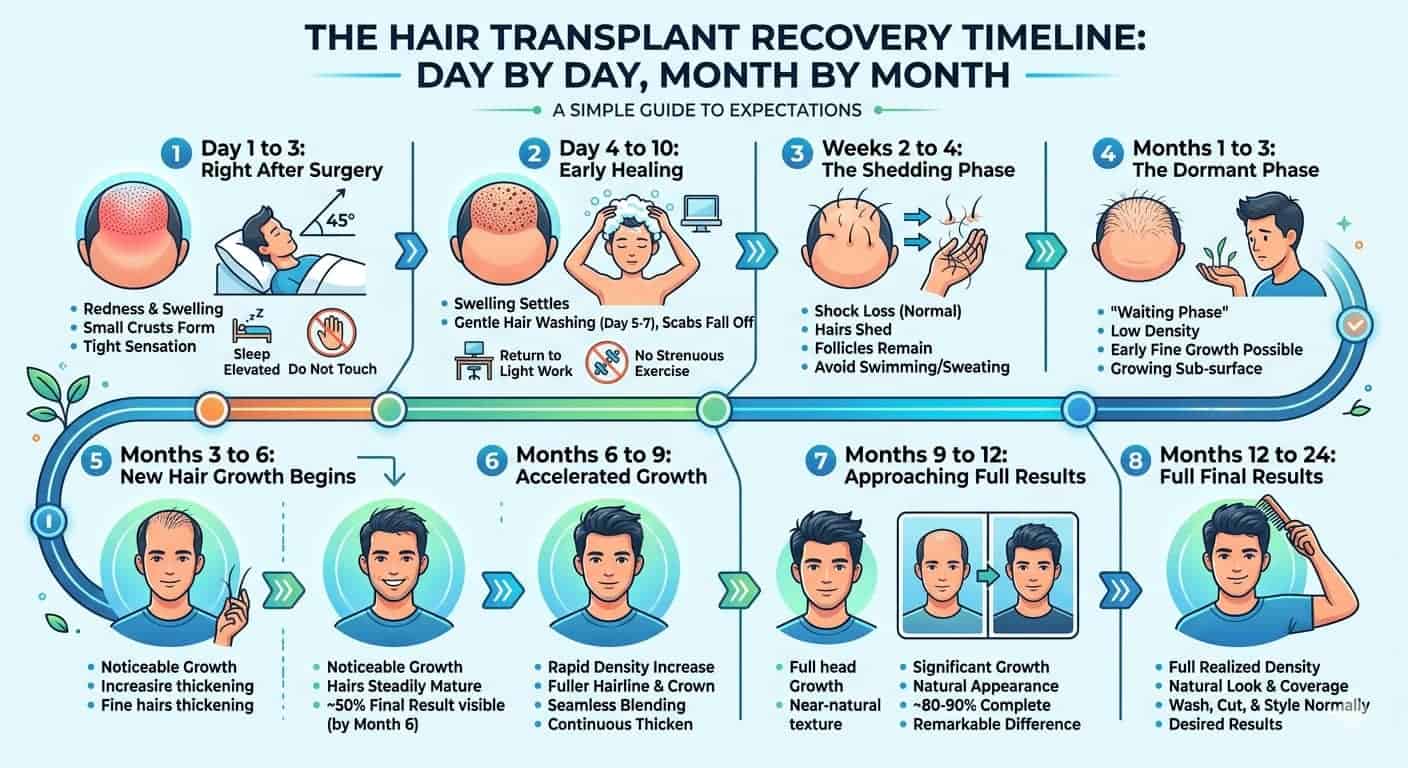
The Hair Transplant Recovery Timeline: Day by Day, Month by Month
Day 1 to Day 3: Right After Surgery
The first seventy-two hours are when your body starts doing the heavy lifting. Immediately after your hair transplant surgery, the transplanted area will look red and slightly swollen. This is completely expected.
Here is what typically happens during this stage:
- Redness and tenderness in both the donor and recipient areas
- Mild to moderate swelling, which can occasionally move down toward the forehead or eyes by day two or three
- Small crusts or scabs beginning to form around each graft
- Some patients experience a tight, uncomfortable sensation rather than outright pain (at Dr. Top Hair Hospital, our patients typically report a pain level of around 2 out of 10)
Post-op care during this window is critical. Sleep with your head elevated at roughly a 45-degree angle to minimize swelling and avoid putting any pressure on the grafts. Do not touch, scratch, or rub the transplanted area under any circumstances. Your transplanted hair follicles are still anchoring themselves into place, and dislodging them at this stage could affect your results.
Day 4 to Day 10: Early Healing
By around day four or five, the initial swelling begins to settle. The scabs around your grafts will start to look more defined as the healing process progresses. This is also when most patients feel well enough to return to light desk work or daily activities, though strenuous exercise and direct sun exposure should still be avoided.
Around day five to seven, you can typically begin gently washing your hair using the technique recommended by your hair restoration specialist. This usually involves a very light, dabbing motion rather than rubbing, with a mild shampoo recommended by your clinic. Getting this right matters because keeping the scalp clean supports healthy hair growth and reduces the risk of infection.
By day ten, most scabs will have naturally fallen off. This is a good milestone. It means your scalp surface has healed, even though the deeper follicular healing is still well underway.
Weeks 2 to 4: The Shedding Phase
This is the part of the hair transplant recovery process that catches most patients off guard, but it is one of the most important things to understand: shock loss is normal.
Between weeks two and four, you will likely notice that many of the transplanted hairs begin to shed. This can feel alarming, especially if you were expecting to see growth. But this shedding does not mean the grafts have failed. What is actually happening is that the hair shafts are falling out while the follicles remain safely anchored in the scalp. Those follicles will produce new hair in the coming months.
Some patients also notice a bit of shedding in their existing, native hair around the transplant area. This is also a normal part of the healing process and is typically temporary.
What to focus on during weeks 2 to 4:
- Continue following your washing routine as instructed
- Avoid swimming pools, saunas, and heavy sweating
- Skip any products not approved by your hair transplant surgeon
- Be patient. The visible results are coming, just not yet
Months 1 to 3: The Dormant Phase
Months one through three are sometimes called the “waiting phase” or the “ugly duckling stage,” and for good reason. Outwardly, not much seems to be happening. The transplanted hair follicles are in a resting state, rebuilding their blood supply and preparing to produce new hair.
Hair density will look low during this period. Some patients feel a little disheartened, which is understandable. But underneath the surface, your scalp is laying the groundwork for everything that comes next. Around the two to three month mark, a small percentage of new hair growth may begin to appear, often as fine, thin hairs that are lighter in color and texture than your existing hair. This is early hair growth, and it is a good sign.
Months 3 to 6: New Hair Growth Begins
This is when the hair transplant timeline really starts to feel rewarding. Around month three to four, noticeable hair growth begins to emerge across the recipient area. The hair starts thin, but it steadily matures.
Here is a rough progression during this stage:
| Timeframe | What to Expect |
|---|---|
| Month 3 | Fine, early hair growth visible in places |
| Month 4 | Approximately 40 to 50% of expected results visible |
| Month 5 | Hairs thickening; coverage noticeably improving |
| Month 6 | Around 50% of final result visible; real confidence boost |
By month six, most patients are genuinely excited about what they see in the mirror. The transplanted and native hair are starting to blend more naturally, and overall hair health in the treated area is improving steadily. This is also a good time to follow up with your hair transplant clinic to review progress and discuss any supporting treatments if needed.
Months 6 to 9: Accelerated Growth
The six to nine month window is where things really accelerate. The transplanted hair follicles are now well-established, and the hair shafts may begin to show a noticeable change in terms of texture, thickness, and color, growing progressively closer to your natural hair.
During this stage:
- Hair density in the recipient area increases significantly
- The hairline or crown begins to look fuller and more defined
- Transplanted and native hair continue to blend more seamlessly
- Hair in terms of texture and density starts approaching your pre-loss appearance
Some patients in this phase also benefit from complementary treatments to support hair growth and prevent further hair loss in non-transplanted areas. At Dr. Top Hair Hospital, our hair restoration experts may recommend options based on your individual hair restoration goals, including treatments to stimulate hair follicles and support the overall results of your procedure.
Months 9 to 12: Approaching Full Results
By month nine, you are in the home stretch. Significant growth is clearly visible, and most patients see approximately 80 to 90% of their final result by the twelve-month mark. The hair is fuller, the texture feels more like your natural hair, and the results of your hair transplant are genuinely transformative at this point.
This is also the stage where before-and-after comparisons become most meaningful. If you have been keeping track with photos (which we always recommend), the difference between day one and month twelve is usually remarkable.
For some patients, particularly those who had larger sessions or are restoring the crown, full results of your hair transplant may continue developing through months twelve to twenty-four. Hair restoration is not a race, and allowing that full timeline to play out naturally is the best way to achieve optimal results.
Months 12 to 24: Full Final Results
Full results typically emerge between twelve and twenty-four months after your procedure. By this point, the hair density, coverage, and natural-looking results you were hoping for should be fully realized. The transplanted hair grows, cycles, and behaves just like the rest of your hair, meaning it can be washed, cut, and styled normally.
This is the stage where many patients return to their hair transplant clinic for a final review and to discuss whether any additional refinement or a second session might help them achieve their desired result. It is also a good time to talk with your hair restoration specialist about maintaining your results and how to prevent further hair loss in untreated areas going forward.
FUE vs FUT: Does the Recovery Timeline Differ?
Both FUE (Follicular Unit Extraction) and FUT (Follicular Unit Transplantation) follow a similar broad recovery timeline, but there are some meaningful differences in the early stages.
| Factor | FUE Recovery | FUT Recovery |
|---|---|---|
| Scarring | Tiny dot scars, minimal | Linear scar at donor site |
| Initial healing | Faster, typically days | Slightly longer due to stitches |
| Return to normal activity | Often within a few days | Usually 1 to 2 weeks |
| Donor area discomfort | Mild | Moderate, may need more rest |
| Long-term results | Comparable | Comparable |
FUE hair transplant recovery is generally considered less disruptive, which is why it has become the dominant method at most leading hair transplant clinics, including Dr. Top Hair Hospital. With our Long Hair FUE technique, many patients are able to return to their normal routine within just twenty-four hours of the procedure.
Hair Care Tips to Support a Smooth Recovery
Recovery is not just about waiting. How you look after your scalp and hair in the weeks and months after your hair transplant surgery has a real impact on your results. Here are some key care points to keep in mind:
- Avoid direct sun exposure on the transplanted area for at least the first few weeks
- Do not smoke, as it can reduce blood flow to the scalp and slow the healing process
- Stay hydrated and maintain a balanced diet to support healthy hair growth from the inside out
- Follow your clinic’s washing instructions carefully, especially in the first ten days
- Avoid tight hats, helmets, or headwear that could put pressure on the grafts during early recovery
- Skip the gym for at least two weeks post-procedure to minimize sweating and physical strain on the scalp
- Take any prescribed medication such as finasteride or other hair loss treatments as directed by your surgeon
Small things add up. Patients who are consistent with aftercare tend to see better graft survival rates and more satisfying final results.
What Makes Thailand a Smart Choice for Hair Restoration

Thailand has become one of the most trusted destinations globally for hair transplant procedures, and for good reason. The combination of internationally trained surgeons, world-class facilities, competitive pricing, and a strong track record of results makes it a genuinely compelling option for patients coming from the UK, Australia, Europe, and beyond.
At Dr. Top Hair Hospital, our lead surgeon is a Diplomate of the American Board of Hair Restoration Surgery (ABHRS). With over twenty years of experience in hair restoration and a team of approximately twenty medical professionals across seven Bangkok locations, we bring a level of specialization that is difficult to match. Our work has been recognized at the HOFS Awards 2024, and our team has been invited to present at the IMCAS World Congress 2026 in Paris, which reflects our standing within the global medical community.
Patients from over eleven countries, including the UK, Germany, Australia, and across Asia, have trusted us with their hair restoration journey. If you are considering combining your procedure with the experience of visiting Thailand, it is worth knowing that many of our international patients find the entire process straightforward and genuinely enjoyable.
Ready to take the next step? See Thailand pricing.
Conclusion
If you are thinking about taking the next step, the best thing you can do is get the right information upfront. Understanding the hair transplant recovery timeline is a big part of going in prepared and coming out satisfied with your results. Knowing what to expect at every stage, from the first tender days post-surgery to the full transformation at twelve to twenty-four months, makes the entire process feel far more manageable.
Wondering if you are a good candidate? Take our quick hair assessment to find out. It only takes a couple of minutes, there is no obligation, and your details stay completely private. Our team, led by an ABHRS-certified surgeon with over twenty years of experience, is here to give you honest, personalized guidance whenever you are ready.