
Aftercare is everything that happens once the procedure is over, and it matters as much as the surgery itself. One rule comes before everything else on this page: the instructions your treating clinician gives you take precedence over any generic timeline, including this one. Your plan is tailored to your procedure, your medical history and your allergy screening, and it can be adjusted as you heal. If anything here differs from what your clinician tells you, follow your clinician and ask them to explain why.
Key Takeaways
- Hair transplant aftercare is just as important as the procedure itself, and your post-op habits directly determine how many grafts survive and how natural your final results look.
- The recovery journey spans from a critical first 24-hour window through a full 12 months, with each phase requiring a specific level of attention and care.
- A structured aftercare routine covering proper washing, sleep position, nutrition, sun protection, and medication compliance dramatically reduces complications and sets you up for lasting success.
Why Hair Transplant Aftercare Is Non-Negotiable
Many patients do not realize that graft survival begins the moment the procedure ends. In the first hours and days after surgery, your newly transplanted follicles are in their most vulnerable state. They are not yet anchored, still healing from micro-trauma, and entirely dependent on the scalp environment you create for them.
Reputable clinics in 2026 typically achieve graft survival rates of 90 to 95 percent. Elite surgical teams with refined aftercare protocols can reach 95 to 98 percent. That difference is not just about surgical technique. It is about what happens after you walk out the door. Poor post-op habits can push survival rates as low as 75 to 85 percent, meaning roughly one in four grafts could fail to survive entirely.
Proper hair transplant aftercare also:
Free Assessment
Not Sure How Many Grafts You Need?
Get a personalized treatment plan from Dr. Top's team. Takes 2 minutes to complete — no cost, no obligation.
- Prevents infection in both the donor and recipient areas of the scalp
- Reduces swelling and inflammation during the critical first week
- Protects grafts from being physically dislodged before they anchor
- Supports healthy new hair growth by optimizing scalp blood circulation
- Helps you avoid complications that could require a repeat procedure
The surgery delivers the follicles. The aftercare delivers the results. That is why hair transplant aftercare is not optional; it is the other half of the procedure itself.
What Happens to Your Hair After a Transplant
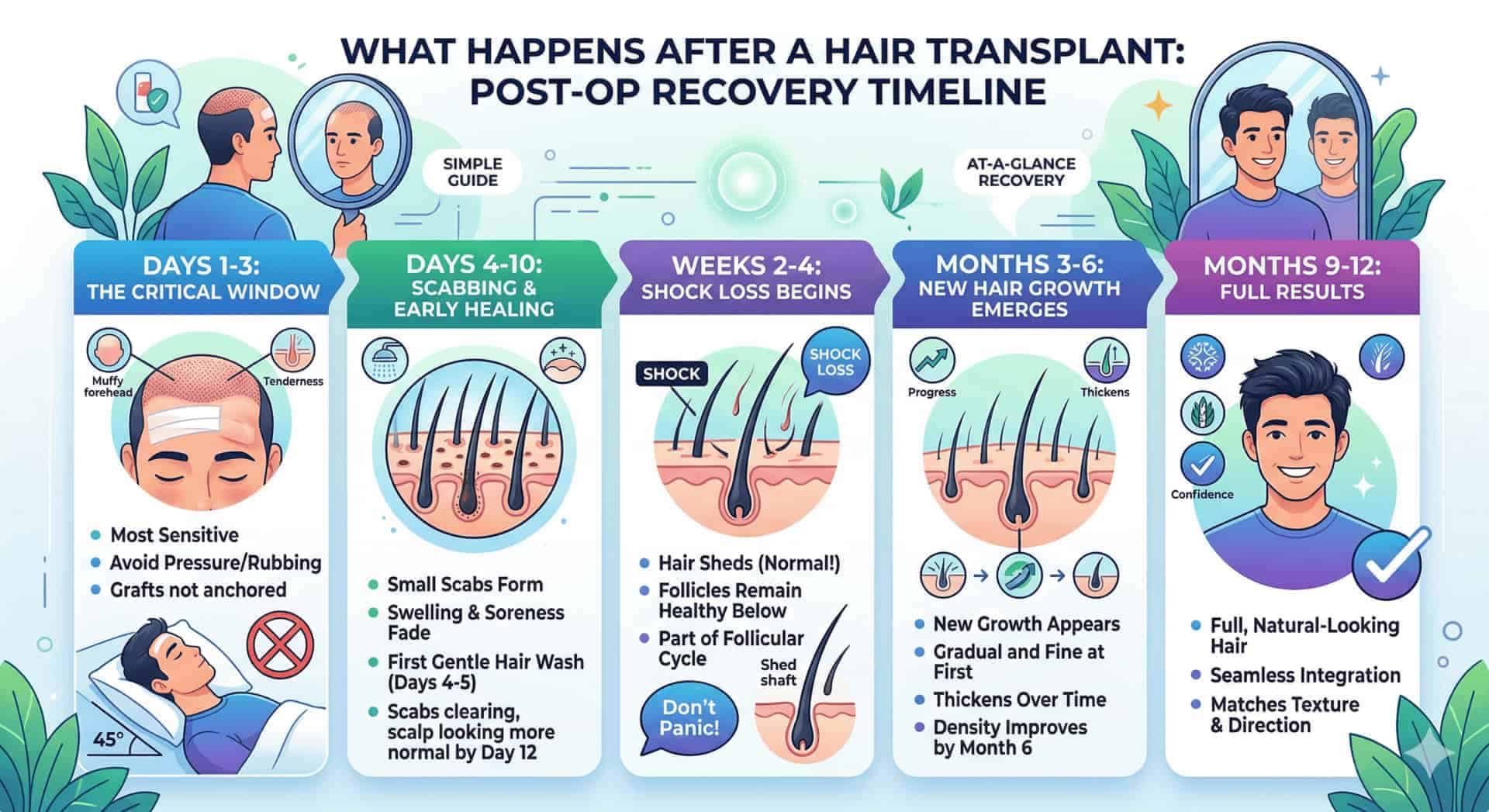
Understanding what is normal at each stage of your hair transplant recovery helps you stay calm and confident throughout the entire process. Here is a clear breakdown of what to expect from Day 1 through Month 12.
Days 1 to 3 Post-Op: The Critical Window
The first 72 hours are the most sensitive. Your scalp will feel tender, and mild swelling around the forehead and hairline is completely normal, typically peaking on Day 3 or 4. The grafts have not yet anchored into the scalp tissue during this window, so avoiding any pressure, rubbing, or bending over is absolutely essential. Sleeping with your head elevated at a 45-degree angle helps minimize swelling and protects the newly transplanted hair grafts from pillow contact.
Days 4 to 10: Scabbing and Early Healing
Tiny scabs will form around each graft site as part of the natural healing process. By Days 4 to 5, soreness and swelling begin to fade, and your medical team may clear you for your first gentle hair wash. By Days 10 to 12, all crusting should be fully resolved and the scalp will begin to look and feel considerably more normal.
Weeks 2 to 4: Shock Loss Begins
Between Weeks 2 and 4, many patients notice the transplanted hair beginning to shed. This is called shock loss and it is completely normal. The hair shafts fall out while the follicles remain intact and healthy beneath the scalp. This phase can feel alarming, but it is a natural and expected part of the follicular adjustment cycle that nearly every patient goes through.
Months 3 to 6: New Hair Growth Emerges
After approximately 3 to 5 months, new hair will begin to emerge from the transplanted follicles. Growth is gradual at first, often appearing fine and soft before thickening steadily over time. By Month 6, most patients notice a meaningful improvement in hair density and overall coverage.
Months 9 to 12: Full Results
The full, natural-looking results of a hair transplant typically become visible between 9 and 12 months post-procedure. At this stage, the transplanted hair should be fully integrated with your existing hair, matching in texture and growth direction for a seamless, natural finish.
The First 24 Hours After Your Hair Transplant
The first 24 hours set the entire foundation for your hair transplant recovery. Your newly transplanted hair grafts are at their most fragile during this window and need maximum protection from any external disruption. We put together a complete breakdown in our guide on the first 24 hours after a hair transplant, which includes a full checklist of dos and don’ts for that critical day.
What to do in the first 24 hours:
- Rest completely and avoid all physical exertion for the full day
- Sleep in an upright or semi-reclined position at a 45-degree angle to reduce swelling and protect grafts
- Keep the transplanted area completely dry and avoid any contact with water
- Take all prescribed medications as directed by your surgeon, including antibiotics and anti-inflammatories
- Apply the clinic-provided saline spray to keep the recipient area moist and support early healing
- Avoid smoking and alcohol, both of which constrict blood vessels and impair the healing process
What to avoid right after your hair transplant:
- Do NOT touch, scratch, or rub the transplanted area under any circumstances
- Do NOT bend over or lift heavy objects, as this increases blood pressure to the scalp
- Do NOT wear tight hats or headwear that puts pressure on the newly transplanted hair grafts
- Do NOT expose your scalp to direct sunlight, dust, or pollution
That first day is the most critical day of your entire hair restoration journey. Give your scalp the complete rest and care it needs, and it will reward you in the months ahead.
How to Wash Your Hair After a Hair Transplant
Washing your hair after a transplant is one of the most critical and most misunderstood parts of post-hair transplant care. The goal is to keep the scalp clean to prevent infection while being gentle enough not to dislodge the new grafts that are still in the process of anchoring. Our step-by-step guide on how to wash your hair after a hair transplant goes through the full technique in fine detail, but here is the essential overview to get you started correctly.
General Hair Wash Timeline
- Days 1 to 2: No washing at all. The scalp needs complete rest.
- Day 3 (or as your clinic advises): First gentle wash using only clinic-approved hair care products
- Days 3 to 12: Use only the post-transplant lotion or mild shampoo provided by your clinic
- After Day 12: Transition to a mild, sulfate-free, medically approved shampoo
Step-by-Step Washing Technique for Days 3 to 12
- Fill a clean bowl with lukewarm water. Never use hot water on the scalp during recovery.
- Add a small amount of your clinic-provided shampoo or lotion and mix it gently in the bowl.
- Using a cup, slowly and gently pour the solution over the transplanted and donor areas.
- Pat the recipient area softly with your fingertips. Never scrub, rub, or apply direct pressure.
- Rinse thoroughly with clean lukewarm water poured gently from a cup.
- Pat dry with a clean, soft towel. Never rub the scalp during the drying process.
Avoid directing a strong shower stream directly onto the scalp during the first 12 days. The water pressure can easily dislodge unsettled hair grafts and compromise your final results. After Day 15, you can begin to gently comb the hair using a wide-tooth comb, starting at the tips and working upward slowly. Harsh hair products, styling products, and chemical treatments should be avoided for at least the first month after surgery.
Understanding Shock Loss After a Hair Transplant
Shock loss is one of the most common concerns patients raise after their procedure, and it is something worth understanding before it happens rather than after. We cover the full causes, timeline, and what is considered normal in our dedicated post on shock loss after a hair transplant, but here is the core overview every patient should know.
It is caused by surgical trauma triggering a condition called localized telogen effluvium. The follicles enter a temporary resting phase in response to the stress of the hair transplant operation. Only the visible hair shafts are shed during this phase. The follicles beneath the scalp remain alive and intact throughout.
Shock Loss Timeline
- Week 2: First signs of hair shedding begin
- Weeks 4 to 5: Peak shedding, when most transplanted and some existing hairs fall out
- Months 2 to 3: Shedding slows and the scalp transitions into the renewal phase
- Months 3 to 4: New hair growth begins to emerge steadily from the follicles
Three Types of Shock Loss
- Transplanted hair shedding: The most common type. The grafts survive while the shafts fall temporarily.
- Existing hair shedding: Nearby fragile hairs may also shed due to the surgical environment around them.
- Donor area shedding: Rare, and typically occurs only if the donor site experienced a high extraction density.
Shock loss usually lasts up to 12 weeks, after which new hair growth begins its steady emergence. Contact your surgeon immediately only if shedding appears excessive or is accompanied by pain, redness, or signs of infection. Otherwise, trust the timeline.
Sleeping Position After a Hair Transplant
How you sleep in the first week after your transplant matters far more than most patients expect. Sleeping flat can cause excess fluid to pool in the scalp, worsening swelling considerably. Rolling onto your side can press the grafted area directly against a pillow, potentially dislodging healing follicles before they have had a chance to anchor. Our post on the best sleeping positions after a hair transplant covers this in greater detail, but the essential rules are straightforward enough to follow from day one.
Best Practices for Sleeping After a Hair Transplant
- Sleep on your back with your head elevated at a 45-degree angle for the first 3 to 5 nights
- Use the special neck pillow provided by your clinic to keep your head in the correct position throughout the night
- If you do not have a clinic pillow, stack two or three standard pillows to prop your head up adequately
- Place a clean, soft towel over your pillow to maintain scalp hygiene while you sleep
- Avoid tossing and turning as much as possible. Side sleeping and face-down sleeping can damage grafts in the first critical week.
By Night 5 to 7, the grafts have begun to anchor into the scalp and the risk of displacement from sleeping decreases significantly. Most patients can return to their normal sleeping position by the end of Week 2.
Exercise and Physical Activity After a Hair Transplant
Returning to the gym is consistently one of the top questions active patients ask after their hair transplant procedure. The risk of exercising too soon is very real. Physical activity raises blood pressure, increases scalp sweating, and can dislodge newly placed grafts or introduce bacteria to open micro-wounds on the scalp. Our exercise guide for hair transplant patients maps out every stage of the return-to-gym timeline in practical detail.
| Timeframe | Safe Activities | What to Avoid |
|---|---|---|
| Days 1 to 3 | Complete rest, gentle indoor walking | All exercise, bending, straining |
| Days 4 to 7 | Light walking outdoors | Gym, running, heavy sweating |
| Weeks 2 to 4 | Light cardio, light bodyweight exercises | Swimming, heavy lifting, contact sports |
| Month 1 and beyond | Most gym routines | High-impact sports without surgeon approval |
Most patients can return to full gym routines, including weightlifting, HIIT, and CrossFit, by 3 to 4 weeks post-transplant, once grafts are fully secured and scabbing has completely resolved. Swimming in chlorinated pools and contact sports should be avoided for at least one full month after the hair transplant procedure.
Sun Exposure and Scalp Protection
UV radiation is one of the most underestimated risks during hair transplant recovery. The newly grafted area is extremely photosensitive, and direct sunlight can damage healing tissue, delay the recovery process, and negatively affect new hair growth. This is especially relevant for patients in Thailand, where UV intensity is consistently high year-round. Our dedicated post on sun exposure after a hair transplant covers the full protection timeline and product guidance for patients navigating outdoor life during recovery.
Sun Protection Timeline
- First 2 weeks: Avoid all direct sun exposure entirely. Stay indoors or in the shade whenever possible.
- Weeks 2 to 6: If you must go outside, wear a wide-brimmed, loose-fitting hat that provides full coverage without pressing directly on the graft area.
- After 2 weeks (with healed incisions): SPF 30 or higher sunscreen can be applied to the scalp. A spray formula is ideal to minimize direct contact with grafts.
- Up to 4 months: Continue daily sun protection whenever spending extended time outdoors.
Avoid applying sunscreen directly to the scalp until all incisions are fully healed, as certain products can irritate fresh grafts and slow the overall healing process.
Nutrition and Diet for Hair Transplant Recovery
What you eat in the weeks following your hair transplant directly affects how efficiently your body heals and how strong your new hair grows. A nutrient-rich diet supports cell repair, reduces inflammation, and delivers the building blocks your follicles need to take root and thrive throughout the hair growth cycle. Our complete post-transplant nutrition and recovery diet guide includes a detailed food list and meal recommendations tailored specifically to each phase of the healing process.
Key Nutrients for Post-Hair Transplant Recovery
| Nutrient | Food Sources | Benefit |
|---|---|---|
| Protein | Chicken, fish, eggs, lentils | Core building block of hair structure |
| Vitamin C | Berries, oranges, kiwi, peppers | Collagen repair in scalp tissue |
| Iron | Spinach, lean red meat, poultry | Maintains blood supply to follicles |
| Zinc | Oysters, beef, nuts, seeds | Supports follicle structure and repair |
| Vitamin E | Avocados, almonds, sunflower seeds | Reduces inflammation, boosts circulation |
| B Vitamins and Biotin | Whole grains, oats, eggs | Supports hair growth and cell repair |
| Healthy Fats | Avocado, olive oil, nuts | Reduces inflammation, improves scalp circulation |
Stay well-hydrated throughout your recovery. Water is essential for nutrient absorption and scalp healing, and it directly supports the long-term health of your new hair follicles. Herbal teas and broths are excellent supplementary options, particularly in the days following surgery.
Substances to Avoid During Recovery
- Alcohol, which dehydrates tissue and significantly impairs healing
- Smoking, which restricts blood flow to hair follicles and compromises graft survival
- Processed, high-sodium foods that increase swelling and inflammation around graft sites
- Excessive caffeine in the immediate post-op period, which can affect blood pressure and hydration levels
Medications After a Hair Transplant
Your surgeon will prescribe a specific regimen of medications to support your recovery and protect your results. Following this regimen precisely is one of the most important parts of your aftercare instructions, and skipping doses or stopping early can leave you vulnerable to infection and complications. For a full medication timeline and breakdown of what each drug does during your recovery, our post on post-op medications after a hair transplant covers every detail.
Standard Post-Op Medications
- Antibiotics: To prevent infection in the donor and recipient areas during the healing phase
- Anti-inflammatories or corticosteroids: To reduce swelling and discomfort in the first few days post-op
- Pain relievers: For scalp tenderness in the first 24 to 72 hours
- Saline spray: To keep the recipient area moist and support a comfortable, scab-free healing environment
Always confirm with your surgeon which over-the-counter medications are safe to use during recovery. Some common pain relievers like aspirin can thin the blood and increase bleeding risk, so checking before taking anything beyond your prescribed regimen is essential.
Minoxidil and Finasteride After a Hair Transplant
A common question among post-transplant patients is whether to use minoxidil and finasteride after surgery. While neither is mandatory, both offer meaningful benefits for long-term hair transplant results. Patients who want a full breakdown of how each medication works and whether it is right for them will find our article on minoxidil and finasteride after a hair transplant covers it thoroughly.
Minoxidil improves blood circulation to the scalp, stimulates follicular activity, and can help reduce the duration and severity of shock loss. It is typically introduced 2 to 4 weeks after the procedure, once the initial healing phase has progressed sufficiently.
Finasteride works by blocking DHT (dihydrotestosterone), the hormone responsible for male pattern hair loss. While transplanted hair is naturally DHT-resistant, finasteride is valuable for protecting native hair in non-transplanted areas from continued loss over time. Unlike minoxidil, it can generally be continued on the day of surgery and throughout recovery without interruption.
Combination therapy using both medications together is widely considered the most effective long-term approach for:
- Enhancing graft density and thickness over the first 12 months
- Reducing the severity and duration of shock loss after the hair transplant procedure
- Preventing further hair loss in untreated surrounding areas of the scalp
Always consult your surgeon before starting or adjusting any hair loss medication as part of your post-operative care plan.
Graft Survival: How to Maximize Your Hair Transplant Results
Graft survival is the single most important measure of a successful hair transplant outcome, and it is directly shaped by patient behavior in the days and weeks following surgery. Elite clinics and diligent patient aftercare together can achieve 95 to 98 percent survival rates. Our expert guide on maximizing hair transplant graft survival goes even deeper on protective strategies for patients who want to give their grafts every possible advantage.
Post-Operative Factors That Directly Affect Graft Survival
- Gentle washing technique: Harsh rubbing or directing shower spray onto the scalp can dislodge unsettled grafts in the first 10 days after the procedure
- Avoiding physical strain: Lifting, bending, and strenuous activity raises scalp blood pressure and creates a real risk of graft displacement
- Scalp hydration: Keeping the recipient area moist with clinic-approved solutions promotes healthy tissue integration around each follicle
- No scratching or touching: Even brief contact can remove a graft before it has properly anchored into the scalp
- Attending follow-up appointments: Regular check-ins with your surgeon allow for early detection of any healing complications
- Proper nutrition: Protein, vitamins, and minerals directly feed the follicles as they anchor and begin to grow into healthy hair
Every single habit on this list contributes to the difference between average and exceptional long-term results from your hair restoration procedure.
Managing Common Post-Op Side Effects
Mild side effects are a completely normal and expected part of the post-hair transplant healing process. Knowing what to expect ahead of time prevents unnecessary anxiety and helps you respond appropriately throughout recovery. We break down each side effect and how to manage it in our post on hair transplant swelling, scabbing, and itching.
Swelling typically peaks around Day 3 to 4 and can migrate from the scalp down toward the forehead and eyes. Applying ice just above the eyebrows (not directly on grafts) and keeping the head elevated are the most effective strategies for managing swelling in the first few days following surgery.
Scabbing forms around each graft site as part of natural wound healing. Do not attempt to pick or remove scabs manually under any circumstances. Allow them to soften and lift naturally through the gentle washing process. By Days 10 to 12, all crusting should be gone.
Itching is common as the scalp heals and nerve endings recover after the operation. Scratching even briefly can dislodge a graft. Using a saline spray or gentle patting (never rubbing) is the safest way to relieve itching without putting your newly transplanted hair grafts at risk.
When Can You Return to Work?
Most hair transplant patients can return to desk or office work within 2 to 3 days of their procedure. The specific timeline, however, depends on your type of work and personal comfort level. For a job-by-job breakdown of what to expect during recovery, our post on returning to work after a hair transplant covers every scenario in practical detail.
- Office and remote workers: Can typically return to work within 2 to 5 days post-op
- Physical laborers: Jobs involving lifting, bending, or outdoor exposure may require 2 to 3 weeks off to protect the grafts
- Social comfort: Some patients prefer to wait until visible scabbing has cleared around Day 10 to 14 before returning to in-person settings
- Appearance management: A loose, wide-brimmed hat after Day 10 can help conceal the transplant area if needed
Communicate with your surgeon about your specific job requirements and environment so they can advise on the right return-to-work timeline for your individual recovery.

Long-Term Hair Transplant Maintenance
A hair transplant is a permanent solution, but protecting your investment over the long term requires consistent, ongoing care. The transplanted hair is DHT-resistant and will grow for life. However, native hair in the surrounding areas can still thin over time without proper maintenance and a supportive lifestyle. Our dedicated post on long-term hair transplant maintenance covers year-one and beyond in full detail, including treatment options and daily care habits worth building into your routine.
Long-Term Maintenance Best Practices
- Continue using medically approved, sulfate-free shampoos to maintain a clean and healthy scalp environment
- Follow up with your surgeon at 6 and 12 months to assess density and growth progress
- Consider PRP (Platelet-Rich Plasma) therapy to stimulate both transplanted and existing follicles over time
- Explore Low-Level Laser Therapy (LLLT) as a non-invasive option to boost blood supply and support long-term follicle health
- Maintain a consistently nutrient-rich diet to continuously feed your follicles from within and support the ongoing hair growth cycle
- Manage stress, sleep quality, and overall health, all of which play measurable roles in the condition of your hair year after year
Monthly progress photos are an excellent habit. They help you track growth milestones clearly and give your medical team useful reference data at every follow-up appointment throughout your hair restoration journey.
FUE vs. FUT Aftercare: Are the Rules Different?
The core post-hair transplant aftercare principles apply equally to both FUE and FUT, but there are a few technique-specific differences worth understanding before your recovery begins. Our comparison guide on FUE vs. FUT aftercare breaks these differences down side by side for patients recovering from either procedure.
FUE aftercare: Because grafts are extracted individually in a FUE hair transplant, there is no linear incision at the donor site. Healing is generally faster, with tiny dot-shaped scabs that resolve within 7 to 10 days. Most FUE patients can return to normal activities sooner compared to FUT patients.
FUT aftercare: FUT involves removing a strip of skin from the donor area, leaving a sutured incision line that requires additional care. This means keeping sutures clean, dry, and protected from any physical disruption. Stitches are typically removed around Day 10 to 14, and the donor area may take longer to fully heal.
Both techniques require the same standard level of care for the recipient area, covering gentle washing, sun protection, proper sleep positioning, activity restrictions, and nutrition. Your surgeon will provide technique-specific aftercare instructions tailored to your exact procedure and individual healing response.
Red Flags: When to Contact Your Doctor
Not every symptom during recovery is cause for alarm, but some signs do warrant immediate medical attention. Contact Dr. Top Hair Hospital right away if you experience any of the following:
- Severe or worsening pain not managed by your prescribed medications
- Persistent or heavy bleeding from the donor or recipient area
- Signs of infection, including increasing redness, warmth, pus, or an unusual odor from the scalp
- Unusual or extreme hair shedding that goes well beyond the expected shock loss pattern
- Fever or signs of systemic illness in the days following the procedure
- Allergic reactions to any medications or topical products used as part of your recovery
When in doubt, always reach out. Our team at Dr. Top Hair Hospital is available to guide you through every stage of recovery and address any concerns that come up along the way.
Conclusion
A hair transplant is only as good as the care that follows it. Every step in this guide, from how you sleep on Night 1 to the shampoo you reach for on Day 3, adds up to something that matters deeply: a full, natural, lasting result that you can actually be proud of. The patients who see the best outcomes are not necessarily the ones who had the most grafts placed. They are the ones who took their aftercare seriously, followed the protocol, and trusted the process even when shock loss made them doubt it.
At Dr. Top Hair Hospital in Thailand, we do not consider our job done the moment you leave the operating room. The aftercare protocol you follow matters as much as the procedure itself. If you are ready to take the first step toward your hair restoration, or you have questions about what recovery looks like for your specific situation, a short personalized assessment is the clearest place to start.
It takes about two minutes, there is no obligation, and it gives you a realistic picture of your candidacy and what the full journey looks like before you commit to anything.
Wondering if you’re a good candidate? Take our free 2-minute assessment to find out — no obligation, and your details stay completely private.
Reviewed by Dr. Top, Diplomate of the American Board of Hair Restoration Surgery (ABHRS). Over 10,000 procedures performed across more than 20 years, with patients travelling from over 11 countries including the UK, Germany, Australia, Canada, France, and across Asia.
Your results begin long before the procedure. Start here.