

When I talk about hair transplant for women, I like to start with one clear point: it is real, effective, and often life changing, but it is not a one size fits all solution. Many women experiencing hair loss are surprised to learn that the real question is not “Can I have a transplant?” but “Am I the right candidate, and what makes female hair loss different in the first place?”
Key takeaways
- A hair transplant for women can work well in the right case, but candidacy depends heavily on the cause of hair loss, the stability of shedding, and the quality of the donor area.
- Female hair loss often looks different from male hair loss, with more diffuse thinning and fewer clearly stable donor zones, so diagnosis comes before any transplant plan.
- The best results usually come from a personalized plan that may combine hair transplantation with medical treatment, scalp evaluation, and realistic density goals.
Why hair loss in women needs a different conversation

Hair loss in women usually does not follow the same pattern seen in men. Instead of a clearly receding hairline or a bald crown, women more often develop diffuse thinning along the part line, crown, or across larger areas of the scalp while keeping much of the frontal hairline intact.
That difference matters because modern hair transplantation depends on moving healthy hair follicles from a stable donor area to a thinning area. In many women, the donor area itself may also be affected by thinning, which can limit transplant options and make diagnosis much more important before surgical hair restoration is considered.
This is why female hair transplant planning should never begin with graft numbers alone. It should begin with understanding the nature of female hair loss, the extent of hair loss, whether the shedding is still active, and whether the donor hair is truly stable enough for successful hair transplantation.
Free Assessment
Not Sure How Many Grafts You Need?
Get a personalized treatment plan from Dr. Top's team. Takes 2 minutes to complete — no cost, no obligation.
Common causes of female hair loss
Before any hair transplant procedure is discussed, I think it helps to understand the most common reasons women’s hair becomes thin in the first place.
- Female pattern baldness or female pattern hair loss can cause gradual thinning, especially along the part line and crown.
- Hormonal changes related to menopause, pregnancy, thyroid conditions, or PCOS can trigger noticeable hair thinning.
- Medical conditions such as anemia, autoimmune disease, lupus, or nutritional deficiencies can contribute to shedding.
- Stress and lifestyle factors including rapid weight loss, restrictive dieting, and chronic stress may worsen hair loss in women.
- Traction alopecia from tight hairstyles, repeated pulling, or long term tension can create localized hair loss that may respond well to transplant treatment in selected cases.
- Scarring or trauma from surgery, injury, burns, or prior procedures can also create areas where hair replacement may be considered.
This is exactly why treating hair loss in women is rarely just about the visible thin area. If the root cause is still active, transplanted hair may be placed into an unstable environment, and the surrounding hair may continue to miniaturize even if the grafts survive.
Hair transplant for women candidacy
Not every woman with thinning hair is automatically a candidate for hair transplant surgery. Good candidates for hair transplant surgery usually have a more stable pattern of loss, enough healthy hair follicles in the donor area, and expectations that match what hair restoration can realistically achieve.
Here is a simple way to think about candidacy:
| Situation | Often a better candidate? |
|---|---|
| Localized thinning with strong donor hair | Yes, often |
| Traction alopecia or scar related loss | Often yes, depending on stability |
| Diffuse hair loss across the entire scalp, including donor area | Often limited or not ideal |
| Rapid, active shedding without diagnosis | Not yet, evaluation first |
| Realistic goal of improved fullness, not full teenage density | Yes, this is the right mindset |
For many women, the most important step is a proper medical evaluation. The International Society of Hair Restoration Surgery notes that diagnosis may involve medical history, scalp examination, trichoscopy, blood tests, or even biopsy in selected cases to determine if female hair transplantation is appropriate.
In practical terms, candidates for hair transplant are usually those with enough donor hair, a predictable pattern, and hair loss concerns that can be improved by redistributing existing hair rather than trying to create unlimited volume. A transplant can add fullness and strategic density, but it does not magically restore every strand that was lost.
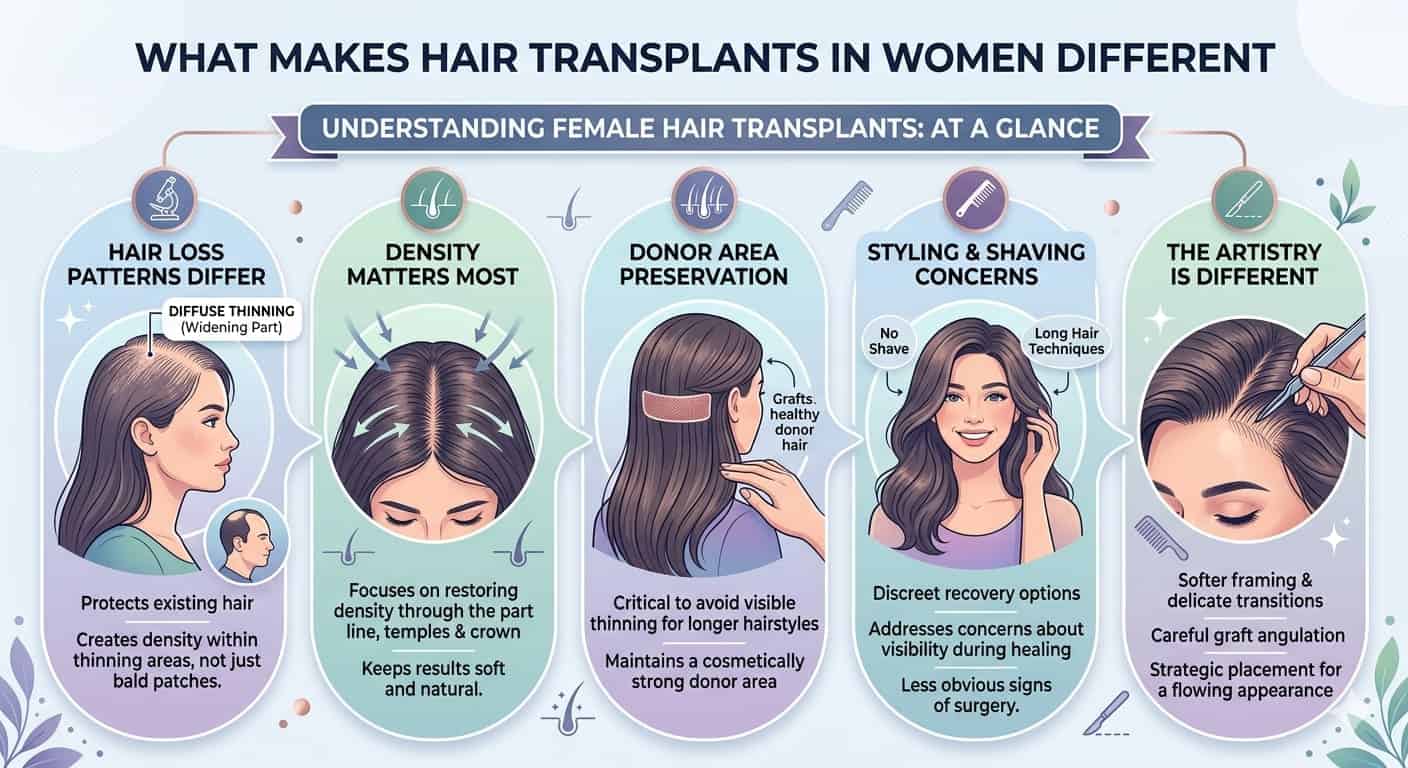
What makes hair transplants in women different
This is where the conversation gets more interesting. Hair transplants in women are not just “the same surgery on a different patient.” The principles are similar, but the planning is often very different.
Hair loss patterns differ
Women often present with diffuse hair thinning rather than isolated bald patches. That means the surgeon has to protect both the donor area and the surrounding hair while planning density in a way that looks natural with the existing hair growth pattern.
Density matters more than a new hairline
Many men seek a lower or stronger frontal hairline. Many women, by contrast, are more focused on restoring density through the part line, mid scalp, temples, or crown while keeping the result soft and natural.
Donor area preservation is critical
If donor hair is limited, overharvesting can create visible thinning at the back or sides of the scalp. That risk is especially important in female hair transplantation because many women wear longer hairstyles and want the donor area to stay cosmetically strong.
Styling and shaving concerns are different
A lot of women ask about shaving, recovery visibility, and how soon they can return to normal life. Some techniques, including certain no shave or long hair approaches, can be useful in selected female patients who want a more discreet recovery.
The artistry is different
A natural female hair transplant often requires softer framing, more delicate transitions, careful graft angulation, and thoughtful placement around the part line. Poor direction, weak density planning, or a harsh hairline can make the result look unnatural very quickly.
Hair transplant techniques for women
The two main hair transplant techniques used today are follicular unit extraction and follicular unit transplantation. Both can work for women, but the better option depends on hair characteristics, the donor area, hairstyle preferences, and the specific hair loss pattern.
Follicular unit extraction
Follicular unit extraction, or FUE, removes individual follicular unit grafts directly from the donor area. It avoids a linear scar and is popular because it is minimally invasive, though it may require shaving unless a no shave or long hair variation is used.
For women, FUE can be a strong choice when careful donor harvesting is possible and when the surgeon wants precise graft selection. But if the donor area is already thin, aggressive extraction can reduce hair density further, so conservative planning is essential.
Follicular unit transplantation
Follicular unit transplantation, or FUT, removes a strip of scalp from the donor area and then dissects it into grafts under magnification. It can provide a high yield of grafts in one session and may allow the surrounding hair to hide the donor site more easily when worn long.
The tradeoff is the linear scar and a somewhat longer recovery. In women who keep their hair long and prioritize donor preservation, FUT can still be a very relevant transplant option when chosen carefully.
A quick comparison
| Technique | What it does | Possible advantage for women | Main tradeoff |
|---|---|---|---|
| FUE | Removes individual hair grafts | No linear scar, can be more discreet with selected approaches | |
| FUT | Removes a donor strip, then dissects grafts | Strong graft yield, donor area can remain visually fuller |
At a clinic level, the right technique should match the patient, not the trend. That is especially true in female hair restoration procedures, where preserving existing hair and donor integrity can matter just as much as adding new hair.
What the hair transplant procedure usually involves
Our women’s hair transplant procedure generally involves evaluating the scalp, designing the treatment area, harvesting grafts from the donor area, and implanting those grafts into thinning zones with attention to angle, direction, and density.
The basic idea sounds simple, but the detail work is what separates average results from natural looking hair restoration. In women, the surgeon must account for surrounding hair, the natural hair growth pattern, and the fact that many patients are trying to improve fullness without obvious signs of surgical hair treatment.
It is also important to understand that results develop gradually. According to the American Society of Plastic Surgeons, hair transplant surgery can camouflage thin areas and create more fullness, but it will not fully restore the coverage someone had before hair loss began.
Recovery and growth expectations
Recovery varies by technique and by patient, but hair transplantation is not an instant result treatment. Newly transplanted hair usually needs time to cycle, and visible growth happens in stages rather than all at once.
For educational content, it is reasonable to explain the process like this:
- The early healing phase is about protecting grafts and the donor area.
- Temporary shedding of transplanted hair can happen before new growth begins.
- Visible improvement comes gradually over months, not days.
- Final density and maturation take time.
That patient education matters because many women worry when transplanted hair falls before regrowth begins. The important point is that recovery should be discussed honestly in advance, with realistic timelines and follow up care built into the hair restoration journey.
Hair transplant cost and value
Hair transplant cost is one of the most searched topics, and understandably so. The cost of hair transplant depends on the number of grafts, the technique used, the complexity of the case, the experience of the hair transplant surgeon, and the location of the clinic.
What I think is more helpful than chasing the cheapest cost of a hair transplant is looking at overall value:
- Careful diagnosis before surgery.
- Thoughtful candidate selection.
- Conservative donor management.
- Natural density design.
- Follow up care and medical support when needed.
That is especially relevant in Thailand, where many patients compare clinics not only on price but also on doctor credentials, team experience, and whether the center is experienced in female hair transplant cases as well as male hair loss. Dr. Top Hair Hospital presents itself as a Thailand based hair transplant center trusted by local and international patients, with globally recognized certifications and a medical team that continues training in Europe and Asia.
The clinic’s published doctor information also states ABHRS certification, more than 20 years of experience, and more than 10,000 successful cases, which supports a credibility focused positioning for patients evaluating hair transplant treatment options in Bangkok.
Why expertise matters in female hair transplantation
Female hair transplantation is a detail heavy procedure. The diagnosis can be harder, donor limitations can be more complex, and the cosmetic expectations are often high because the goal is usually seamless density that blends into existing hair.
That is why experience matters. Dr. Top Hair Hospital states that its doctors are trusted by both Thai and international patients and that the team emphasizes internationally recognized standards, ABHRS level expertise, and ongoing global training. For a Thai clinic serving women who may travel for care, that combination of local access and international facing standards can be reassuring when considering a surgical hair restoration plan.
Who should pause before getting a transplant
Even when a patient wants quick action, there are cases where it is smarter to slow down. Women with unexplained shedding, active diffuse hair loss, uncontrolled medical conditions, or unrealistic expectations should usually complete a proper workup before moving into hair transplant surgery.
The same goes for anyone hoping a transplant will create dramatic density everywhere on the scalp when the donor hair is limited. A successful hair transplant for women is usually about strategic improvement, not unlimited coverage, and the best outcomes start with that honesty.

Conclusion
A hair transplant for women can be an excellent option when the cause of hair loss is clear, the donor area is strong, and the plan is designed around how female hair loss really works. If you are considering treatment in Thailand, working with a clinic that understands female hair loss patterns, donor management, and natural density design can make a meaningful difference.
Wondering if you’re a good candidate? Take our 2-minute assessment to find out through Dr. Top Hair Hospital, with no obligation and complete privacy for your details.