

Let’s be honest — when most people start researching hair transplants, the first thing they Google is the cost. And that’s completely understandable. But here’s what nobody tells you upfront: choosing a hair transplant surgeon based on price alone is one of the costliest mistakes you can make. Hair transplantation is permanent. Done well, it can genuinely change your life. Done poorly, it’s incredibly difficult — sometimes impossible — to fix. So before you book anything, let’s talk about what actually matters.
Key Takeaways
- Choosing the right hair transplant surgeon goes far beyond comparing prices — credentials, technique mastery, and real patient results matter most.
- Look for board certification (such as ABHRS or ISHRS membership), hands-on experience with both FUE and FUT, and a surgeon who personally performs the critical steps of your procedure.
- A proper consultation is your first real test — if the clinic skips straight to pricing without evaluating your hair loss, consider that a red flag.
Why the Surgeon You Choose Changes Everything
Hair transplant surgery is equal parts science and art. A skilled surgeon doesn’t just move hair follicles from one part of your scalp to another — they design a natural-looking hairline, evaluate your long-term hair loss pattern, and make dozens of judgment calls throughout the procedure that directly impact your final result.
| What a Skilled Surgeon Considers | What Price Alone Tells You |
|---|---|
| Hairline design and natural direction | Nothing about technique |
| Long-term hair loss progression | Nothing about experience |
| Donor hair density and viability | Nothing about surgical involvement |
| Graft survival and placement angle | Nothing about your actual result |
This is why choosing the right hair transplant surgeon matters more than almost any other factor in your decision. The same procedure — say, Follicular Unit Extraction (FUE) — can produce dramatically different outcomes depending entirely on who is holding the instruments. An experienced hair restoration surgeon understands graft survival, density distribution, the angle of implantation, and how your hair will likely behave years down the line.
Price, on the other hand, tells you very little about any of that.
Free Assessment
Not Sure How Many Grafts You Need?
Get a personalized treatment plan from Dr. Top's team. Takes 2 minutes to complete — no cost, no obligation.
What Board Certifications Actually Mean
The Credentials That Carry Weight Globally
One of the first things to verify when choosing a hair transplant surgeon is their credentials. In the field of hair restoration, two certifications carry significant weight globally: the American Board of Hair Restoration Surgery (ABHRS) and membership in the International Society of Hair Restoration Surgery (ISHRS).
The ABHRS requires surgeons to pass rigorous written and oral examinations, demonstrate substantial surgical volume, and adhere to established ethical standards. Similarly, the ISHRS — affiliated with the International Alliance of Hair Restoration Surgeons — promotes ongoing education, best practice guidelines, and peer accountability across its global membership.
Certification Isn’t Enough on Its Own
When a surgeon holds these credentials, it’s not just a badge. It means they’ve been evaluated by peers and tested against international benchmarks. That said, board certification alone doesn’t complete the picture. A board-certified plastic surgeon who dabbles in hair transplants occasionally is not the same as a surgeon who specializes exclusively in hair restoration. You want someone whose primary focus is hair — someone who performs hair transplant procedures regularly, in volume, and stays current with evolving techniques.
FUE vs. FUT: Why Your Surgeon Should Know Both
When considering a hair transplant, you’ll inevitably encounter two primary techniques: Follicular Unit Extraction (FUE) and Follicular Unit Transplantation (FUT). FUE involves extracting individual hair follicles from the donor area and implanting them one by one. FUT involves removing a strip of scalp tissue to harvest follicular units, which are then dissected and implanted.
Choosing the Right Technique for Your Hair Loss
Each method has its strengths. FUE typically leaves minimal scarring and involves a faster recovery, making it the more popular choice today. FUT, however, can be more efficient for patients requiring a higher graft count or who have limited donor hair. A truly experienced hair transplant surgeon should be proficient in both — and able to recommend the right approach based on your specific hair loss pattern, scalp laxity, and long-term goals.
Be cautious of clinics that only offer one technique and present it as the universal solution. The best hair transplant surgeons tailor their approach to the individual patient, not the other way around.
Experience and Surgical Volume: Numbers That Matter
There’s a reason seasoned hair restoration experts emphasize surgical experience so heavily. Hair transplant surgery involves thousands of individual follicular unit grafts in a single session — and the precision required at that scale only comes with practice.
When evaluating a surgeon, consider:
- Years in the field: Look for surgeons with at least five or more years of focused experience in hair transplantation, ideally with consistent annual volume.
- Number of procedures performed: A surgeon who has completed a significant number of hair transplant surgeries has encountered the kind of variability — different hair textures, donor densities, scalp conditions — that builds genuine expertise.
- Specialization: Surgeons who dedicate their practice entirely to hair restoration tend to produce more consistent results than those who split their time across multiple cosmetic procedures.
- Hands-on involvement: Verify that the surgeon personally performs the critical steps — extraction, recipient site creation, and hairline design — rather than delegating these to technicians.
The Technician Problem Nobody Talks About
That last point deserves extra attention. In some clinics, the surgeon is present only for a brief assessment while technicians handle most of the actual procedure. This is a significant red flag. The artistry of hair transplantation — particularly hairline design and graft placement — should always involve your surgeon directly. When you’re paying for a hair transplant specialist, make sure you’re actually getting one.
Before and After Results: The Portfolio Test
Any reputable hair transplant clinic should have an extensive portfolio of before and after photos from actual patients. These images tell you more than any marketing brochure ever could.
When reviewing a surgeon’s portfolio, look for:
- Natural-looking hairlines — not perfectly straight lines, but age-appropriate, slightly irregular patterns that mirror how hair naturally grows
- Cases similar to yours — hair loss stage, hair texture, and ethnicity can all influence results, so look for patients whose baseline resembles your own
- Consistent density and direction — transplanted hair should blend seamlessly with existing hair, with graft placement that respects natural growth angles
If a clinic’s portfolio is sparse, heavily filtered, or only shows a handful of cases, that’s worth noting. Volume and consistency of results are strong indicators of a surgeon’s real-world skill level.
The Consultation: Your First Real Indicator
What a Proper Consultation Looks Like
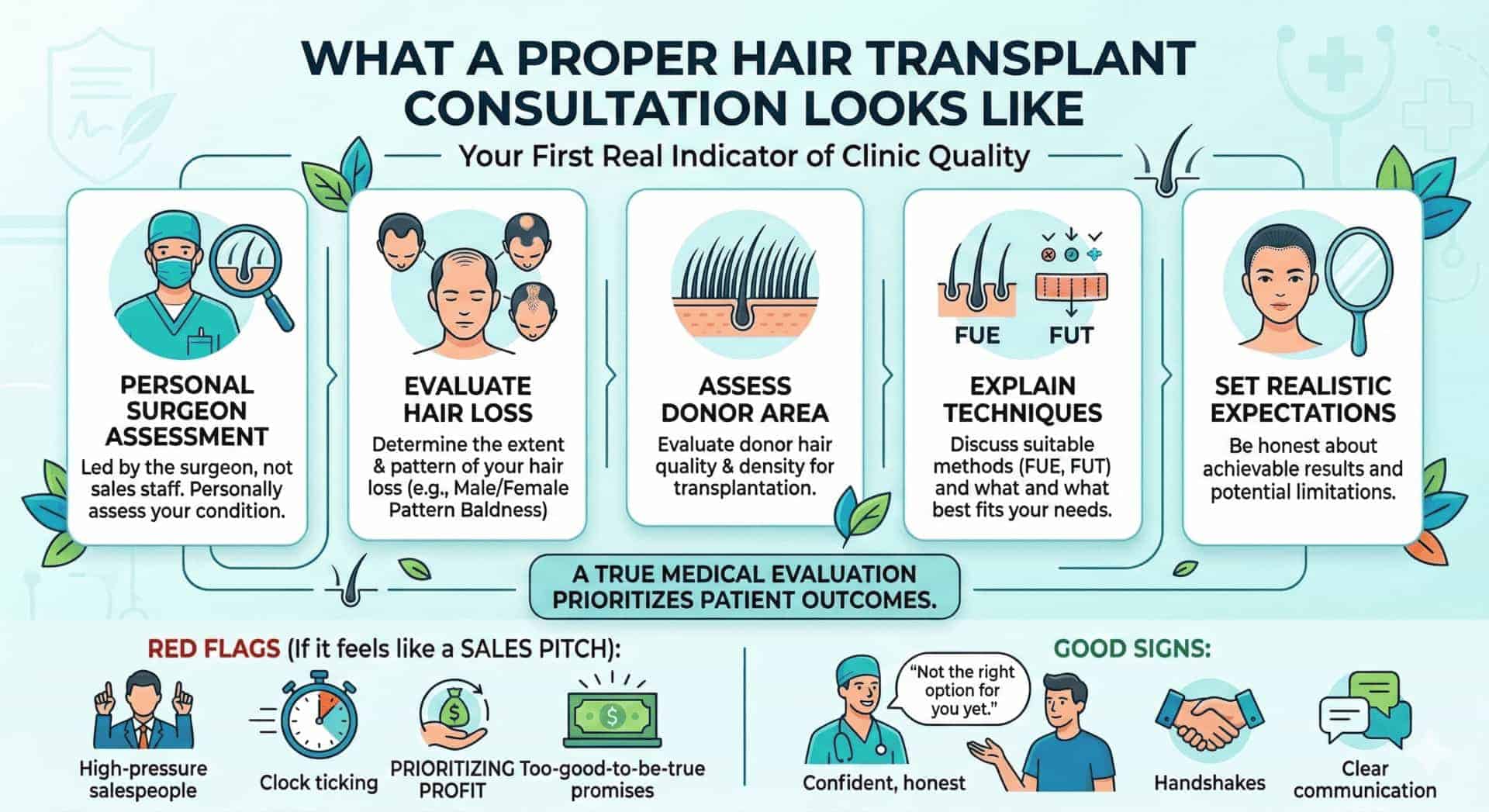
How a clinic handles your initial consultation reveals a lot about how they’ll handle your surgery. A proper consultation for hair transplant surgery should involve the surgeon — not just a coordinator or sales representative — personally assessing your scalp, discussing your hair loss history, and walking you through realistic expectations.
During the consultation, a good surgeon will:
- Evaluate the extent and pattern of your hair loss
- Assess your donor hair quality and density
- Discuss whether you’re a suitable candidate for surgical hair restoration
- Explain which technique — FUE, FUT, or another approach — best fits your situation
- Be honest about what results are and aren’t achievable
If the consultation feels more like a sales pitch than a medical evaluation, trust that instinct. Hair restoration surgeons who prioritize patient outcomes lead with honesty — including telling patients when surgery isn’t the right option for them yet.
Red Flags Worth Knowing
Not every clinic that markets itself as a hair transplant specialist deserves that title. Here are some warning signs to watch for when choosing the best hair transplant surgeon for your needs:
- Unusually low pricing with vague explanations of what’s included — graft count, surgeon involvement, and aftercare should all be clearly outlined
- Pressure to book quickly or “limited time” promotions that rush your decision
- Technician-led procedures where the surgeon’s role is minimal or unclear
- No verifiable credentials — a legitimate hair transplant doctor will have traceable certifications, professional affiliations, and verifiable patient reviews
- Overpromising results — any surgeon who guarantees dramatic density restoration for advanced hair loss without discussing donor limitations is not being fully transparent with you
- Limited or absent before and after portfolio — this is a non-negotiable for any reputable hair transplant clinic
Hair loss may be emotionally distressing, and that vulnerability is sometimes exploited by clinics more focused on volume than outcomes. Don’t let urgency override due diligence.
⚠️ Quick Gut-Check Before You Book:
- Did the surgeon personally assess your scalp?
- Were credentials shared without you having to ask?
- Did the consultation feel medical — not like a sales call?
- Was the pricing explained with a clear breakdown?
If you answered no to any of these, it’s worth a second opinion.
Why International Standards and Ongoing Training Matter
The field of hair restoration is not static. Techniques evolve, technology improves, and the best surgeons invest consistently in staying ahead of those changes. Surgeons who attend international conferences, train with peers globally, and pursue continuing education in both established and emerging methods are better positioned to deliver results that hold up over time.
At Dr. Top Hair Hospital by The Skin Clinic, our medical team continuously trains in both Europe and Asia, ensuring every hair transplant procedure aligns with the highest international standards. Our globally recognized certifications aren’t just credentials on a wall — they reflect a sustained commitment to excellence that patients from across Asia and beyond have come to trust. When you’re choosing the right surgeon for a procedure as permanent as hair transplantation, that commitment to ongoing advancement matters deeply.
Questions to Ask During Your Hair Transplant Consultation

Going into your consultation prepared makes a significant difference. Here are some practical questions to ask any hair transplant surgeon before committing:
| Question to Ask | Why It Matters |
|---|---|
| Are you ABHRS or ISHRS certified? | Confirms peer-validated expertise |
| How many procedures have you personally performed? | Gauges real surgical volume |
| Who performs each step of my surgery? | Ensures surgeon — not technicians — leads |
| Which technique suits my case, and why? | Tests if advice is tailored or generic |
| Can I see similar before and after cases? | Validates consistency of results |
| What does post-surgical aftercare involve? | Reveals how seriously they support recovery |
These questions aren’t meant to put anyone on the defensive — a reputable hair transplant surgeon will welcome them. The willingness to answer openly and thoroughly is itself a strong positive signal.
Once you’ve found the right surgeon, see what quality costs in Thailand.
Conclusion
Choosing a hair transplant surgeon is one of the most important decisions you’ll make on your hair restoration journey — and it genuinely deserves more thought than a quick price comparison. The right surgeon brings a combination of verified credentials, consistent hands-on experience, honest communication, and a real understanding of what your hair needs long-term. That’s not something a discount can replicate.
You now know what to look for, what questions to ask, and what red flags to avoid. The next step is putting that knowledge to work with an honest, no-pressure assessment that tells you exactly where you stand.
It takes about two minutes, there is no obligation, and it gives you a clear picture of your candidacy and options before you commit to anything or anyone.
Find Out If I Am a Candidate
Takes 2 minutes. No obligation. Your information stays private.
Reviewed by Dr. Top, ABHRS-certified, one of approximately 20 ABHRS-certified surgeons in Thailand and 300 globally. Over 10,000 procedures performed, 300+ annually, with patients from over 11 countries including the UK, Germany, Australia, Canada, France, and across Asia.
Hair restoration is permanent. Make sure your first conversation is with someone who treats it that way.