
If you’ve spent any time researching hair restoration, you’ve likely come across two names that keep showing up: FUE and DHI. Both are modern, well-established hair transplant techniques with strong track records, but they’re not the same, and choosing between them can make a real difference in your results. Let’s break down what each method actually involves, how they compare in terms of cost, technique, and outcomes, and which one might be the right fit for your hair restoration journey.
Key Takeaways
- FUE (Follicular Unit Extraction) and DHI (Direct Hair Implantation) are both minimally invasive hair transplant techniques that extract individual hair follicles, but they differ significantly in how those grafts are implanted into the scalp.
- DHI typically costs more than FUE due to its specialized Choi implanter pen and more time-intensive process, but it often delivers faster recovery and greater precision for targeted treatment areas.
- Neither method is universally “better”; the right choice depends on your hair loss pattern, donor hair availability, and the expertise of your medical team.
Understanding FUE Hair Transplant Techniques

FUE, or Follicular Unit Extraction, is one of the most widely used hair transplant methods in the world today. It works by individually extracting hair follicles from a donor area, typically the back or sides of the scalp, using a fine circular punch tool, usually between 0.6mm and 1mm in diameter. These individual hair follicles are then carefully stored before being implanted into the recipient area through pre-made tiny incisions.
What makes FUE a leading hair transplant technique is its versatility.It’s minimally invasive, leaves no linear scar, and suits a wide range of patients, from those dealing with early-stage hair loss to those experiencing more extensive balding. Because individual hair follicles are extracted rather than a strip of skin, recovery time is manageable, and patients can typically return to light daily activities relatively quickly.
FUE also allows surgeons to cover larger areas of hair loss in a single session, making it especially effective for patients who need a higher graft count. The procedure generally takes between six and eight hours, depending on the extent of the transplant. When performed by skilled hands, FUE hair transplant procedures consistently deliver natural-looking results with high graft survival rates, making it a trusted cornerstone of modern hair restoration.
Free Assessment
Not Sure How Many Grafts You Need?
Get a personalized treatment plan from Dr. Top's team. Takes 2 minutes to complete — no cost, no obligation.
What Is DHI? Direct Hair Implantation Explained
DHI, or Direct Hair Implantation, is an advanced evolution of the FUE method. The extraction process is nearly identical; individual hair follicles are harvested one by one from the donor area using a fine punch tool. The key distinction, however, lies entirely in the implantation step.
In DHI, a specialized device called the Choi implanter pen is used to load each extracted follicle and insert it directly into the scalp in a single, controlled motion. This means DHI doesn’t require the surgeon to pre-make incisions in the recipient area before placing the grafts, a step that’s necessary in traditional FUE. Instead, the Choi pen handles both the channel creation and implantation simultaneously, streamlining the process into one fluid action.
This approach gives the surgeon precise control over the angle, direction, and depth of each implanted follicle, a significant advantage when recreating a natural-looking hairline or adding density to specific areas. The result is often a more refined, aesthetically detailed outcome, especially in delicate zones like the frontal hairline, temples, or crown. For patients who still have some existing hair in the treatment area, DHI is particularly valuable because the Choi pen can implant new follicles without disrupting the surrounding hair growth.
Key Differences Between DHI and FUE
While DHI and FUE share a common foundation, both involve extracting individual hair follicles from the donor area, the differences between them are meaningful, particularly when it comes to technique, recovery time, and overall cost. Here’s a closer look at how the two compare.
Technique: How Each Hair Transplant Procedure Works
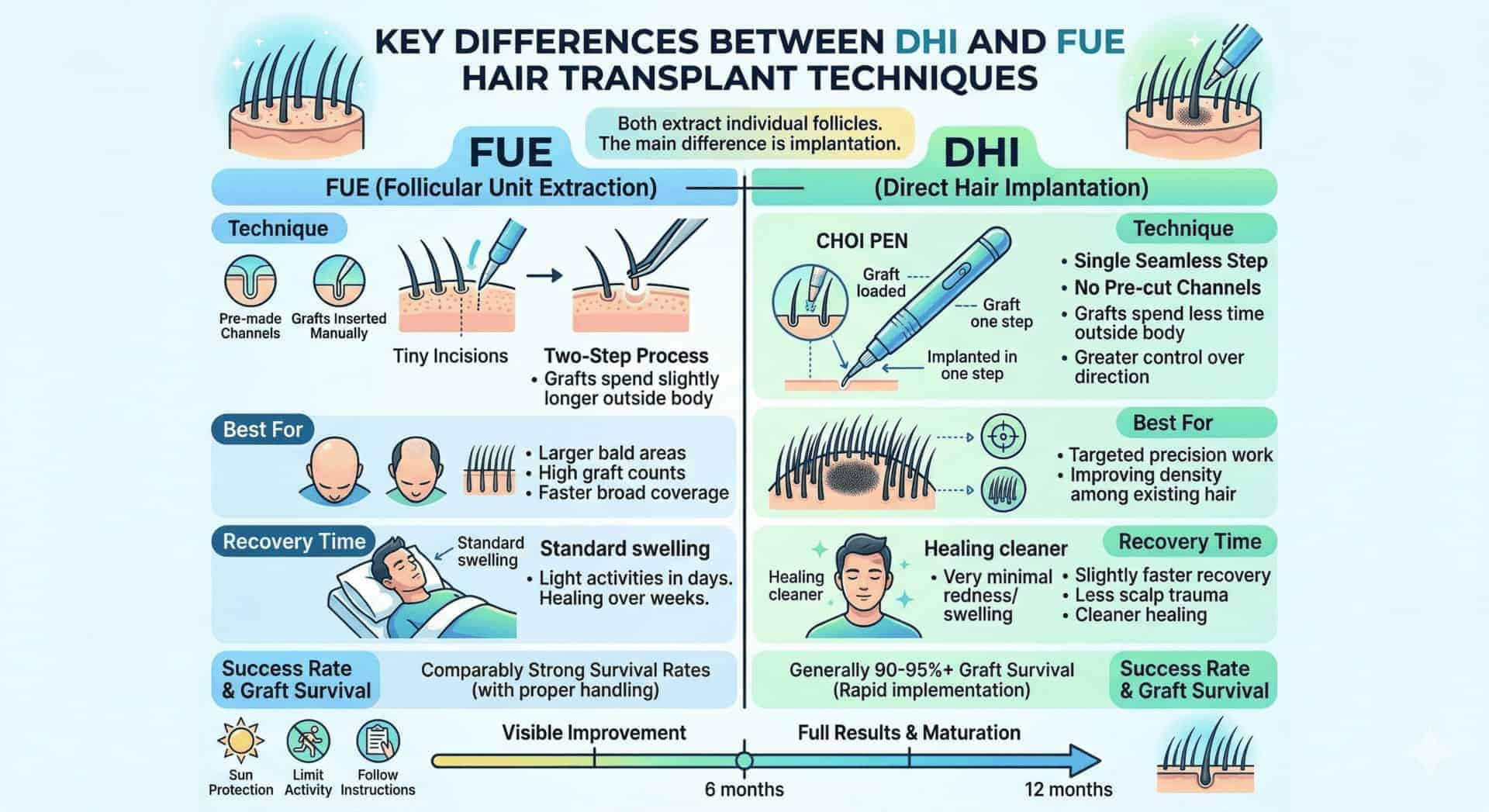
The most fundamental difference between DHI and FUE lies in the implantation method. In standard FUE, the surgeon follows a two-step process: first, recipient channels or tiny incisions are made in the balding area, and then the harvested grafts are inserted manually into those channels. While this approach consistently produces excellent results, there is a slightly longer window during which the grafts remain outside the body.
DHI streamlines this with the Choi pen. Each hair follicle is loaded directly into the pen and implanted into the scalp in one seamless step, eliminating the need for pre-cut channels. This not only means grafts spend less time outside the body before being placed, which can positively influence survival rates, but it also gives surgeons far greater control over placement direction. That level of precision plays a key role in achieving hair growth that looks naturally dense rather than plugged or artificial.
Both are considered advanced hair transplant techniques, but they suit different scenarios well. FUE allows for faster, broader coverage of larger areas, making it the preferred option when a patient has more extensive hair loss or requires a high graft count in a single session. DHI, by contrast, is often recommended for patients seeking precision work in targeted zones, or those who want to improve hair density in an area that still has existing hair, since the Choi pen can implant new follicles without disturbing what’s already there.
Recovery Time: Comparing DHI vs FUE
Recovery time is another area where the differences between DHI and FUE are worth understanding. Because DHI involves less scalp trauma, no pre-made incisions, less manual handling of grafts, and minimal disruption to surrounding tissue, patients often experience a slightly faster recovery. Redness and swelling tend to subside a bit sooner with DHI, and the healing process is generally cleaner overall.
That said, FUE is not a procedure with a lengthy or difficult recovery either. Most FUE patients can resume light daily activities within a few days, with steady healing progressing over the following weeks. For both methods, visible hair growth results take time — patients typically begin to notice meaningful improvement around the six-month mark, with the full maturation of transplanted hair often reaching its best appearance at around twelve months post-procedure.
Post-procedure care matters equally for both techniques. Avoiding direct sun exposure, refraining from strenuous physical activity during early recovery, and following your clinic’s aftercare guidelines all play a significant role in ensuring a smooth healing process and optimizing long-term results.
Success Rate and Graft Survival
When it comes to success rate, both FUE and DHI perform impressively well when carried out by experienced surgeons. DHI hair transplant procedures generally report graft survival rates in the range of 90 to 95 percent, with the rapid implantation process, which reduces the time grafts spend outside the body, being a contributing factor. FUE, when performed with careful graft handling and proper storage, achieves comparably strong survival rates, and sometimes higher when advanced methods are used.
It’s worth emphasizing that the surgeon’s skill and clinical experience play an enormous role in determining these outcomes. The best hair transplant results, regardless of the method chosen, come from clinics where the medical team has deep technical expertise and a genuine commitment to precision at every stage of the hair transplant process.
FUE vs DHI Hair Transplant Cost: What to Expect
Cost is one of the most practical considerations for anyone planning a hair restoration procedure, and when comparing DHI vs FUE, there is a clear difference. In general, DHI hair transplant procedures tend to be more expensive than FUE, and the reasons for that are straightforward.
DHI requires specialized equipment, particularly the Choi implanter pen, which adds to the overall cost of the procedure. The technique is also more time-intensive, as the one-by-one direct implantation process is meticulous and considerably slower compared to FUE’s capacity to cover larger areas more efficiently in a single session. These factors, combined with the need for a highly trained surgical team capable of executing the method with precision, all contribute to a higher price point.
The actual cost of hair transplant surgery varies significantly depending on the number of grafts needed, the clinic’s location, and the experience of the medical team. Pricing structures also differ between clinics; some charge per graft, while others offer session-based or package pricing. DHI tends to cost more than FUE for equivalent graft counts, but the gap can vary widely depending on where you seek treatment.
That said, cost should not be the sole deciding factor. A less expensive procedure performed by an underqualified team can lead to poor outcomes, patchy coverage, unnatural hairlines, or low graft survival, which may ultimately require corrective work. Investing in a reputable clinic with internationally trained surgeons and recognized certifications consistently delivers better value over the long term.
Natural-Looking Results: FUE vs DHI
Both FUE and DHI are fully capable of producing natural-looking and dense hair restoration results. Where they differ is in the specific conditions under which each method shines brightest.
DHI’s precision advantage, the Choi pen’s fine control over angle, depth, and hair direction, makes it particularly well-suited for crafting detailed, natural-looking hairlines and building density in areas where existing hair is still present. Because the pen implants each follicle without disturbing the surrounding scalp tissue, DHI is often the preferred choice for patients who aren’t fully bald but want to fill in thinning or receding zones with a seamless, lifelike result.
FUE, meanwhile, excels at efficiently covering larger areas. For patients dealing with more advanced or severe hair loss, FUE allows surgeons to transplant a higher volume of grafts in a single session, creating broad coverage while still achieving natural-looking outcomes. Modern hair restoration with FUE has advanced significantly, and when performed with expertise and artistic attention to hairline design, the results are consistently impressive.
In both cases, achieving natural-looking and dense hair comes down to strategic planning: accurately mapping the donor hair, assessing the hair loss pattern, determining the appropriate graft count, and designing a hairline that suits the patient’s facial structure and long-term hair growth goals.
DHI vs FUE Hair Transplant: Who Is Each Method Best For?
Choosing between DHI and FUE isn’t about declaring one the winner, it’s about finding the method that aligns with your specific situation. Here’s a practical breakdown to help guide that decision:
FUE may be a better fit if you:
- Have a larger area of hair loss that requires a higher graft count in one session
- Are looking for a more cost-effective hair transplant option with strong, proven long-term results
- Have enough donor hair to support broader scalp coverage
- Want a versatile hair transplant technique compatible with various hair types and hair loss patterns
DHI may be a better fit if you:
- Want precise density work in specific areas such as the frontal hairline, temples, or crown
- Still have existing hair in the treatment area that needs to be preserved during the procedure
- Are prioritizing faster recovery and minimal scalp trauma
- Want maximum control over hair angle and direction for the most refined, natural outcome
In practice, the best hair transplant technique for you will be determined through a thorough consultation with a qualified specialist who takes the time to assess your hair loss stage, donor hair quality, scalp health, and aesthetic goals. At Dr. Top Hair Hospital by The Skin Clinic, we evaluate each patient individually before recommending an approach, whether that’s FUE, DHI, or a strategic combination of both. Our internationally trained team is dedicated to delivering treatments that meet the highest global standards for patients both locally and from around the world.
Want to learn more? Here is our detailed pricing of both FUE and DHI in Thailand

Conclusion
At the end of the day, the FUE vs DHI hair transplant conversation doesn’t have a one-size-fits-all answer, and that’s perfectly okay. What matters most is that you walk into your hair restoration journey well-informed, with a clear understanding of what each method offers and how it aligns with your personal goals. Both FUE and DHI are proven, advanced hair transplant techniques. FUE is a powerhouse for larger coverage areas, offering efficiency, versatility, and consistently strong results. DHI brings unmatched precision to targeted work, making it ideal for hairline refinement, density building, and patients who still have existing hair in the treatment zone.
Understanding the difference between FUE and DHI puts you ahead of most people walking into their first consultation. The next step is finding out which approach is actually right for your hair, your scalp, and your goals.
A short personalized assessment is the clearest way to get there. It takes about two minutes, there is no obligation, and it gives you a precise, honest picture of your options before you commit to anything.
Wondering if you’re a good candidate? Take our free 2-minute assessment to find out — no obligation, and your details stay completely private.
Reviewed by Dr. Top, ABHRS-certified.
The right technique starts with the right assessment.