

So you’re considering a hair transplant abroad, and honestly, it’s one of the smartest moves you can make for your hair restoration journey. But before you book that flight, there’s one thing that matters more than the price tag or the glossy before-and-afters you’ve been saving: asking the right questions. The clinic, the surgeon, the technique, the aftercare — it all needs to be crystal clear before you commit.
Key Takeaways:
- Knowing the right questions to ask before a hair transplant abroad can be the difference between a life-changing result and a costly regret.
- From verifying your surgeon’s credentials to understanding the full cost of a hair transplant, preparation is everything.
- A reputable clinic will always welcome your questions and provide clear, honest answers before you commit to anything.
Why the Questions You Ask Before a Hair Transplant Really Matter

Deciding to undergo a hair transplant abroad is a big deal. You’re not just spending money; you’re trusting a medical team with something deeply personal. Hair loss affects confidence, identity, and how we show up in the world, so getting it right matters.
The problem is that the hair transplant industry, especially in popular destinations, has a very wide range of quality levels. Some clinics are internationally certified, staffed by experienced hair transplant surgeons who stay current with global standards. Others, not so much. The difference between the two often comes down to one thing: how prepared you are before you even pick up the phone.
Free Assessment
Not Sure How Many Grafts You Need?
Get a personalized treatment plan from Dr. Top's team. Takes 2 minutes to complete — no cost, no obligation.
Asking detailed questions before booking doesn’t make you a difficult patient. It makes you a smart one. And any clinic worth its reputation will welcome those questions without hesitation.
Is the Surgeon Actually Qualified?
This is the first and most critical question to ask. When you’re getting hair transplant surgery abroad, you need to know exactly who will be performing the procedure, not just the name on the website.
Ask whether the surgeon is a member of the International Society of Hair Restoration Surgery (ISHRS) or a similarly recognized body in hair restoration surgery. Find out how many hair transplant procedures they’ve performed, what their training background looks like, and whether they regularly update their skills.
Surgeon Credential Red Flags vs Green Flags
| ❌ RED FLAGS | ✅ GREEN FLAGS |
|---|---|
| Vague “years of experience” claims | Specific procedure counts (5000+ cases) |
| No visible certifications | ISHRS/ABHRS membership |
| Technician-led procedures | Surgeon performs extractions |
| Generic staff photos | Named medical director |
| No before/afters by surgeon | Patient results with surgeon signature |
Also ask specifically: will the surgeon be present for the entire procedure, or is part of it delegated to technicians? This is a common concern at high-volume clinics, and it’s something you deserve a straight, honest answer to before you commit.
What Hair Transplant Technique Will Be Used?
Not all hair transplant techniques are the same, and the right one for you depends on your hair type, hair loss pattern, and donor hair availability.
The two most widely used methods are FUE (Follicular Unit Extraction) and FUT (Follicular Unit Transplantation). The FUE hair transplant procedure involves extracting individual hair follicles from the donor area and implanting them into the recipient site. It leaves minimal scarring and typically has a faster recovery compared to FUT. Direct Hair Implantation (DHI) is a refined variation of FUE that uses a specialized implanter pen for more controlled, precise placement of individual hair follicles.
Ask the clinic which technique they recommend for your specific situation, and why. A qualified hair transplant surgeon will assess your hair loss pattern, your existing hair density, and your goals before recommending anything. If a clinic pushes one method without evaluating your individual hair loss first, that’s a red flag worth paying attention to.
How Many Hair Grafts Do I Actually Need?
One of the most practical questions to ask before a hair transplant is about the number of hair grafts required for your specific degree of hair loss. This directly affects the cost of a hair transplant and, more importantly, the final result.
The number of grafts needed varies widely depending on the extent of your hair loss, your hair type, and the areas you want covered. Someone with early-stage thinning needs far fewer grafts than someone with a more advanced hair loss pattern. A reliable clinic will conduct a thorough assessment to determine the right number for you, rather than slotting you into a generic package.
Ask about the number of individual hair follicles that will be harvested, how donor hair will be preserved during the procedure, and what happens if the donor area cannot supply enough grafts. These are the kinds of detailed questions that separate a truly qualified hair transplant surgeon from one who’s just going through the motions.
What Does the Hair Transplant Cost Actually Cover?
Hair transplant cost is one of the biggest reasons people look abroad in the first place. Prices in destinations like Turkey can be significantly lower than in Western countries, but the key is understanding exactly what is included in the quote.
Ask for a full breakdown. Does the cost include pre-surgery consultations? Blood work? Post-surgery medications? Accommodation? Follow-up appointments? Some clinics offer genuinely all-inclusive packages, while others advertise a low base price that climbs quickly once you start adding essentials.
Also ask what happens if you need a touch-up or corrective work down the line. Knowing the clinic’s policy on this upfront saves a significant amount of stress later. A transparent clinic will walk you through every line item without hesitation, because they have nothing to hide.
Can I See Results From Patients With Similar Hair?
Before and after photos are one of the most useful things a clinic can show you, but only if they’re relevant to your situation. Ask to see results from patients with similar hair types and hair loss patterns to yours.
If you have curly hair, fine hair, or other specific hair types that require different handling, you want to see how the clinic has managed similar cases. An afro hair transplant, for instance, requires a different level of technique and experience compared to straight hair. The way individual hair follicles are extracted and implanted can vary significantly depending on hair texture and curl pattern.
Ask to see results from patients with similar hair loss patterns and similar degrees of hair loss. A clinic confident in its outcomes will have no problem matching case studies to your profile. If they can only show you their best results without being able to connect them to someone in a similar situation, keep digging.
What Does Recovery Actually Look Like?
Understanding what happens after your hair transplant surgery is just as important as understanding the procedure itself. Hair restoration does not happen overnight, and knowing the realistic recovery timeline helps you plan properly.
Week-by-Week Recovery Timeline
DAY 1-3: 🚫 No touching, redness/swelling normal
DAY 4-7: 💧 Gentle washing begins, scabs form
WEEK 2: 🛀 Normal washing, return to work
WEEK 3-4: 🍃 Shock loss (normal shedding)
MONTH 3: 🌱 First new hair growth
MONTH 6-12: 📈 Full density develops
Ask what the first few days after a hair transplant will look like. There is typically some redness, swelling, and scabbing in both the donor and recipient areas. Find out when you can wash your hair, when you can return to work, and when to expect new hair growth to begin appearing.
Transplanted hair usually sheds within the first few weeks following surgery. This is completely normal, but it can be alarming if you are not prepared for it. Hair to fully grow and settle typically takes anywhere from 9 to 12 months. Ask about what hair growth milestones to expect at each stage and what signs might indicate a complication that needs attention.
Most clinics have a specific protocol for washing your hair in the days after a hair transplant, and following it correctly is important for protecting the newly implanted hair grafts. Make sure you receive clear written instructions before you leave the clinic.
Am I Even a Good Candidate for a Hair Transplant?
Not everyone is an ideal candidate for a hair transplant right now, and a responsible clinic will tell you that honestly rather than take your booking regardless. Being a good candidate for a hair transplant depends on several factors: the stability of your hair loss, the health and density of your donor area, your age, and your overall health.
If you are still experiencing rapid hair loss, a surgeon might recommend waiting or starting a hair loss treatment first to stabilize things before surgery. Ask your surgeon to assess your current hair loss and give you a realistic picture of what a hair transplant can and cannot achieve for your specific situation.
It is also worth asking about future hair loss. Even after a successful transplant, your existing hair can continue to thin over time. Understanding how your individual hair loss pattern might progress helps you plan for the long term, whether that means a single procedure or a phased approach across multiple sessions.
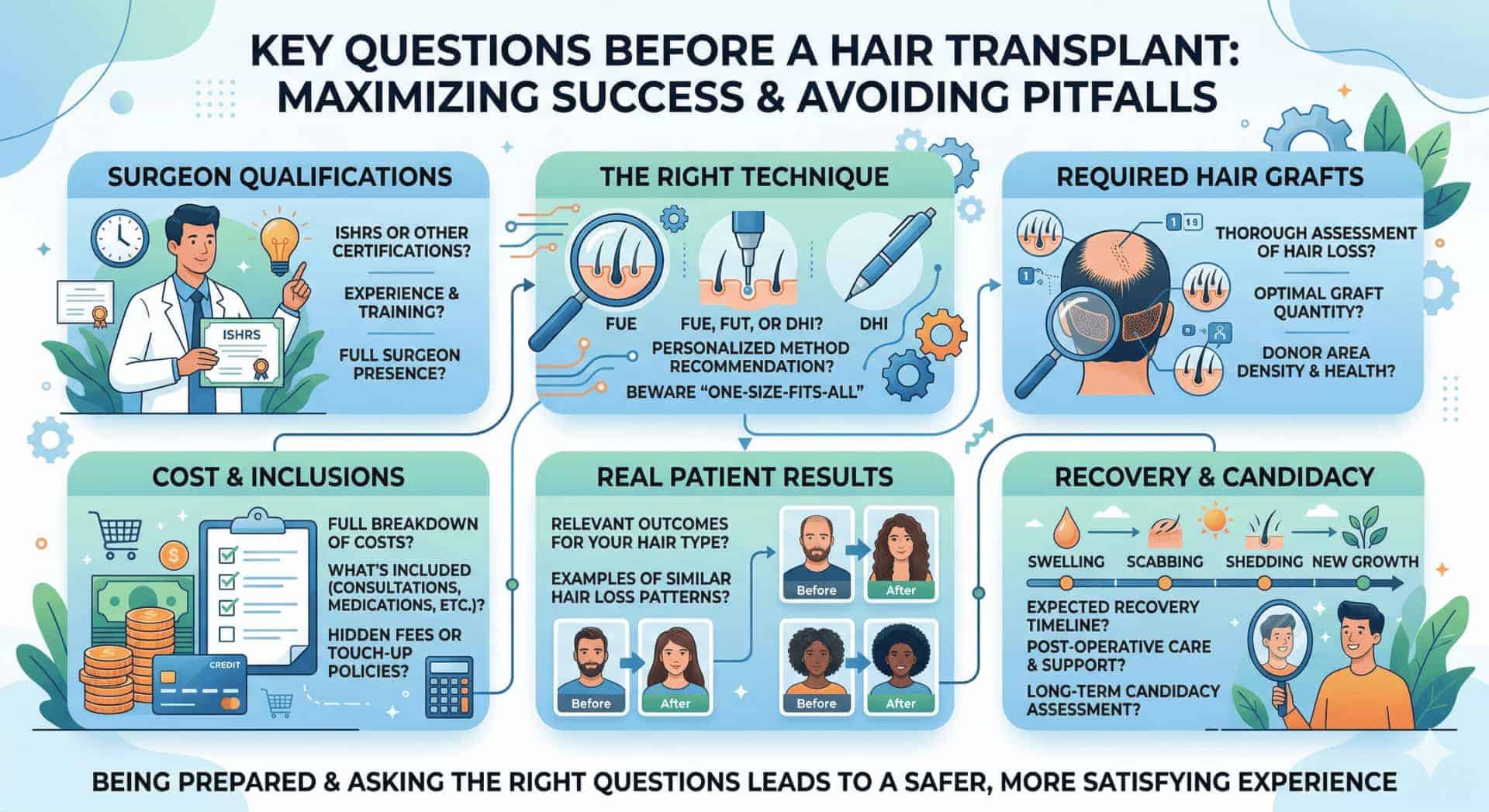
10 Essential Questions to Ask Before Getting a Hair Transplant Abroad
To make it easy to reference, here are the 10 essential questions to ask before you commit to any clinic:
- Is the surgeon certified and affiliated with a recognized body like the ISHRS?
- Who exactly performs the hair transplant surgery, and will the surgeon be present throughout the entire procedure?
- What hair transplant technique is recommended for my hair type and hair loss pattern, and why?
- How many hair grafts do I need, and is my donor hair supply sufficient to achieve my goals?
- What does the full cost of a hair transplant include, and are there any additional fees?
- Can I see results from patients with similar hair types and hair loss patterns?
- Is the clinic internationally certified, and what quality standards does it follow?
- What does the recovery process look like, and what aftercare support is available after I return home?
- Am I a good candidate for a hair transplant right now, or would waiting produce better results?
- What is the clinic’s policy if I am unsatisfied with my hair transplant results?
These questions will help you assess any clinic honestly and protect your entire hair restoration experience from the very first consultation to the final result.
What If Something Goes Wrong?
This is the question most people avoid asking, but it is one of the most important ones on the list. Hair transplant surgery, like any medical procedure, carries some degree of risk. Knowing what the clinic’s policy is if complications arise, or if you are unhappy with your results, gives you a critical safety net before you travel.
Ask about their revision policy. Ask whether they have a support system in place for international patients after they return home. Ask how they handle questions or concerns that come up weeks or months after the procedure. A clinic that gets defensive or evasive about these topics is giving you important information about how they operate.
A bad hair transplant result is not just frustrating; it can be expensive to correct and emotionally difficult to work through. The most effective way to prevent it is to ask your surgeon the right questions before you book, not after something has already gone wrong.

Conclusion
Going abroad for a hair transplant is a decision that deserves careful thought and the right questions behind it. The more you know before you book, the better your results, your experience, and your peace of mind will be. Asking detailed questions before a hair transplant is not just preparation; it is the foundation of a successful outcome.
At Dr. Top Hair Hospital, we welcome every question on your list because we believe an informed patient gets the best results. A short personalized assessment is the clearest way to start. It takes about two minutes, there is no obligation, and it gives you a realistic picture of your candidacy and options before you book anything or travel anywhere.
Wondering if you’re a good candidate? Take our free 2-minute assessment to find out — no obligation, and your details stay completely private.
Reviewed by Dr. Top, ABHRS-certified, one of approximately 20 ABHRS-certified surgeons in Thailand and 300 globally. Over 10,000 procedures performed across more than 20 years, with patients travelling from over 11 countries including the UK, Germany, Australia, Canada, France, and across Asia.
Whenever you are ready, we are here.